Feeds:
Posts
Comments

Archive for the ‘Personal’ Category

(The city of Lenoir played host last weekend to the first Smoking in the Foothills Barbecue Competition and Festival, a new event sanctioned by the Kansas City Barbecue Society. Though the event overall has been called a success, it was not without its rookie-year hiccups, including a lack of lighting the first night at the tent were people were supposed to sample chicken wings and vote for their favorite.)

The first sign that I had erred was the screaming.

It seems that in the impenetrable darkness of the People’s Choice tent on the first night of the Smoking in the Foothills festival, instead of a chicken wing I had grabbed a woman’s wrist.

I apologized as quickly as I could remove my teeth from her tender flesh, which though lacking sufficient smoke lingered nicely on the palate. As I said, it was extremely dark, so I do not know whom I bit or whether she actually looked like a chicken — though by her springy texture and light flavor I would guess she was in her mid-20s and would pair nicely with a medium-bodied white wine — but I could hear quite clearly, which is how I know my apology was not only not accepted but profanely rejected, despite my also complimenting her repeatedly on her seasoning.

After that, before I bit into any piece of chicken that night I first asked it how it was enjoying the food. If it didn’t answer, I assumed it was a chicken leg.

On the third try, though, I learned I had to listen more closely because that lady was still chewing and unable to answer except by a grunt, and by then my teeth had nearly plunged in. Unable to see how close she was to being a snack, she simply pulled back her arm and moved on.

Casting my hands about in the dark, I listened for the sound of foil, which I knew from the brief glimpse before darkness fell was a sign of where the containers of wings were. “One, please,” I said, and pushed one of my 10 tickets toward a slightly darker area that looked like it perhaps was one of the trick-or-treat pumpkins that had been placed around the table for gathering tickets, though once it turned out to be a man’s rear end. If it were not so dark, that would not have ended well, but he couldn’t find me any better than I could find chicken legs in that abyss.

I stumbled away from him as quickly as I could, bouncing against others who were similarly blind in the dark like we were one large, slow-motion mosh pit, and when I got what I felt was a safe distance, I lifted my last chicken leg and bit into it. It crunched dryly, and my mouth filled with the taste of carbon.

Emerging into light cast by a street lamp, I blinked like a mole and looked in my hand, finding what more closely resembled a charcoal briquette than a piece of meat. Perhaps it had been chicken at one time.

A couple nearby came blinking toward the light, and the man looked down into his hand and said, “No, it’s the white ticket we’re supposed to use for voting, not a red ticket for another chicken wing.”

“Who should we vote for?” the woman said.

The man looked back into the dark mass of people, where amid the bumps and stumbling I could still hear the slurps of eating.

“I don’t know,” he said. “I don’t even know how to find the table.”

A woman walked up, rubbing her wrist. She stood directly under the light and held her wrist close to her face.

“I was right!” she yelled, turning to face a large figure in the dark as I started to edge away toward the end of the street. “These are teeth marks!”
Read Full Post »

I can’t stand weather news.

Of all the kinds of news that can strike, weather is the worst.

The reason I can’t stand it is the same one that causes you to take an umbrella along even if the forecast says it probably won’t rain — everyone knows the forecast is usually at least a little off. Weather is broadly predictable, but in the nitty gritty details it’s still pretty unpredictable.

And when it comes to news, I can’t stand trying to report on things that haven’t happened and might never happen.

Weather is custom-made for television. Forecasters can tell it’s coming, and they can paint colorful maps to show what’s coming, and they can talk about it endlessly before anything ever materializes. Then it gets here, and someone can stand out in the weather and tell the camera what’s happening. Then it goes away, and even if it didn’t amount to much, someone can stand outside next to a puddle and tell the camera what did or didn’t happen.

And that range of unknowns ahead of time, the portion of it that is not predictable, is why TV loves to talk about it. There are multiple scenarios. It takes time to cover them, and you can draw a different map for each one.

I’ve had reporters who ask me, after TV has been hyping a coming storm for two days but the storm is still two days out, “Shouldn’t we do a story?”

I answer, “About what? When the story runs tomorrow, the storm will still be a day away. The forecast could change.”

Forecasters will tell you for several days about a potential weather disaster, such as a winter storm or a potentially tornado-spewing line of thunderstorms, or a hurricane, and what hazards may be involved.

After all that buildup, eventually the weather gets here — or it moves somewhere else. Whether it arrives or moves, the result is almost always less than the worst-case scenario.

WE COULD GET A FOOT OF SNOW! But we get 2 inches.

THE HURRICANE COULD MERGE WITH THIS HUGE STORM! But the hurricane slides off to the east.

Hurricane Joaquin was a Category 3 hurricane heading for the Carolinas, where it would smash together with a giant cold front. Then it was a Category 4 heading for the Outer Banks, Virginia or New York, there to smash with the front. Then it started heading out to sea, to smash with nothing.

Worst is a weather system that arrives with lousy timing. For any newspaper, “lousy timing” means after deadline, when it’s simply too late for us to get anything in the paper.

For a while it looked like the worst of this weekend’s weather might hit Caldwell County on Saturday night, well past the News-Topic’s deadline. I spent a lot of time worrying how to handle that, what I would be able to get on Sunday’s front page, whether I would need to ask an extra reporter to work on the weekend, whether I’d get in trouble for running folks into overtime pay by coming in on Sunday …

But then Joaquin started moving east. By Saturday afternoon, it seemed apparent the worst had passed.

By this morning, with any luck, the only people still excited about the storm will be on TV.

Read Full Post »

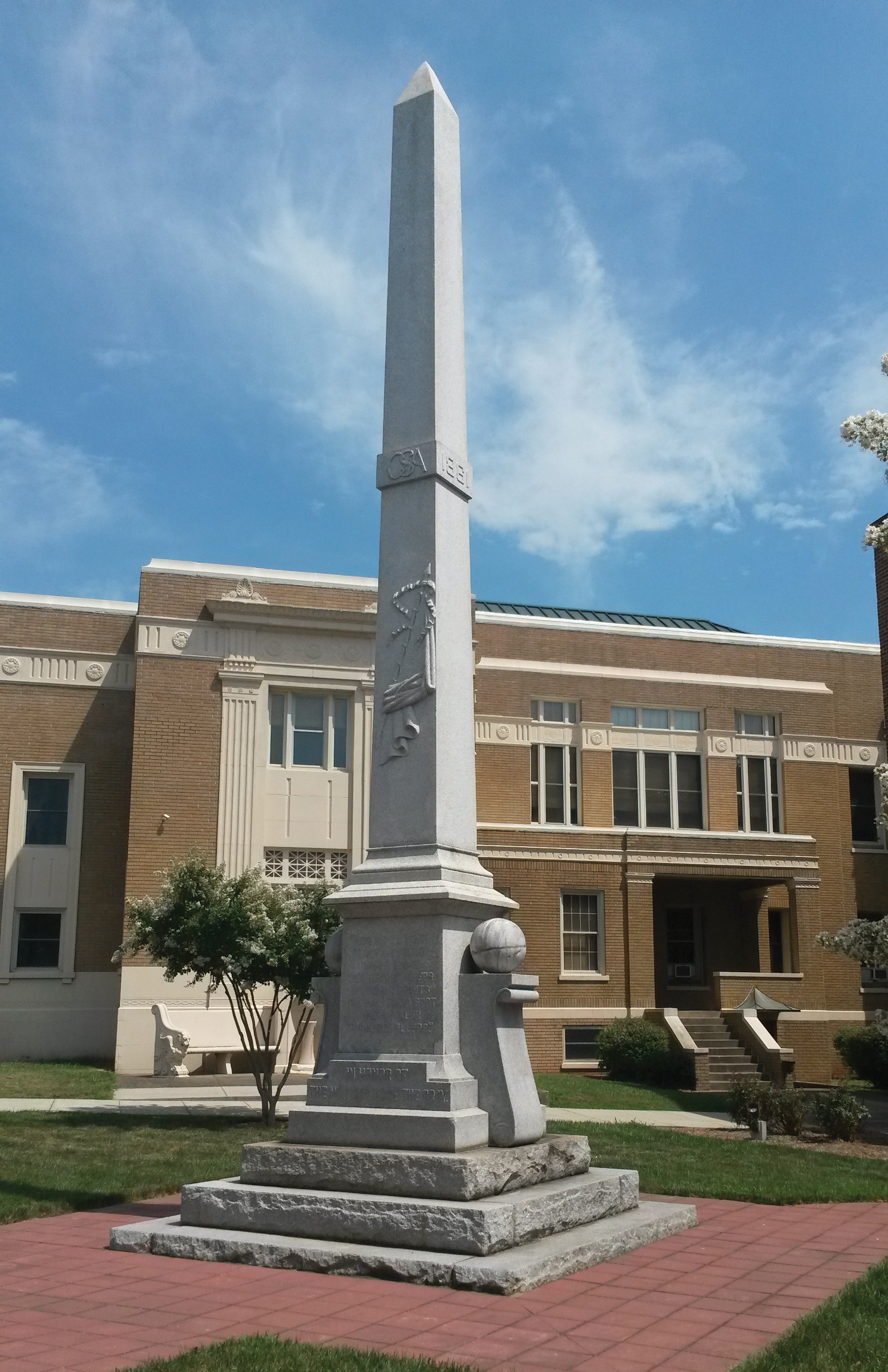
The Confederate memorial in downtown Lenoir was erected in May 1910, though originally it sat at the middle of the intersection of Main Street and West Avenue. It was paid for by the local chapter of the United Daughters of the Confederacy.

The Confederate memorial in downtown Lenoir was erected in May 1910, though originally it sat at the middle of the intersection of Main Street and West Avenue. It was paid for by the local chapter of the United Daughters of the Confederacy.


No version of the Confederate flag appears on the memorial obelisk that the United Daughters of the Confederacy paid to have erected at downtown Lenoir’s main intersection in May 1910.

In many ways, it resembles a cemetery memorial. Near the top on the side facing the intersection are the letters CSA, for Confederate States of America, above a bas relief image of a cloth or shroud similar to depictions on many decorative headstones from the early 20th century, and on either side are 1861 and 1865, the short-lived nation’s year of birth and year of death.

On the front of the base of the memorial are four lines from Theodore O’Hara’s poem “Bivouac of the Dead,” written in 1847 in honor of troops killed in the U.S. war with Mexico. Excerpts from that poem appear on both Union and Confederate memorials around the nation, as well as throughout Arlington National Cemetery. Below that it says, “In honor of the men who wore gray.”

On the back of the base are listed the regiments where men from Caldwell County served, and below that is “Erected by the Vance Chapter of the United Daughters of the Confederacy of Caldwell County, N.C. May 1910” — the only place where either “Confederate” or “Confederacy” appears.

The obelisk is surrounded by a flat lawn and hidden a bit from West Avenue by a row of crape myrtles. It is a small but park-like setting, quiet, spartan and even a bit funereal.

Directly south of that is Lenoir’s veterans memorial, which has a larger obelisk, an eternal flame within a sleek, dark pyramid, the flags of all services with a plaque at the base of each, the state and U.S. flags, and pavers with individual names. This corner commands attention, calling passersby to investigate, and yet it is solumn and stately. It is not just a memorial marker but a tribute to all the generations who helped ensure the survival of the United States of America.

In that context, the Confederate memorial had always struck me as a historical marker honoring the dead, not celebrating the cause for which they fought. Whatever their beliefs or motivation, these were fathers, sons, brothers and neighbors. They had lives before the battlefield, and that is the loss the monument mourns.

But on Thursday a woman from somewhere else in North Carolina — if she gave her name and where she was, it was so briefly that it never registered, but her accent was familiar — asking whether the News-Topic had reported on whether Lenoir was going to dismantle and remove what she called the city’s “Confederate statue.”

I surmised she meant that, in light of the sharp shift of attitudes against the Confederate battle flag since the shootings in Charleston, S.C., all things Confederate may be considered suspect.

I told her that no one to my knowledge had raised the suggestion, that since there is no depiction of the “Stars and Bars” on the monument I had not made a connection with the flag controversy, and that the monument is an obelisk, not a statue depicting a soldier defiantly standing ready to fight, as exist in many other towns.

She then insisted that, yes, the memorial actually is connected to the controversy “because the word Confederate is on it,” and she launched into an explanation of why, “soon,” people “all across the state” will be calling for such monuments to be removed. Without pausing, she said she would put my response “in my paper. Thank you,” and hung up.

I reeled a bit. “My paper”? Had I just been the victim of drive-by advocacy journalism? Or was she writing a research paper on the topic as an academic exercise?

I suppose I’ll find out sooner or later, Google help me.

Read Full Post »

Smith fire
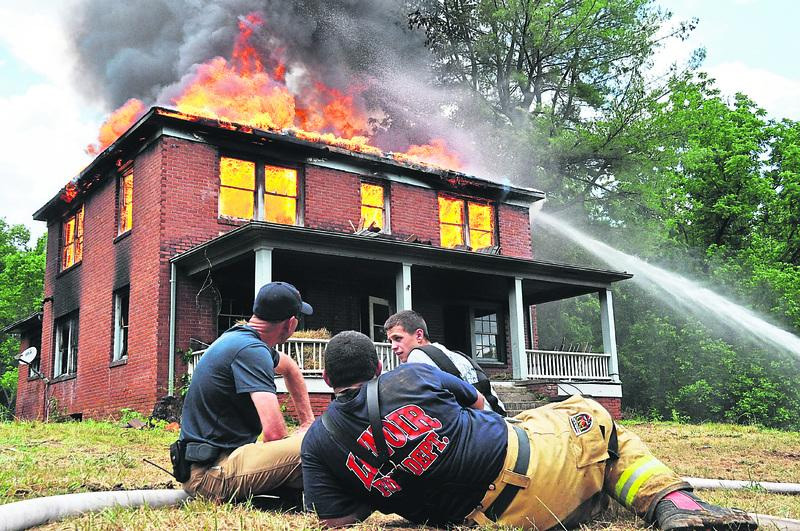
I didn’t stay to watch the old Smith family home at the corner of Abington Road and Harper Avenue burn all the way to the ground.

But it was long enough to be reminded that in fire, beauty and horror are siblings.

This is especially true when an old house like this one burns.

The house was a two-story, brick American Foursquare, an architectural style that was especially popular in the early 20th century. It was built in the 1930s. A firefighter on the scene said some of the interior walls and ceilings were beadboard.

I would imagine the interior woodwork remained a sight to behold right up to when the flames touched it, even if the view out the front door had changed significantly since the 1930s, where what must have once been a quiet, two-lane road now is a four-lane bypass.

As someone put it in an understated comment on a Facebook photo of the fire, the house looked like it had a lot of potential.

Unfortunately, the lot it sits on also has a lot of potential, but not for single-family uses such as that house.

The developers who bought it plan to begin work in July to build a three-story apartment complex intended for low-income adults over 55. The house’s footprint is where one end of the L-shaped building will be, said Roy Helm, president of Wesley Community Development, a Methodist-based company that is planning the apartments together with the Western North Carolina Housing Partnership.

The developers let firefighters use the house for training. Battalion Chief Ken Nelson of the Lenoir Fire Department said that nine teams of firefighters from Lenoir, Hudson and Gamewell each had at least two training sessions finding and fighting fires that were set inside the house.

A two-story house like this one is especially valuable for training, Nelson said, because fire behaves differently where there are stairs, which act like a chimney. Fire creates its own weather, and the structure of a house influences it. Firefighters need to be able to see how fire behaves in different kinds of structures.

By about noon, after setting and putting out 20 or more fires, the firefighters set the final one, then stepped back.

Eventually I had to step back too. I kept stepping back. Once the flames burned through the roof, the heat emanating into the front yard — even against the wind — felt uncomfortably hot. I wondered whether the lenses in my glasses would warp, even as I watched Chief Ken Briscoe, wearing glasses, stand his ground 20 feet closer than I was.

Many of the firefighters, standing in T-shirts, remained closer to the fire than I could bear. Perhaps that’s good training too. They get used to the heat.

One things I’m not sure I could get used to is the burning. That beautiful wood, those stately bricks, that old, crinkled glass. The things that would evoke memories and provoke stories from those who grew up here.

In a couple of months, even the ashes will be gone.

Read Full Post »

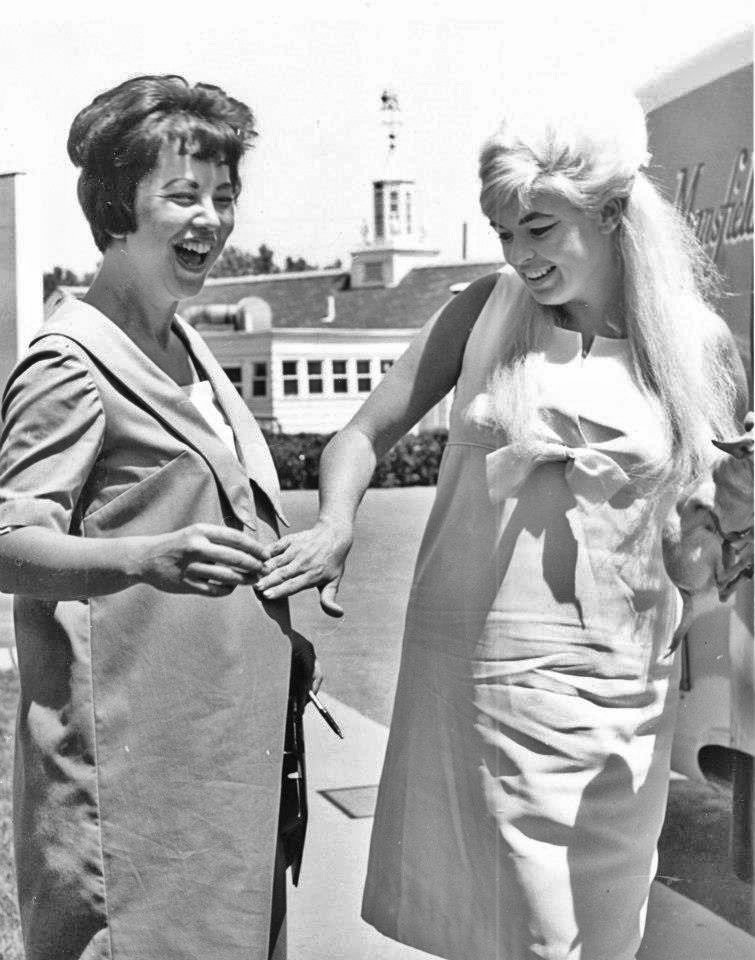
Actress Jayne Mansfield, right, feels the belly of pregnant reporter Gail Tabor in 1965 in Columbus, Ohio.

Actress Jayne Mansfield, right, feels the belly of pregnant reporter Gail Tabor in 1965 in Columbus, Ohio.


My dead mother is more successful on the Internet than I am. It happened Thursday.

She had a little help.

But that doesn’t lessen my bemusement. It only seems to show how capricious the online audience is and how difficult it can be for a writer to be heard in the digital cacophony of the Internet.

I should explain.

I’m a second-generation journalist. My mother, Gail Tabor, was a reporter for the Citizen-Journal in Columbus, Ohio, when she met my father, Steve Lucas, who was pursuing a PhD in business at Ohio State.

She kept reporting right up through her pregnancy with me. She left reporting when she had me, but 12 or 15 years later, after her divorce and a move to Phoenix, Arizona, she got a job at the Arizona Republic. She worked as a features reporter, fashion editor, gossip columnist and news reporter, in roughly that order, until being forced into early retirement in the mid-1990s.

At the time she left the newspaper, the Internet was barely a thing most people had even heard of, and like most people she didn’t own a computer.

A few years after she retired, I took a job in Richmond, Virginia, that among other things called for me to be a daily advocate to the company’s newspaper editors for adopting various “new media” practices – video, blogs, social media, and on and on. As part of that work, I started a blog nearly 10 years ago devoted to those things.

The original blog was behind a company firewall and couldn’t be viewed by the larger world of the Internet, but in 2011 I migrated it here to WordPress.

Despite my clearly brilliant insights, however, the blog has never gained much of an audience – except for one post in 2012 that called for media companies (including but not limited to newspapers) to recognize that the people who produce their “content” are their most valuable commodity and need to be paid like it. That post drew a favorable comment on Steve Buttry’s blog, which got it noticed and linked to by All Things D, and traffic to my blog spiked to an all-time high. Nothing else I wrote ever came close to achieving that kind of audience. (Despite that post’s popularity, no one ever adopted my recommendation. Journalists, and content-providers in general, remain paid like dirt.)

Earlier in 2012, my mother died. Among her things were a good many of her newspaper stories and columns. One was a column she wrote in 1983 about a candy treat called Buckeye balls, which are rolled peanut butter balls dipped in chocolate, but not totally covered in chocolate so they look like Ohio buckeye nuts. Making Buckeye balls was a fall tradition for my family, usually done on the day of the Ohio State-Michigan game.

I loved that column and typed it, in its entirety, into a post on my blog.

Over time, that post became the second-best-read item on my blog. Pretty much every day, at least a couple of people searched the Internet for “buckeye balls,” “buckeye candies” or some variation and followed a link to that post.

And then on Thursday a slideshow online called United States of Food: Official State Foods mentioned “buckeye candies” in its Ohio entry and linked to my mother’s column on my blog.

The traffic blew away my previous one-day record. So now my mother, who never blogged a day in her life, has both the best-read post on my blog and the biggest single-day audience. If it were anyone but Mom, I’d be upset.

Read Full Post »

My mother, who has been dead three years and never lived in Lenoir, received an offer in the mail at my house this week to get a free hearing exam.

“You have received this invitation today because you best represent the segment of the population which is most likely to experience hearing loss and tinnitus,” it said.

I would not have thought of the dead as the segment of the population most likely to suffer from hearing loss, but in hindsight I should have known better. If nothing else, all the dirt muffling sounds from the surface would make that person keenly aware of how much better his hearing could be.

Anyway, my mother was cremated. Surely that process cleared up any problems with her ears.

But as I thought about it I realized there are other possibilities.

What if the afterlife is more like the Catholics envision it, or used to (do they still believe in limbo and purgatory?), and when you die it isn’t a clear-cut case of going to heaven or hell? There could be intermediate steps. Maybe not limbo as the Catholic church described it, but something hung in the middle between heaven and hell.

My mother lived a good life and was kind to helpless animals, but she was no saint — she was a journalist, after all — so perhaps she escaped hell but is condemned to an eternity of tinnitus, a constant ringing sensation in the ears.

It would be like the afterlife was portrayed in the comedy-horror movie “An American Werewolf in London,” where the victims of a werewolf are cursed souls and must roam the earth as ghosts until the werewolf’s blood line is severed.

This would make being bitten by the journalism bug a curse similar to being bitten by a werewolf. (If you don’t think being a journalist is a curse, come spend a day with my boss.) I’m sure this idea would strike any journalist as uncomfortably familiar in the same way as looking into a mirror at a big, formal gathering and seeing yourself with a severe case of bedhead.

Except in the movie, the ghosts of the werewolf’s victims looked just like their physical corpses – bloodied and mauled, and gradually decaying.

In the case of the cursed journalist, the ghost would walk the earth forever, constantly sticking a finger in his ear and wiggling it, or lying in bed in the dark trying to ignore the ringing. And of course, the curse for a journalist is doubled because the dead can’t drink.

I can see it now, and probably will the next time I belly up to a bar. I’ll look down at the row of seats and imagine dead journalists at each one, all looking longingly at my beer while they wiggle an index finger in their ears. All except Mom. She was a scotch drinker.

Read Full Post »

When the news came out last week that NASCAR driver Kurt Busch testified in court that his ex-girlfriend was a trained assassin, and he cited the things that made him think so, like a lot of people I had one thought:

There are perfectly reasonable explanations for each of those things.

For instance, the time that his ex, Patricia Driscoll, came home wearing a trench coat over an evening gown that was covered in blood. The exact same thing happened to me. My wife had left our house, as Driscoll did, wearing camouflage gear, and she said she was going to meet some friends. Four or five hours later, I came out of the kitchen with a snack of microwaved hot wings, and suddenly Jane was standing there in the foyer, her hair mussed, wearing this stunning, off-the-shoulder, white dress that had large, red spatters all over the left side. I didn’t even hear her come in, which happens all the time – we joke that she moves like a ninja.

“I should have told you, it was an engagement party, but a few of us decided our group should arrive as just us girls, so we didn’t tell our husbands and changed clothes on the way,” she explained, and I was so relieved, because I get so bored with her friends’ talk of travel to places like Moscow and Baghdad and their midnight meetings in dark alleys.

And she said the red on the dress was just chocolate syrup with red food coloring, just like they use in movies for fake blood. The bride-to-be, she explained, loves red – it’s going to be a big color in the wedding – so there were red Kit Kats and red-velvet-cake bites on sticks that everyone could dip in this fountain of red chocolate, which someone who had way too many red mimosas fell into and knocked to the floor, and the chocolate spattered everywhere, and Jane happened to be standing fairly close it.

There’s always a reasonable explanation.

Again, take the testimony by Richard Andrew Sniffen, a friend of Busch’s who is a Christian music minister, that after Busch broke up with Driscoll, she said to Sniffen that she would take Busch down.

“I will destroy him,” Sniffen said Driscoll told him.

That reminded me of one night recently when I thought Jane was really mad with me after I yelled at her for having left her Bushmaster Carbon 15 with collapsible stock and red-dot sight leaning up against the bed, where I tripped over it.

“I’ll murder you,” I thought I heard her mutter.

“Did you say, ‘I’ll murder you’?” I asked.

“What? No,” she said, smiling. “No, I said, ‘I’m really sorry.’” She came over to me and caressed my face. “You’re so silly,” she said as she tugged a lock of my hair. She tugged it a little too roughly, really. It hurt. She’s stronger than she looks, I keep reminding her, and I have the bruises to prove it.

But she kissed me, picked up her rifle and went to the study to finish reading this month’s “Soldier of Fortune.”

If I hadn’t asked what she really said, think of the misunderstanding and hurt feelings that could have resulted.

Really, it’s obvious why Busch and Driscoll broke up. Clear communication and understanding are the cornerstones of any serious relationship.

Read Full Post »

My heart ached as the sixth-graders walked one by one to the microphone at the J.E. Broyhill Civic Center, gave their first name and said what they want to be when they grow up.

Most appeared nervous. In some, that translated into a stiff gait, gaze locked forward. Some walked as if they were on a high wire, so conscious of the eyes on them that they perhaps feared tripping or stumbling. One skinny, gangly girl’s nerves made her long limbs jiggle as she walked, and she flashed a broad, self-conscious smile.

Some, like that girl, had begun the physical growth spurt that soon will make their parents feel suddenly much older. But most, even the taller ones, still had a child’s voice.

As each one, still brimming with a child’s energy but not yet a teenager’s bravado, spoke into the microphone, that child’s voice announcing a career ambition stabbed at the place in my heart where I keep sentimentality locked away.

“I want to be a technology designer,” a boy said, and the sweet earnestness bored into me.

These 41 children were this year’s recipients of Dream Awards from the Foundation of Caldwell Community College and Technical Institute. They were nominated by their teachers and guidance counselors because they show great potential to achieve these goals – or others that may replace them in the coming years.

“I want to be a paleontologist, vet or author,” a girl said, and the broad range of options she is considering swept me along like a river. She believes in these, I saw it in her eyes, she believes she can do it, and hearing that child’s voice speaking it, I wanted to pick her up and help her along.

These are all children who could become the first members of their families to attend college. Sixth-graders surely don’t realize what a barrier that is, but it is one, as adults come to understand. The understanding is part of what creates the ache when you look into a young face full of life and energy and dreams. An adult knows how many obstacles will come along.

A lack of money to pay tuition may be the least of the problems a child will confront before graduating high school, but unlike so many of those problems, it’s one that is easily addressed.

Not easily enough, of course. The 41 recipients of this year’s awards are not the only students who would be worthy of this attention. The money the foundation has raised goes only so far.

“I want to be a pediatrician,” a girl said, and I thought how many other girls might have said that but weren’t lucky enough to be chosen and brought to this room.

During their 25 years the Dream Awards have helped hundreds of students take a critical step closer to achieving their dreams.

It’s not enough. It’s not nearly enough.

Read Full Post »

As I sat at the office daydreaming about a coming shipment of fresh, raw Liberian monkey meat – it’s Africa’s sushi, you know – a friend posted a link on Facebook to a list from Britain’s Daily Mirror of the top 10 tips for avoiding catching the Ebola virus.

This, I thought, fits the very definition of “news you can use.” On “Morning Joe” just this morning, one of the show’s guests was practically beside herself over what she saw as clear parallels between the Ebola cases in Texas and the 1995 movie “Outbreak.”

“How can anyone say no one could have guessed what would happen when things are playing out exactly, exactly, like they did in that Hollywood movie,” she said more than once, which was big news to me because I had not realized until that very moment that the Ebola virus has mutated and become airborne so that it is as easily transmitted as the flu, which is the entire basis of the movie and the earlier novel by the same name. She had to have meant that because she repeatedly used the word “exactly,” which I believe the FCC forbids unless you have first read a dictionary and know what the word means so you can use it without sounding like an idiot.

So, knowing that the virus now is spreading “exactly” as it did in those works of fiction, I was eager to read these tips on how to prepare myself for avoiding the coming plague.

For the most part, though, the tips were disappointing.

“Wash your hands.” Wash my hands? I need medical experts to tell me this? My mother told me this all the time, and her college degree was in journalism, which anyone, including my state’s governor, can tell you means she had no skills.

“Avoid contact with anyone you believe is infected.” Uh huh. Got it. If you see me walking down the sidewalk toward you and I suddenly cross the street to avoid you, go see your doctor because clearly you don’t look right.

The Mirror added that “should you need to go near someone with Ebola you need to be wearing protective gear, including a face mask and gloves,” and it helpfully provided a link to Amazon (use the link or go to Amazon and search for “ebola protection”), where you can buy a Honeywell Liquid Tight Safety Coverall with integrated Gloves and Overboots for about $110.

Buying that means I’ll have to tell my wife we need to skip a couple of “date night” dinners downtown to keep my credit card bill down, but for the sake of escaping Ebola, I know she’ll agree it’s worth the sacrifice.

“Avoid dead bodies.”

I’m waaaaaaay ahead of you there.

“Do not touch bats, chimpanzees, monkeys or gorillas,” the Mirror warned.

OK, define “touch.”

“Or their blood or fluids. And do not eat raw meat prepared from these animals.”

What?! No raw monkey meat treats?!

There goes my weekend.

Read Full Post »

Why is the governor picking on me?

Well, Gov. Pat McCrory’s not picking on me personally, but he says he wants journalists to go away. That’s already happening at a fast enough pace without any outside wishing.

“We’ve frankly got enough psychologists and sociologists and political science majors and journalists. With all due respect to journalism, we’ve got enough. We have way too many,” McCrory said Thursday in Greensboro while announcing a plan to visit businesses in every county in the state to learn what skills high-demand industries need.

His line got laughs, the Triad Business Journal reported. He also mentioned lawyers as being too numerous.

“And journalists, did I say journalists?”

Yes, sir, you did. A real comedy machine, you are.

The Business Journal also quoted McCrory on the importance of raising the prestige of industries such as trucking, which incidentally is one of the Lenoir region’s higher-paying and faster-growing employment sectors.

“I’m very impressed with the people who can drive trucks and are qualified to drive trucks,” McCrory said. “I don’t know how you back it up, I don’t know how you go forward, I don’t know how you park it, I don’t know how you drive such long distances.”

I’m sure McCrory enjoys tweaking journalists because they so often catch him or his appointees saying or doing things he probably wishes could be said or done over again, but if not understanding how to do something is what it takes for him to hold a profession in high regard, then he needs to rethink his wish for there to be fewer journalists.

It was journalists from the McClatchy newspaper chain, including the Raleigh News & Observer and the Charlotte Observer, who recently uncovered what no one in state government had – that the construction industry has been improperly misclassifying workers as independent contractors, which not only robs those workers of benefits and protections but allows the companies to avoid payroll taxes. The journalists found that if the level of misclassification at only 64 government-backed housing developments they examined in North Carolina extends to the construction industry as a whole in this state, the state and federal government are losing $467 million a year in taxes, the newspapers reported.

You might think it’s a fine thing for businesses to avoid taxes wherever possible, but what this reporting found is illegal cheating. If you want your taxes cut, do it the legal way – buy a politician. Otherwise you are leaving tax obligations for the rest of society to pick up. Those avoided taxes include money that otherwise would help Social Security and Medicare stay solvent.

Journalists found that.

If it’s not difficult to find places where tax cheaters are blowing half-billion-dollar holes in the budget, why didn’t anyone else find that?

On the other hand, maybe McCrory wasn’t really knocking journalists. Before mentioning journalists, he said there are too many political science majors. Since McCrory himself has a degree in political science from Catawba College, maybe his speech actually was an expression of existential angst – to be, or not to be? – and his own yearning for a job that made him feel more fulfilled and less constantly under attack, perhaps tooling down the road in a big rig as little boys in the backs of SUVs passing on the highway make the tug-down gesture, the universal plea for a trucker to blast his horn.

No one criticizes a trucker when he blows his horn. Not even journalists.

Read Full Post »

« Newer Posts - Older Posts »