Feeds:
Posts
Comments

Archive for the ‘Print media’ Category

Clearing my email this morning after a week away on vacation — during which I managed for the first time in 11 years to stay off the Internet (well, except for my 2-year-old non-smartphone’s minimal connectivity) — I found a link to an Editor & Publisher article about how to increase the number of young people who subscribe to a newspaper. There are some good nuggets from the two contributors in that article, but I remain skeptical that many newspapers are geared for this effort, for the simple reason that when push comes to shove, they are still putting out print products aimed at an audience that doesn’t watch TV or read anything on the Internet. Last week’s massacre at a movie theater in Aurora, Colo., provided the latest, but surely not last, major example. I woke on vacation, checked my phone and found a Washington Post news alert sent overnight about the shootings. We turned on CNN and watched coverage for several hours, until it seemed that little new detail was likely to come out soon, and then turned it off and went about our vacation day. The next morning I went out and bought a newspaper — a major regional newspaper based in a metropolitan area. The shooting coverage was the centerpiece, the top headline, and took up the majority of the page — and there was NOT ONE SINGLE WORD on the front page that told me anything I had not heard on TV before noon the previous day. Turning inside, there was a sidebar of new information — new to me, at least, who had not been watching TV or reading the Internet since before noon. The experience angered me, both as a reader who expected better and as an editor.

My patience with newspapers was tried again when we returned home to find that our newspaper carrier had either not gotten word of our “vacation stop” or had ignored it and continued to deliver our paper. Why does anyone want to pay to have a daily alert to burglars piled up by the front door?

Older readers who are already newspaper junkies may brush these off and keep their subscriptions, but a combination of spotty service and old news is no way to win new readers.

Read Full Post »

John Robinson, former editor of the News & Record in Greensboro, N.C., has perfectly captured, in a very short blog post, the mythic spirit of the print newsroom. I get a little misty.

Read Full Post »

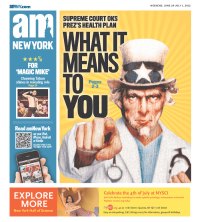
Times Herald-Record vs. am New York
Today is one of those days when you can look across the country and ask again, “What is the purpose of a newspaper’s front page?” On the most basic level, it’s for the biggest news of the day. On a practical level, though, the front-page treatment of the Supreme Court decision on the Affordable Care Act offers a stark example of different approaches to handling the big news of the day, and at this level the front page is either for what happened yesterday or it’s for what the big event is going to mean down the road.

If you look over today’s front pages at the Newseum (note that the pages change automatically, so after Friday June 29 you’ll see different pages than I’m referring to), it’s clear that most editors took the former approach. A sample of the headlines on this theme:

Court upholds health care law
Court upholds health mandate
OBAMACARE UPHELD
HEALTH LAW STILL STANDS
Health care law stands
COURT UPHOLDS OBAMACARE
OBAMACARE LIVES
Health Law Survives
Obama’s health care law upheld
Court: Health care law passes muster
Top court upholds law
Landmark victory for health care law
Health reform survives
Health-care law upheld
UPHELD
STILL STANDING
IT’S THE LAW
THE LAW STANDS
Upheld 5-4

But this court decision did not come out Thursday night. It was shortly after 10 a.m. when it became the top item of discussion on every TV and radio news network and it exploded across the Internet. The kinds of people who buy newspapers do not live in caves. By the time the morning paper showed up, they already knew the law had been found constitutional, and they likely had heard tons of reaction and explanation.

Given all that, what purpose does the front page with headlines like those above hold? Perhaps it becomes a keepsake for them, something to file away in a box to pass on to the grandkids.

But if one of the purposes of the front page is to entice people to read, I don’t think the headlines trumpeting what the reader already knows do that. Especially for single-copy sales, the above headlines are not going to draw the occasional reader – the people who care about news but may not subscribe.

Scattered among the day’s pages you can find a notable minority with headlines that spun the news forward to answer the question, “What does this mean for me?” especially in the context of what your particular state now has to do – even papers that took the “yesterday’s news” approach generally answered this question in story or Q&A form, but if there was a headline addressing it, it was small – and a few that focused on analysis, such as the surprise role of Chief Justice John Roberts casting the decisive vote. Those would seem to be much more promising territory for finding things that the typical person would still want more information about.

We’ve been saying for years now that newspapers are competing for attention in an environment when people are saturated with breaking news, yet at times like this it seems we struggle not to fall back on old habits. Agree or disagree?

A post at Poynter.org has a compilation of some of the day’s more notable front pages if you are late in looking for them.

7/9/12 UPDATE: Sam Kirkland, a Dow Jones News Fund copy desk intern for the Tampa Bay Times, makes a similar point in a July 6 post at Poynter.org, saying that most of the headlines on the health care ruling may serve the role of scrapbook material but they didn’t make him want to read:

“… the louder a headline shouts, the less likely I am to read the story, because a story commanding a 120-point headline likely commanded my attention yesterday, when it was fresh.”

Read Full Post »

FamousQuotesAbout.com/on/Newspaper
Newspaper columnists always seem to remember that Thomas Jefferson once said, “Were it left to me to decide whether we should have a government without newspapers, or newspapers without a government, I should not hesitate a moment to prefer the latter.” What I’ve never seen in a newspaper are any of the other things Jefferson said about newspapers, such as:

“Advertisements … contain the only truths to be relied on in a newspaper.”

“I do not take a single newspaper, nor read one a month, and I feel myself infinitely the happier for it.”

“The man who reads nothing at all is better educated than the man who reads nothing but newspapers.”

“Nothing can now be believed which is seen in a newspaper. Truth itself becomes suspicious by being put into that polluted vehicle.”

I’m not the first to notice this (among others, in 2009 Jay Rosen discussed the first quote and why it is the only one you ever see in newspapers), but it came to mind today in a copyediting context (yet another columnist citing the first quote).

6/28/12 UPDATE: Googling that last quote led me to the full text of the letter that it came from, which included a suggestion for a better way to section a newspaper:

“Perhaps an editor might begin a reformation in some such way as this. Divide his paper into four chapters, heading the first, Truths; the second, Probabilities; the third, Possibilities; the fourth, Lies. The first chapter would be very short, as it would contain little more than authentic papers and information from such sources as the editor would be willing to risk his own reputation for their truth. The second would contain what, from a mature consideration of all circumstances, his judgment should conclude to be probably true. This, however, should rather contain too little than too much. The third and fourth should be professedly for those readers who would rather have lies for their money than the blank paper they would occupy.”

Read Full Post »

Somehow I had missed the perfectly respectable, safe-for-work New York magazine story in 2009 about the porn industry’s Internet-driven woes and, allegedly, what the news industry could learn from them. Much thanks to JimRomenesko.com for helping me find it, because how often do people in mainstream journalism get a chance to learn about porn and be able to say with a straight face that it’s work-related research?

The quick summary: While porn initially benefitted from the Internet, over time the improving technology, bandwidth and cameras have meant that free or extremely cheap amateur video is blowing up the revenue stream.

And although the 2009 article indicates that what I guess you’d call porn industry officials felt they had some ideas for dealing with the downturn, a new article in The Atlantic indicates the problem continues unabated:

“What holds for journalism in this case holds for sex. In both cases, the competition is so broad that customers are likely to go elsewhere rather than pay. There are, obviously, exceptions in the case of newspapers — the Wall Street Journal has a profitable paywall, and the New York Times appears to be having some early success with its own.”

While I think there’s a certain amount of fun in the porn/journalism comparison, it’s a fundamentally flawed comparison. You will never find 12-year-old boys huddling in one friend’s room with the door closed to pass around a copy of the New York Times that one of them snuck from under his father’s mattress. Sex is a biological pursuit of primitive urges. Seeking out writing and information is an intellectual pursuit (partisan froth aside). Journalism may have a better chance of finding a niche of people willing to embrace paying for worthwhile presentation of worthwhile information. In other words, as The Atlantic’s article put it, I think people do have slightly higher standards for their news than for their porn. Slightly.

Read Full Post »

Congratulations to Earl J. Wilkinson for his post on INMA’s The Earl Blog coining a new term (new to me, at least, even if you’ve heard it before) for the nearly mythical, not to say non-existent, kind of news story that takes forever to report and write but which hardly anyone actually reads: “Trekking Through Zimbabwe.” It’s no “hiking the Appalachian Trail,” but it will do.

Wilkinson’s post is about the new “ownership class” emerging in what once was the newspaper industry (he says it’s emerging as the newsmedia industry). He identifies two categories of these new owners: Owners who are doing everything in their power to repair the old model or invent a new model before the economic waves cover them up; owners who, evaluating the cost/benefit analysis of making those changes, are electing to divest and find more efficient ways to invest shareholder monies.

The post is an assessment of where the industry’s evolution is. It’s worth a read.

Read Full Post »

UVa president Teresa Sullivan addresses students / Washington Post
The element that caught my eye from the outset in the uproar over the University of Virginia Board of Trustees forcing out the university president is the attention given in the trustees’ email exchanges to online education. Specifically, my attention was held one line quoted from a New York Times column by David Brooks, “The Campus Tsunami”:

“What happened to the newspaper and magazine business is about to happen to higher education: a rescrambling around the Web.”

The rest of Brooks’ column is not nearly so hyperbolic – yes, hyperbolic. Most of what happened to the newspaper and magazine business could not possibly happen to higher education. The root of the disruption in print media is the exodus of advertising, which traditionally accounted for something around 80 percent of the industry’s revenue. Education has no remotely similar parallel, so instantly you eliminate 80 percent of the chance that the devastation that happened to newspapers and magazines will happen to higher education.

The remaining 20 percent, however, is what Brooks spends the bulk of his column on, and as far as that goes, he makes a good case, and here I would say the trustees simply jumped too far.

When industries are disrupted by technological innovation, as the trustees seem to fear is about to happen to higher education, it’s usually because the business’s leaders didn’t understand what their business really was. Railroads didn’t diversify into trucking because they thought their business was railroads, not moving freight; IBM passed over the chance to make personal computers because they thought their business was making and maintaining mainframes, not helping businesses increase productivity through technology.

Disruption (the oversimplified explanation) happens when someone comes up with something that meets a need that the existing business does not, and it provides it at a low enough cost that any flaws in the product don’t matter to the customer.

In the newspaper and magazine business, disruption hit on two sides: the advertiser side, and the reader side. A number of advertisers (especially those who placed classified ads in newspapers) have found that the free ad sites online, or the kind of targeted online promotions that are much less expensive than print ad campaigns, either meet their needs as well as or better than print ads, or else they are good enough and cost a lot less, freeing up money for other kinds of promotions. At the same time, a number of readers have found that the proliferation of free information online – of all kinds, not just news – fills their need for information or entertainment better than does paying for a limited bundle of information on paper.

As I said, colleges don’t have advertisers, so the reader end of the print media’s disruption is the only part that seems to have any parallel to what may be coming to higher education. The situation print media face is that what they provide may not be perceived as holding enough value for the reader that those people are willing to pay for it. A growing number of news sites are testing that, sometimes gingerly, setting up paywalls, usually offering full access for those buying a subscription and allowing everyone else a small number of free views a month before a payment is required. The essential choice for the reader is whether to pay for the site’s staff-produced content or just get by with all the free content available everywhere else. The value of that staff-produced content depends entirely on the perception of the reader. I like to quote one of my early editors on the value issue: She said she decided at the end of the day whether she had done good work by asking whether she would pay 50 cents for what’s in the next day’s paper. That can be a tough argument to make some days, which is why the Readership Institute in 2005 or so was making presentations about the importance of creating an “Experience” newspaper, the idea being that if you focused more attention on section fronts, specifically centerpieces, and creating buzz-worthy presentations, it could elevate the value of the overall newspaper beyond the sum of its parts, and if you did it consistently you created a role for yourself in a person’s daily routine that went beyond the simple gathering of information.

The value of a college degree, however, is a bit similar. To some extent, a person goes to college for the experience, and it’s not hard to get people to recall fondly the experience elements of college that made it rewarding. But people don’t go into hock for $50,000 for the experience of college, they do it because they perceive there is a long-term payoff, which supposedly is backed up by the market – in other words, someone will hire a graduate of the University of Virginia (just to stick to the subject at hand) because a degree from there is perceived by that employer as being worth more than a degree from other schools. Or, especially, from online schools.

Unless employers suddenly decide that online degrees are as valuable as any other degree, there is a market-driven value behind getting a degree from bricks-and-mortar colleges.

So what exactly where the UVa trustees getting at? They’re not talking so far, so it’s hard to say. On May 31, Rector Helen Dragas sent the vice rector, Mark Kington, the URL for a Wall Street Journal column about the “massively online open course” movement. According to Inside Higher Ed’s summary:

“The column argues that the MOOCs have the potential to change the cost structure in higher education, as long as institutions are willing to replace some in-person education with online education. ‘[I]n this way, college X might have its students take calculus, computer science and many other lecture courses online from MIT-Harvard (or other suppliers), and have them take other classes with their own local professors for subjects that are better taught in small seminars. College X can thus offer stellar lectures from the best professors in the world — and do locally what it does best, person to person.’”
What that describes is outsourcing basic-level lecture classes – those where 200 students pile into a massive hall to hear a professor essentially talk at them, not with them, for an hour. Or, as the subhead on the Wall Street Journal column put it: “The substitution of technology (which is cheap) for labor (which is expensive) can vastly increase access to an elite-caliber education.”

That would lower some labor costs for a college that didn’t need to hold its own lecture classes. It would be a revenue source for a college that offered online lectures by “star professors,” as Brooks called them.

There’s a certain revolutionary air in the idea that a course of study at one college could involve numerous lectures from places all over the world, and it probably would wind up meaning smaller faculties – though not, I suspect, an end to the rapid growth in administrative staff, which is the biggest upward pressure on college costs. Funny how that works.

Related reading: A post Wednesday on the Remaking the University blog has a good roundup of items related to what’s happening at the UVa.

(The Richmond Times-Dispatch as a PDF of the trustees’ emails.)

Read Full Post »

One of my great frustrations in recent years has been that as news organizations have tried to cope with advertising declines, almost everyone — both readers and journalists — have seemed relatively ignorant about the revenue and cost structure of the typical newspaper. Readers and journalists complain that the more you cut, you make the paper less worth picking up, which is true, but at the same time if you raise the price they complain about that too. Often the companies’ woes are portrayed as the result of greedy bosses trying to pad profits, a stereotype that perhaps was closer to the truth in the ’80s, but in the current economy even nonprofit-owned newspapers are struggling. Given all that, why not tell readers exactly what it costs to put out the paper and what percentage of that they are actually paying? Finally, someone has: the publisher of the Arkansas Democrat-Gazette, in a letter explaining a doubling of the cost of buying a paper. That paper, unlike most large papers in the U.S., keeps all of its content behind a paywall to protect its paid circulation, which seems to have worked — but as the letter explains, since subscription payments do not cover much of the cost of producing the paper, that hasn’t insulated it from trouble:

“Despite all of these efforts, our advertising, like most newspapers, has continued to decline. Even though advertisers tell us they get good results from advertising with us, they have far more options on where to advertise today. With this loss in ad revenues, and by maintaining our circulation and news reporting, we have seen our profits dwindle to unsustainable levels. … In the future, we will have to rely more heavily on revenue from readers and subscribers.”

That kind of frank discussion of the business side is going to be vital going forward. People may understand that you get what you pay for, but since the news industry has for so long sold them subsidized products, people need a whole new education about what exactly they are paying for.

Read Full Post »


I will take issue with the poynter.org headline The one chart that should scare the hell out of print media, for two reasons. First, it’s actually two charts, the second of which is above, from a presentation by KPCB’s Mary Meeker. The two illustrate what appears not to be a blip but a trend in the money end of the news business. The one above extrapolates the advertising revenue.

You may question whether it is reasonable to extrapolate a trend from the greatest economic collapse since the Depression. I would argue yes both because it started before the economic collapse and because of the second chart, comparing where advertising revenue is spent and where consumers spend their time:

Note on the far left: People spend 7 percent of their time with print media, but print gets 25 percent of the advertising revenue. Note on the far right: People spend a combined 36 percent of their time with Internet and mobile media, but those get just 23 percent of the ad revenue. Even if print will be perceived as a better buy (not a bet I would make), at some point those numbers seem likely to come closer to equalizing.

First conclusion: The ad revenue decline of recent years seems likely to continue.

This leads to a point made by Ken Doctor at the Nieman Journalism Lab: Money coming to news organizations from readers (paid circulation/online access) is growing as a percentage of revenue. Partly this is because of declining ad revenue — if you’re total revenue is $100, then $20 is a small percentage, but if your revenue drops to $50 then $20 is pretty big – but it’s also from the growth of various kinds of paywalls. I remain convinced that an all-or-nothing paywall closes a newspaper off from the possibility of luring new customers, but the trend toward metered paywalls seems able to draw in both avid readers and those who wouldn’t pay even for the bigger headlines of the day.

What the combination seems to lead us toward, as Doctor indicates, is a model where many news organizations will be asking for subscriptions more on the basis that NPR stations ask for memberships — not because they have something every day that you want know, but because you want free access because they regularly do. Advertising, in this scenario, becomes an increasingly less important revenue source; readers drive the revenue.

One fear I have read often in the past is that a news model driven by what is popular would gravitate toward the lurid and celebrity gossip, but I don’t think the above situation would do that. The kind of readers drawn by that kind of news would not be the ones who pay for regular access. Those readers would want at least the occasional substantial bit of civic journalism or in-depth news. You might make a living (a la TMZ) if you are at the top level of celebrity gossip, but at the local level that won’t cut it.

But what also seems likely is that the new level of revenue may not support seven-days-a-week newspapers in many markets, as Clay Shirky argued will eventually be the case even with the Washington Post. If that becomes the common model, then would mere daily scarcity of news drive enough people to buy online subscriptions to get news from “newspapers”? After all, in many markets there are TV and radio stations, which already send out news for free, and in many cases there may be small sites such as Homicide Watch (cited by Shirky) that focus on certain high-interest news areas more thoroughly. What then would spur people to pay for access to the mainstream non-TV news site?

Aggregation is part of the equation — if a news organization shows that no matter the source, it will round up all the news in the community, it could gain a loyal local following. But that seems not enough, to me. If less frequency is key, I wonder whether a higher quality of writing in the reduced number of publication days will be a major factor. If that’s the case, then the frequent publishers’ first instinct of holding down news salaries when budgets constrict could be counterproductive.

The keystone of my evidence, besides any manager’s common sense, is from a story by NPR’s “Morning Edition” in early May about new research measuring human performance in groups, which found that a minority of any group typically will account for a majority of the group’s performance. In other words, a few stars get more done at better quality than a larger group of more typical people. That runs counter to my experience of what managers at all levels do in the face of budget pressures, which is to replace departing staffers with someone who costs a lot less and is deemed “good enough.” “Good enough” hires, if you extend the logic of this study, actually cost more in the long run because they are not just a little but a great deal less capable.

There’s a tantalizing hint of this thinking in the memo from Jim Amoss to the Times-Picayune newsroom about changes in New Orleans from the paper’s reduction in days of print:

“Concerning pay in the new companies, I want to dispel some rumors: There could be some salary adjustments, depending on changes in job descriptions. But most people will make what they make today, if not more.”

I will repeat the relevant part: “most people will make what they make today, if not more.” In a world where the competition for eyeballs is not just local, the need for writers who can catch a reader’s attention is heightened, and it would make sense that if you find you have someone who can both produce the daily bits of news needed to keep a news site relevant while also producing stories worthwhile to the remaining partial-week readership, you would pay that person better than someone who could do only one of the two functions.

For that reason, I would reach back all the way to the early 2000s for a piece of advice I heard an executive repeatedly give (mostly in vain) to publishers: You get what you pay for. If you cut the size of your staff but increase the pay of the remaining people, so that your payroll overall is the same, you might be able to attract and retain the people you need. It is guaranteed that if you cut the staff size and hold the line on the pay – or, worse, cut it – you will never have the people you need, and who would want to pay to read your sorry rag at that point?

6/12/12 UPDATE: I’m gaining some hope about the above from an INMA article about the Star-Tribune boosting reader revenue closer to 50 percent:

“We’re asking users to pay more of the freight. But for that strategy to work, we knew we needed to focus on high-quality customers who see value in our products and have low churn. And to get those high-quality customers, we’ve focused on three areas: our core print audience, pricing/retention, and accessibility.”

If you’re going to focus on high-quality customers, you have to have high-quality staff to provide the value needed to hold onto those customers:

“The content we provide isn’t available anywhere else. This is local reporting — business, local sports, city council meetings. You are doing that, and you are relevant. Differentiate yourself from your competitors. Once you do that, you’re going to get people and you’re going to get them to pay.”

But it’s beyond content to a smart strategy on pricing and marketing. Those are not my areas of expertise, but the article’s points sound good to this journalist.

Read Full Post »

If I had been blogging angry, my post last week about Warren Buffett’s letter to his company’s new editors and publishers might have sounded like Clay Shirky’s take on it:

“Buffett is famously the greatest investor alive, and almost as famous for plain-spoken observations about the market, so you’d assume his first public memo about Media General would offer insight into the current state of the newspaper business. The actual text, however, merely makes it clear that Buffett doesn’t understand that business.”

A lot of the rest is similar to what I said, though. I take no credit for influencing Shirky, I just wrote faster. But he has a line I wish I had thought of:

“Small-town residents of the sort Media General serves tend to adopt technology late, but the future eventually arrives, even in Opelika, Alabama.”

The CEO of Media General, in an interview with a Richmond-area business website, says something pointing in that very direction:

Publishing revenues are down about 50 percent over the past five years, Morton said, but much of the costs— printing presses, delivery drivers, etc. — have held steady.

“There was nowhere to hide from these revenue declines,” Morton said.

“Over the past five years, our first thought was that this was heavily due to the recession and, like many other recessions in the past, that this was a cycle. You tighten your belt, freeze hiring and even drop the number of people.

“So we went through a couple years thinking that was the way to handle it. But it kept going.”

It wasn’t until the second quarter of 2011, Morton says, “that we realized the world had changed.”

UPDATE: And from John Robinson, a briefer but better explanation than I gave of what these newspapers, unshackled from MG’s debt, ought to be doing:

“The real question is, what is the newspaper spending its profits on? And the follow ups: Is it investing in the future? Is it investing in its staff? Is it reducing the profit-taking so that more can be funneled back into the operation? Is it reducing its investment in the newsprint product so that it can increase an investment into digital news creation and distribution?”

Read Full Post »

« Newer Posts - Older Posts »