Feeds:
Posts
Comments

Archive for the ‘Print media’ Category

The Guardian has a new advertisement for its “open journalism” (essentially the intersection of traditional journalism, crowdsourcing and social media) that is the most fun ad ever for a news outlet. I wish I could embed the video here, but it isn’t working. (Warning when you go to the page: It’s an extremely slow-loading page.) The ad’s explainer text:

“This advert for the Guardian’s open journalism, screened for the first time on 29 February 2012, imagines how we might cover the story of the Three Little Pigs in print and online. Follow the story from the paper’s front page headline, through a social media discussion and finally to an unexpected conclusion.”

Read Full Post »


You’ll spend 18 minutes very well if you watch the talk by Kathryn Schulz, author of “Being Wrong: Adventures in the Margin of Error,” on the topic of what we learn by being wrong. In particular, it’s useful as a manager to remind yourself that different people see things differently, and your perspective might not be the best for understanding what’s going on. Or that events have changed beyond your plans, so you need to adjust. As a reporter or editor, you have to keep this in mind all the time so you don’t automatically ascribe motivations to people. As Schultz says, “It does feel like something to be wrong; it feels like being right.”

Her talk reminded me of the time I have most audibly been on the receiving end of someone assuming he was right and I was wrong. It was at the 2004 Republican National Convention, the night that Vice President Dick Cheney spoke, but the keynote speaker that night was a Democrat, Sen. Zell Miller of Georgia, whose speech rained fire and brimstone on the Democrats. I was there to serve as the editor for the Media General Washington Bureau staff covering the convention, and at some point as the fury of the speech became clear, the bureau chief, Marsha Mercer, looked and me, and I looked at her, and she said something like, “This is the lead, isn’t it?” There was no other way to see it, I thought. What Cheney eventually said that night was utterly expected. So Mercer wrote the story, I read it over, and I filed it. We packed up and headed out of the media area attached to Madison Square Garden, and my cellphone rang. A night editor at one of our papers was calling to ask, more or less, if we were out of our minds. “It’s the vice president’s night,” he said, and we simply should not have relegated the VP to the bottom half of the story. I wondered about it overnight and the next morning, when it was clear that almost everyone had done what that editor said we should have — led the story with Cheney’s speech. But for the next solid week, the only thing about the convention that got much discussion was Miller’s speech. I think you could make the case either way that night, but at that moment people making the different decisions felt just as sure that they made the right call and that the others were clearly wrong.

My point isn’t that Marsha and I were proved right, but that as an editor you have to remember that people have different perspectives, and even if your reporter has written a story completely opposite of how you think he or she should have, you have to understand why before you launch into a critique of what’s wrong with it.

Read Full Post »


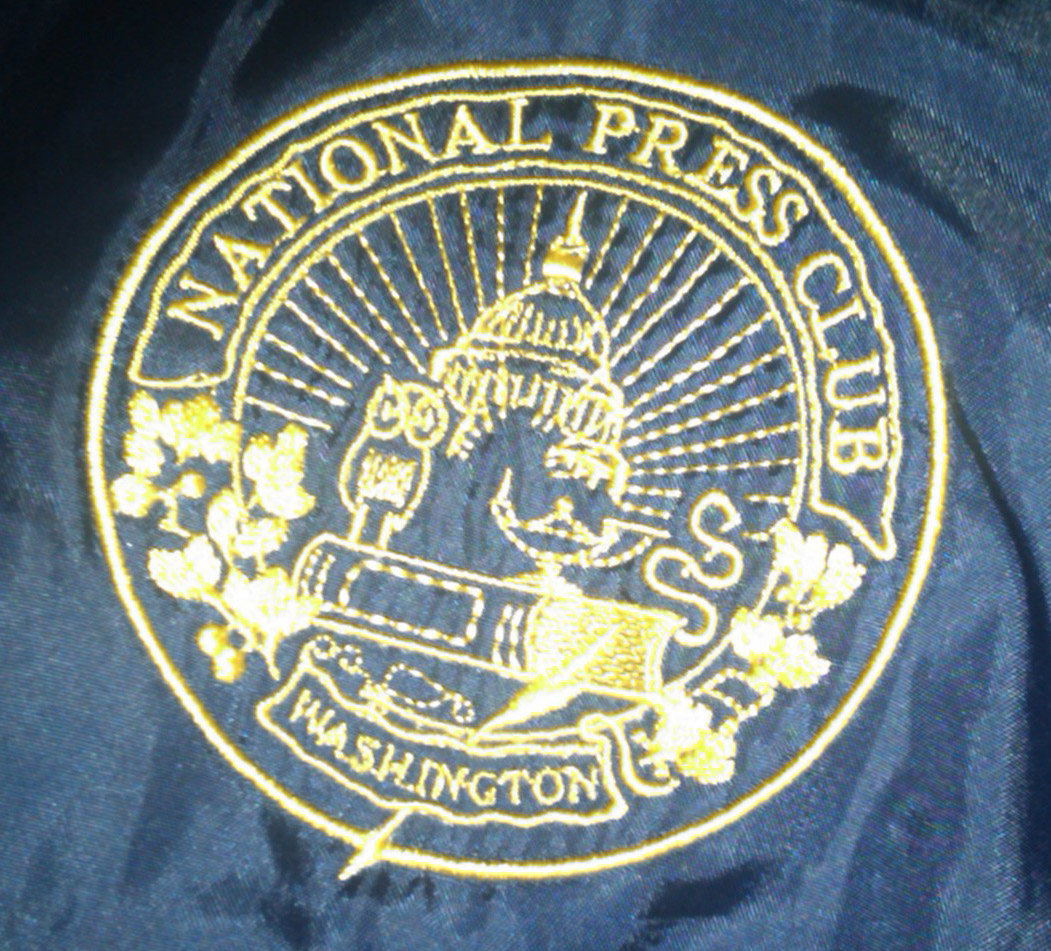
Around 10 years ago, when I found myself traveling several times a year to Washington, D.C., I joined the National Press Club, and I bought my dad a blue windbreaker with the club’s logo on it. After my dad died two years ago, the windbreaker came back to me, and in this mild winter I find myself wearing it a lot. Today at the convenience store near my office, the young man at the cash register looked at the gold logo and asked, “What’s the National Press Club?” I explained it is a group based in Washington for reporters and editors. “Oh, so you’re a reporter!” he said, almost beaming, and I could imagine him going home after work and saying, “You’ll never guess who came into the store today! A journalist! I see them on TV all the time, but I never thought I’d meet one.”

“No,” I said, “I’m an editor.”

His face fell. “Oh.”

Read Full Post »


Journalists need reminders now and then to pay closer attention to the lazy language they pick up from official sources – especially police, bureaucrats and businesspeople, to name three very large groups that like words that are not perhaps what you would call conversational English. Let this from Bob Ingrassia at The Fast Horse Blog be your reminder for this month that when it comes to the language in your stories, in the words of Eddie Murphy’s Axel Foley (in the clip above), “It should be more natural, brother, it should flow out.” If you wouldn’t say it in normal conversation with a friend, you might need to rethink what you’re writing or saying. Bob’s list of words or phrases to be banished and their conversational equivalents (and more are offered in the comments on his post):

fled on foot = ran away
high rate of speed = speeding
physical altercation = fight
verbal altercation = argument
reduce expenditures = cut costs
terminate employment = fire
reduction in service = layoff
blunt force trauma = injury
discharged the weapon = shot
transport the victim = take him/her
lower extremities = legs
officers observed = police saw
at this point in time = now
express concerns = complain
incendiary device = bomb
obtain information = ask or interview
deceased = dead
sexual relations = sex
roadway = road
fail to negotiate a curve = missed a curve
determine a course of action = consider options
vehicle = car or truck
citizen = person
individual = man or woman
commence = begin
emergency personnel = police, firefighters
utilize = use
complainant = victim
fatally injured = killed
motorist = driver
juvenile male/female = teen boy or girl
respond to the scene = arrive
precipitation = rain, snow
purchase = buy
intoxicated = drunk
controlled substances = drugs
appendages = arms, legs
contusion = bruise
head trauma = head injury
laceration = cut
provide leadership = lead
obstruct = block, get in the way
came to the conclusion that = decided, figured out
arrived at a decision = decided
reside = live

Read Full Post »

U.K.’s The Guardian, which is on the forefront in many experiments with public participation and transparency in the news, recently launched a variation on opening daily story budgets to the public. Jeff Sonderman writes for Poynter.org:

“This is a noteworthy experiment in both form and function. Readers can quickly gauge the leading stories of the day, how they’re unfolding and what the public might contribute. The result is a pleasant mix of facts, analysis, process and discussion — an illustration of news as a process, not a product.”

I can easily see how this would be burdensome for a small newsroom, but it’s not an all-or-nothing idea. The interaction and transparency is what’s important, regardless of how frequent the contact is.

Read Full Post »


If you work for a traditional newsroom, especially a newspaper, in all likelihood you are in a situation not that different than the Oakland A’s as depicted in “Moneyball.” You don’t have the money you feel you need to do the job the way you were brought up to believe it needs to be done, and that situation is never going to get better. The University of Southern California’s Center for the Digital Future even predicts the end of most printed newspapers in just a few years, owing not just to the economic factors hurting advertising but, more importantly, consumer habits shifting media use increasingly to digital platforms. I’m not so pessimistic myself, but I think it’s undeniable that technology is changing how people spend their time, and both reading and viewing are moving more and more to digital platforms.

News organizations face a stark choice. As expressed in “Moneyball” by Brad Pitt as the general manager of the A’s: “Adapt or die.”

That means going beyond seeing your website or social media channels as added tasks that take away from your real job. You have to think about news throughout the day in terms of people scanning for it on their phones, on their tablets, on their computers.

Steve Buttry of Digital First Media (aka Journal Register) has been posting a series on his blog this week detailing some of the practical changes of this approach, starting with how it would affect the ways a court reporter, photographer or sports reporter might do the job. (Dare I say this might be the first time anyone has written something suggesting a link in any way between Steve and Brad Pitt.)

Perhaps most important in Steve’s series is advice for editors leading a Digital First (or digital-first) newsroom. If the message doesn’t come from the top that digital-first is the new SOP, it won’t happen. If the message isn’t accompanied by evidence that those at the top are paying attention, it won’t happen.

Much of Steve’s advice echoes tips about coaching and leadership generally – there are sections on standards, listening, praise and collaboration.

One suggestion he makes that would be an important step for newroom leaders to drive the message because it would be a big change in newsroom habits:
“Focus your meetings on digital platforms. Ask what you’re covering live, who’s shooting video, what the social chatter is, what stories are getting good traffic. … Put tomorrow’s print Page One it its proper place: as an afterthought at the end of the meeting.”

Also good advice that newsroom leaders have to internalize:

“Don’t tell your staff they have to ‘do more with less’ unless you are providing tools for them to work more efficiently (in my career, a few things that have actually helped us do more with less are portable computers, spreadsheets, databases, cellphones and pagination). Usually, ‘do more with less’ is a management cliché that means we have failed to make tough decisions about priorities.

“As you focus more attention on digital platforms, you have to focus less on print. Consult with your staff and colleagues and make tough decisions about priorities. How are you going to change the newshole, design, editing process, content, staffing, etc. of the print product so you can focus more attention on digital.”

In other words, what are you really changing? You don’t have the staff you used to have, you never will again – “Newspaper companies have seen their advertising revenues drop by 58 percent from the third quarter of 2005 to the third quarter of this year (64 percent after adjusting for inflation). Any profits are achieved only by severe cuts in staff and other costs. That path is simply unsustainable.” – and you have a shifting audience.

What will adaptation look like in your newsroom?

Related: The Innovation Excellence website takes seven quotes from Moneyball and explains how they directly relate to driving innovation through an organization.

Read Full Post »

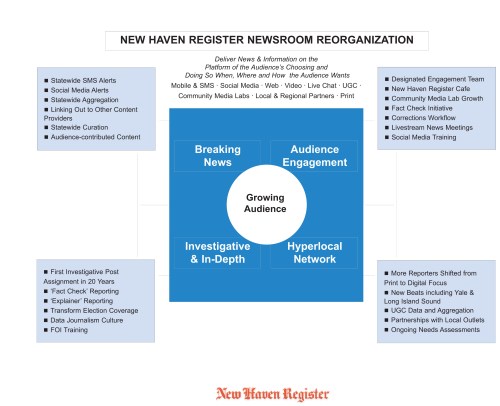
New Haven Register reorg
The headlines about the newsroom reorganization of Journal Register’s New Haven Register, including from Journal Register itself and from Jim Brady, editor-in-chief of Digital First Media, focus on the investigative and depth reporting beats. Those are certainly noteworthy, given recent debate (which I touched on here) in journalism circles about whether the emphasis on the Web is inherently a drive that dumbs down the news, and I recommend reading Brady’s post on the issue explaining that “it shows that you can address the needs of traditional journalism while still reorienting your newsroom toward the future.”

But I’m equally interested in the newsroom organization chart because it helps paint a clearer picture for people who have trouble envisioning just how a digital-first newsroom might be organized. Sometimes that can be the biggest barrier, what makes the idea cross from the land of buzzwords and hype to a plan of action. Inherent in any reorg like this is the idea that you have to reassess everything you traditionally do; if you feel you must preserve everything, then doing anything different is not just different, it’s “in addition to” and will never get done without additional staff.

Read Full Post »


Nieman Journalism Lab has an interesting report on software that can detect lies or misleading statements in a story, and for a little bit I thought this was going to be a piece on the next step toward robot reporters. (For a diversion, here’s a link to a 2009 video about robot reporters.)

It’s not. *phew*

But it’s the kind of thing that could alter the reporting process:

“His software is not designed to determine lies from truth on its own. That remains primarily the province of real humans. The software is being designed to detect words and phrases that show up in PolitiFact’s database, relying on PolitiFact’s researchers for the truth-telling.”

In other words, the intitial step of fact-checking a statement remains the same, but thereafter the software automatically speeds the process for other reporters, potentially allowing more time and effort to be devoted to things that have not already been checked.

Read Full Post »


Required reading from Steve ButtryRequired reading from Steve Buttry in response to a traditionalist writing in CJR (my categorization). Key summary:

“I bow to no one in my love for the good old days of journalism. But everyone trying to take journalism back to the good old days should understand some basic truths:

–You won’t find the future by retreating to the past.
–Whatever comes next in journalism can’t and shouldn’t be built to replace either the best or worst of current or historic journalism. You build the future on the technology and opportunities of the future in the context of the future.
–Watchdog reporting performed by professional journalists is absolutely part of journalism’s future, and I don’t know anyone discussing the future of journalism who doesn’t plan and hope for a successful future for professional watchdog reporting.
–Journalism of the past doesn’t look as strong on closer examination as it does through your nostalgic filter.”

I won’t rehash the details of Steve’s rebuttal, but as I plowed through the CJR article, “Confidence Game: The limited vision of the news gurus,” I was struck that much of the article seemed based on misunderstandings or semantics. Perhaps the points made over the years by the “future of news” (abbreviated as FON) “gurus” are a Rorschach test and I also am seeing in them what I want to see.

Where writer Dean Starkman sees the FON arguing that news inherently has no value, I have been reading “news is a commodity” as an argument that much of the daily stuff we fill the paper with needs to be rethought – not the investigative journalism that Starkman rightly praises but the long, formulaic, blow-by-blow accounts of city council meetings and court hearings that few people read. In coaching writers all over the Southeast, I have found that the 25-inch process story containing six inches of news is far too common, and there are similar examples of little-noticed copy coming from throughout many newsrooms. It’s not that ALL news has no value, but how much of what you are producing is the kind of thing people actually will subscribe for? Are you the only one covering this story or just one of at least a handful writing essentially the same story? Evaluate it.

Where Starkman sees a push for “reporting on the fly, fixing mistakes along the way,” that favors spontaneity over “traditional methods of story organization, fact-checking, and copyediting” and “formal style and narrative forms,” I see a call for simply being less hidebound, trying to see whether a traditional news story actually is the best form for conveying the information you have gathered.

The comparison of the “gurus” to hippies just leaves me a bit floored, but it does illustrate that on this point, at least, he is correct: There is a culture gap.

But the real kicker is that the conclusion of Starkman’s piece indicates to me at least that while he disagrees mightily with all the things he imagines the FON crowd is saying – and if they were really saying those things, in many specifics I’d have to agree with him – he basically agrees with the practical thrust of what I think they actually have been saying. (It’s a long article, so after you start reading and get the flavor of it if you get to where you think you just can’t click through all nine pages, just click 8 and read from there.)

I’ll end on Starkman’s optimistic ending:
“Rebuilding or shoring up institutions is going to take some new, new thinking, but it can be done. In the words of that original media guru, Marshall McLuhan: ‘There is absolutely no inevitability as long as there is a willingness to contemplate what is happening.’”

12/5/11 UPDATE: Clay Shirky himself has weighed in:

“Like a Yeats of the newspaper world, Starkman yearns for the restoration of a culture considerably purer than the actual newspaper business has ever been. Reading Confidence Game, you’d never know that most papers are not like the NY Times, that most of what appears in their pages is syndicated, that sports is often better represented on the masthead than hard news. You’d never know that more American papers printed today will include a horoscope than international news. You’d never know that newspapers are institutions where grown men and women are assigned to write stories about dogs catching frisbees.

“Saying newspapers will provide a stable home for reporters, just as soon as we figure out how to make newspapers stable, is like saying that if we had some ham, we could have a ham sandwich, if we had some bread. We need to support the people who cover hard news, but when you see a metro daily for a town of 100,000 that employs only six such reporters (just 10% of the masthead, much less total staff), saving the entire edifice just to support that handful looks a lot harder than just finding new ways to support them directly.”

Read Full Post »

Initially, the Nieman Journalism Lab’s look at how several highly touted innovation projects from 2006 fared, as part of the Newspaper Next project (more on that can be found here, but it’s a 2008 post), depressed me a little bit. As the Nieman post notes, of the seven projects, only three saw the light of day (including one by MG’s own Richmond Times-Dispatch — conducting market research to find out what local businesses wanted) and all three were not really started as a result of Newspaper Next. Others either never launched or petered out — a common factor seems to be aiming higher than your resources allow you to get. Also, some of the people involved at the outset moved on, so it wouldn’t be surprising if whatever urgency an innovation project had moved on with them.

So I was stewing a bit in mild despair about the industry’s ability to change. After all, these seven projects got national attention; these organizations raised their hands and volunteered to climb that stage, so you might have expected a serious push to have been made on all seven. The best that came out of any of them was an internal change in thinking and culture. That’s no small accomplishment for a newspaper company, but it’s pretty far short of what anyone hoped for five years ago.

But after thinking about it a while, I had to change my mind. Looking at my computer screen, with the TweetDeck symbol in the status bar and the word “Facebook” on one of the browser tabs, reminded me of a few of the changes that have crept through newsrooms since 2006. What the still-growing acceptance of Facebook and Twitter in newsrooms have in common with the Newspaper Next projects is an internal change in thinking and culture. Like experiments a few newsrooms have tried in opening their daily news budgeting process to varying degrees of public scrutiny (most recently rolled out in several Journal Register newsrooms), the idea of using social media to open the news process to public view initially strikes news people like it probably would strike a sausage maker if you suggested setting up webcams so people could watch the hog in live video all the way from the farm to the deli counter. A few years ago, it was not a popular concept at all. In some quarters, it remains highly unpopular.

But things changed. Those weren’t the only changes. Video, mobile, chat, website analytics – you could make a list of things that in many newsrooms now are part of the daily flow of conversation and (we hope) planning. The sum total of change from 2001 to 2011 in newsrooms is significant, but most of the individual changes were small and somewhat unheralded.

So I end up in a better place psychologically on this Friday afternoon than I had been a couple of hours ago. Incremental, internal change, as the Nieman Lab post notes, may be harder to notice and measure at the time. From Nieman’s interview with Tom Silvestri, publisher of the Times-Dispatch: “What happens is there’s no parade or Outlook invitation,” he said. “You don’t even get a cake with candles. But something happens.”

Read Full Post »

« Newer Posts - Older Posts »