Feeds:
Posts
Comments

Warren Buffett
I would wager you would have a difficult time finding an employee of any Media General newsroom that is soon to become part of Berkshire Hathaway’s BH Media Group who wasn’t thrilled by Warren Buffett’s letter to his company’s publishers and editors. It declares what he calls a “hands-off principle” in the management of the newspapers. As far as it is defined, it sounds as good as any management declaration that living journalists who don’t own their own papers would be able to remember.

On content:

“I believe newspapers that intensively cover their communities will have a good future. It’s your job to make your paper indispensable to anyone who cares about what is going on in your city or town.
“That will mean both maintaining your news hole — a newspaper that reduces its coverage of the news important to its community is certain to reduce its readership as well — and thoroughly covering all aspects of area life, particularly local sports. No one has ever stopped reading when half-way through a story that was about them or their neighbors.
“You should treat public policy issues just as you have in the past. I have some strong political views, but Berkshire owns the paper — I don’t. And Berkshire will always be non-political.
“… Our job is to reign supreme in matters of local importance.”

On the possibility of duplicating the debt levels that could not be maintained as revenue shrank:

“We shun levels of debt that could ever impose problems. Therefore, you will determine your paper’s destiny; outsiders will never dictate it.”

Read that again: “You will determine your paper’s destiny; outsiders will never dictate it.” That is where the rubber meets the road in this story, because it’s not entirely true, and the real question is to what extent editors and publishers understand that.

What is it that is driving the industry’s decline? The debt was a factor, so its removal is a great help and provides breathing room, but it’s not the driver. The level of debt that Media General had incurred might have been manageable at the levels of revenue that were coming in 10 or 15 years ago, and if those had kept up then everything would have been peachy. What changed? Buffett’s letter somewhat addresses this:

“We must rethink the industry’s initial response to the Internet. The original instinct of newspapers then was to offer free in digital form what they were charging for in print. This is an unsustainable model and certain of our papers are already making progress in moving to something that makes more sense. We want your best thinking as we work out the blend of digital and print that will attract both the audience and the revenue we need.”

Clearly the experiments with online paywalls now under way at a number of these newspapers will continue, but that doesn’t address the real driver. If you find the formula for paywalls of any kind that get you back to the paid-content equivalent of whatever your paid circulation was 15 years ago, you are not fixing the problem because paid circulation has never, at least since the 19th century, come close to paying the cost of producing the news. If you drop $1 in a newspaper box, the actual per-unit cost of creating that newspaper probably was $3 or $4. Traditionally, the bulk of that cost is covered by advertising because advertisers have thought it was well worth it to reach the mass audience. Newspapers produce news, but their business has always (at least since the 19th century) been selling eyeballs to advertisers, not selling newspapers.

Paywalls may help, to the extent that they provide at least some revenue and the lack of free local news online can stem the loss of print circulation, which in turn helps justify the rates charged to advertisers. But advertising has been declining for years for reasons that have nothing to do with drops in print circulation.

The real driver behind the industry’s trouble is that the Internet is not just an alternate delivery medium. As Jeffrey Cole of the University of Southern California’s Center for the Digital Future has put it, the advent of high-speed Internet is driving changes in society and personal behavior just as the advent of television did. That, not the decision by newspapers “to offer free in digital form what they were charging for in print,” is the force behind the growth of 24/7 news on mobile devices and tablets. If you somehow could put every newspaper in the world behind a hard paywall, that wouldn’t address all the TV networks, local TV stations, radio networks (NPR, to name one), web-only news sites, local place blogs, topic-oriented websites, and on and on and on. People expect to find everything they want to know online not because newspapers are there but because, as I said in a post last month, everything else is there. And because everything and everyone else is there, that is where many advertisers increasingly want to be – and they are not just trading print news sites for online news sites, they are exploring the Internet’s plethora of options for reaching an audience.

Buffett knows all this, I think. As he told the Richmond Times-Dispatch in an interview Thursday, “(Print) circulation for the industry will decline,” and experimentation is necessary:

“Some newspapers are experimenting with various pay-for-content models in their digital editions. Buffett didn’t specify what sort of model should be adopted, saying that is something the company’s newspapers will have to work out themselves.
“‘I think there is a better formula’ than the current revenue model, Buffett said in the interview. ‘I don’t think staying free over the next 10 years is the sound choice.’”

So we have to circle back to the “hands-off principle.” Here’s what the directive to publishers and editors boils down to in plain English: You make the decisions, as long as you maintain both your news hole (that’s one of the few things specifically spelled out in the letter) and profitability (not spelled out, but Buffett’s not running a charity, so it’s assumed).

The situation, then, is not much changed from what it was before, for these papers and any others: If advertising continues to migrate not just to other platforms but to non-news venues, what’s left is higher prices for readers, in print and online. Can a paywall for a small or medium-size news organization bring enough revenue to cover all production costs that are not covered by the remaining advertising? I hope so. I think so. If it can’t, hands-off or hands-on won’t matter.

Which brings us to this portion of Buffett’s letter:

“American papers have only failed when one or more of the following factors was present: (1) The town or city had two or more competing dailies; (2) the paper lost its position as the primary source of information important to its readers or (3) the town or city did not have a pervasive self-identity. We don’t face those problems.”

No, we don’t. But that doesn’t mean we won’t discover a No. 4 reason: The publisher and editor failed to recognize what the problem really was.

As a rookie reporter, I once had the idea of doing a first-person feature about learning to ride a horse, and I called around to a few places. Once place I called, I asked about scheduling a visit, and the person was kind of nonchalant, sort of “Yeah, just come out, we’ll work something out,” sounding not very interested. I called another place and they scheduled something firm. So I never followed up on the first place, wrote my story entirely based on the second — and after the story ran, the first place called my boss and complained about how they had set aside time, scheduled a trainer to wait for me, etc. etc. I was mortified, and it burned a hole in my psyche, and ever since then I have been absolutely mystified — and mortified — by many reporters’ continuing habit to treat public interaction as if it’s a video they can just hit pause and stop on without worrying about how the people on the other end feel or what they are thinking. Last night a reporter told me another reporter would call me today. Still waiting. I work in the business, so I’m like a battered spouse — I’ll forgive anything. But be warned, reporters, whether they read your newspaper regularly or watch your TV show, they think it’s important to have been contacted, and they anticipate the promised follow-up. If you fail to follow through and treat people with this kind of indifference, most people will just write you off, if they are that lenient, and your colleagues with you. You dig your own industry’s grave.

This is off the usual topics for this blog. Obituaries are completely out of the control of most newsrooms, so my intended audience — journalists — can do nothing about this complaint. But having dipped into the obituary pool Friday after my mother died, I can report with great authority that on this part of their business, this nation’s newspapers are practically lying naked across a table, eyes closed, holding a sign that says, “Whatever,” waiting for a madman with a knife to come along. If you have never made arrangements to place an obituary, let me assure you: It is messy, and it is EXPENSIVE. It is everything, in fact, that begs for someone to come along offering a simpler, easier, cheaper solution — an idea that was introduced to the news industry years ago as a job to be done. But of course no one really wants to make it cheaper, because that would reduce revenue. I remember once hearing a publisher gripe about a company-imposed mandate to simplify and beautify classified ads; the end result was a better-looking (bigger type, more photos), more enticing page that offered more options to people placing the ads, but the ads were bigger without the price going up, so revenue per ad was lower. Focusing on that is just short-term thinking — the number of classified ads has been dropping like a rock for years, driven by free online ads, so the intent of the change was to try to improve the printed ad experience and stem the decline, and maybe entice more people to come back. If you’re constantly watching your back, trying not to lose more ground, you can’t go forward.

Almost two years ago, Steve Buttry pointed out the problems and opportunities in the obit business. He was right then, and he’s righter now. But it’s even worse than I knew when I read his post in 2010.

I attempted to place my mother’s obituary in five newspapers — in the town where she was born, in the city where she began her journalism career, in the city where she retired, in the city where she lived for 10 years before a heart attack changed her life and mine, and in my own city. One told me that obits had to come from a funeral home, not individuals, which is a barrier because I’m not using a funeral home; my mother is being cremated by the Cremation Society of Virginia, which told me to handle the ads myself. I explained this but was told the ad had to come from a funeral home. So, one paper gets no ad. The cost at the other papers ranged from around $300 to nearly $500 (in my own city, the ad was free because I work for the company — an excellent employee benefit but one you hope never to use). In the accompanying listing for each at legacy.com (yes, each one has a separate, unlinked listing), my mother’s name appears as Anita Lucas, even though she never went by Anita — like many people, especially in the South, she went by her middle name, Gail — except for one listing: the obit placed in The News & Observer of Raleigh.

The News & Observer also was the only one that had a completely web-based system for placing the ad. It was easy and seamless. Every other place had me e-mail in the information, and they called me back to get credit card information. Not bad, but not seamless.

One day, probably in the not-too-distant future, someone is going to combine something like the N&O’s online obit-submission system with a cheap price, and at that point, newspapers will hear another nail pounded in the coffin of their revenue model. For instance, why not a TV station? TV has geographic market presence — which I’m not convinced is even necessary nowadays — and this is revenue TV stations don’t now get, so a low-cost, web-only model is nothing but a plus to them. Or some newspaper company, like the N&O’s McClatchy, might decide, “Hey, why don’t we roll out this web-based obit system as a national thing, like Craigslist, and not just limit ourselves to where we have a building?”

When the day comes that someone actually does this, newspaper executives won’t be able to say no one saw it coming or tried to warn them.

5/21 UPDATE: Through Twitter, legacy.com noticed my complaints and addressed its end of them, so her obits now appear online as Gail Lucas, and the guest books have been combined.

A disobedient son

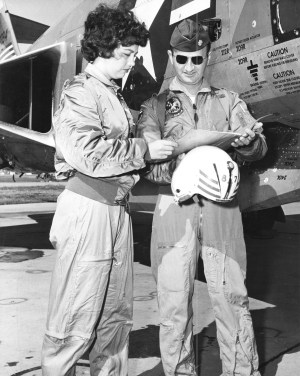
Gail Tabor at Lockbourne Air Force Base
My mother told me not to go into journalism. She made herself crystal clear. I remember when I told her I thought I wanted to study journalism in college. She fixed me with the kind of look teenagers usually get for breaking the news they are gay, and she said something like, “You don’t want to do that. You’ll never have any money.” She was a divorced mother of two boys, working for the Arizona Republic, so she knew her subject matter well.

She started her career at the Columbus (Ohio) Citizen-Journal, where in 1961 her job as society editor took her to cover an “Officers’ Wives” luncheon at Lockbourne Air Force Base, and during her visit she was given a tour of the restricted area where all the planes were kept, and she got the idea to ask for a ride in one of the planes — a supersonic F-101B. Her account of her exchange with Lt. Don Fullerton, the assistant information officer at the base, sums up her life:

Gail Tabor in flight helmet“Ha,” said Fullerton, “you’d faint on takeoff.”

That did it. I just had to get that flight.

She got the flight, becoming the first woman to fly in an F-101 and the fifth woman to break the sound barrier. The experience so exhilarated her that she kept damn near everything about it — from her typed draft, covered with edit marks, to copies of the three first-person stories she wrote about the experience (bearing the two-column logo, featuring fancy cursive-style type, of “Women’s Features”) — in a folder the rest of her life.

She interrupted her career to raise two boys. One had the sense to go into sales and other business-oriented pursuits. The other liked to write and felt the same sort of exhilaration that led to that folder of yellowing paper, so when she said, “You don’t want to do that,” he thought, “Yes I do.” He has second thoughts nowadays, but when it comes down to it, he still hasn’t been able to follow her advice.

Stijn Debrouwere helps explain “the mess the news industry is in,” going over tangible examples of how the way people — primarily young people, but not just them — have changed the way they look for information and where they look. It’s a post solidly in the mainstream of examinations of industry disruption, which continue to be useful for helping traditional journalists look past their immediate source of distress: layoffs/buyouts and budget cuts (the latest example, from AdAge about a situation at the Washington Post). Those problems are just symptoms resulting from what Stijn calls the “death by nibbles.” He also does address the issue of what journalists should be doing, including stressing storytelling and personality; “joining the revolution” by considering alternate ways of distributing information, ways that you would not call journalism; become less boring (seriously, that is a huge issue); and “Do stuff that does still matter.”

5/8/12 UPDATE: It’s interesting to compare the above with what the CEO of the Deseret News Publishing Co. — which is seeing circulation gains — says are big ideas changing the media industry. One of the two he cited for content can, I think, wind up getting dismissed:

“Differentiate your content: Invest where you can be ‘the best in the world.’”

Don’t let “best in the world” send you off a cliff, particularly if you run a small newsroom. No one is saying a 20,000-circulation paper or small website needs to compete with the New York Times — or even the Deseret News. But what exactly is it your audience expects you to be best at? Probably not the food page. Town council coverage? Local youth sports? Much more likely. Put your efforts where they can make a difference.

Read all about it
A frequently heard complaint about news online and the use of web metrics is that they might dumb down the news and reward sensational and short pieces over serious journalism. The Longform Blog would seem to be made specifically to fly in the face of any tendency toward short, unserious news: Every day it recommends four stories — non-fiction only, each 2,000 words or more. As explained in a second-anniversary post:

“There’s no Most Popular box to keep the numbers churning for particular stories, we don’t SEO the hell out of posts, and every piece we recommend spends roughly the same amount of time at the top of the homepage. In deciding what to click, all readers have to go on is who wrote an article, where it was published, when it came out, and what it’s very basically about.”

And so, out of the 2,805 articles recommended since the site went up two years, the editors have looked back and drawn conclusions about what really interests people who go out specifically in search of longform journalism:

“So, turns out that it doesn’t really matter what kind of content you’re talking about—video, pics, 5,000-word features—sex on the internet is still sex on the internet. Stories in the sex category were nine times as likely to end up among the year’s most read. Looking for an even more sure-fire way to make the list? Write a story about porn.”

Murder also rates very high.

On a much more encouraging note, the stats show that truly compelling narrative non-fiction has legs — or, in webspeak, I guess it has a long tail:

“Readers on Longform are more likely to send an older story to the most-read list than they are a new one…”

The moral? Maybe it’s pay attention to web metrics or don’t, it doesn’t seem to change what people want to read.

Niagara Falls
This morning brought me a good composite illustration of the evolving media landscape, at least a snapshot of it, that is so challenging for traditional news organizations to adapt to.

On Facebook, a journalist friend vented about local sites’ aggregation practices, which several times a day summarize and link to news her staff has reported: “It’s my reporters doing all the hard work! Am I looking at this wrong?” It’s a type of heartburn, but keep it in perspective: It has been going on since the first time a radio talker read the news on the air.

Nieman Journalism Lab reports on how NPR is trying a new strategy for rolling out new shows, aiming to simplify the process and lower the cost while also making use of social media. My first thought was it just shows that NPR, perhaps because it relies on grants and donations rather than advertising, has been somewhat insulated from the economic issues confronting print and commercial broadcast news organizations because it has been several years since I became used to hearing the idea of “fail fast, fail cheap.” But my second thought was that it illustrates one problem for traditional media: We don’t like to do anything just one time. I don’t mean stories, I mean columns, features, shows, sections, segments. We’re used to the idea of stand-alone news and features, but anything that we would do more than once, but not at least weekly and not for the foreseeable future, is a giant barrier. Any traditional news source is tremendously structured and formatted. The idea of predictability is roundly accepted as a plus, that people want to know what they are getting before they even try. Try telling a newspaper editor (not to pick on newspapers; this is just an example) that certain stories should run in larger type. At best, he’ll convene a committee to discuss it for a few weeks, and if they tend to agree they’ll run off test copies on the press and discuss it some more. So in that sense, even though many organizations have been preaching “fail fast, fail cheap,” almost no one really practices it. “Fail fast, fail cheap” means you go ahead and do it, and if it clear quickly that it isn’t working, you stop.

Finally, John Robinson explains what I would call the cognitive dissonance in a Pew study of news habits, which reported that “31 percent of people ages 18-24 get no news on an average day, and 22 percent of 30-34-year-olds get none either.” The nut of John’s argument:

“The 18-24 year-old age group is the ‘if-the-news-is-that-important-it-will-find-me’ generation. Those folks are on Facebook. They get news every time they log on. Their friends tell them the news in their worlds. (And for you not on Facebook, don’t think that they talk about what they had for breakfast.) This generation doesn’t immediately call it news the way we old-timers do, but when they watch, say, the president slow jammin’ the news, it is news. When they see the ‘Trending Articles’ foisted upon them by Facebook, that’s news. (Well, some of them are.)

“But if you ask them where they get news, the answer is Google and Yahoo and Jon Stewart and Huffington Post. It’s rarely actual, traditional, mainstream news organizations. The news may originate there, but they don’t identify those as the sources. And that’s one of the problems with using the generic term ‘news’ in a survey.”

And that right there is the larger issue: Not just young people but almost everyone now picks up news everywhere throughout the day. It used to be far more structured; the morning paper (or, before that, the afternoon paper), the evening TV news and whatever people talked about during the day that was passed on by word of mouth or that was big enough to warrant a news break on TV or radio in the middle of the day. It’s all atomized now, or it’s increasingly so.

A further illustration: Although I started my day with the morning paper, all of the above was stimulated by things I found online — starting with Facebook.

A damp Wednesday morning in a small town in central North Carolina. People file into a tiny church (seating capacity approximately 100) for the funeral of a beloved writer, who was my wife’s mentor. A woman sits down next to me. She is a writer, from Winston-Salem. We three chat. She asks whether I, like my wife, am a writer too. I explain I am in the netherworld between newspapers and online: “I have a website where all of my company’s newspapers, which include the Winston-Salem Journal, can share th–”

“You ruined a perfectly good newspaper,” she says.

“I didn’t do it.”

“Ruined.”

Somehow I don’t feel up to a discourse on the economics of advertising, especially classified advertising, and how little any newspaper reader actually pays of the total cost of producing a newspaper.

The past is gone


Late in the documentary “Page One: Inside the New York Times” — the SPJ Virginia Pro chapter held a viewing Saturday night at the University of Richmond — Times reporter David Carr tells a room of journalists in Minnesota something like (the quote may not be exact because I’m going from memory): “Don’t think about all the people who are gone. Think about the fact that you are still here.” It’s partly encouragement, partly a warning not to succumb to survivor’s guilt. It can also be taken — whether or not Carr specifically meant it that way — as an instruction to newsroom leaders: If you spend all your time thinking about the beats your news organization used to cover and all the bureaus everyone used to have but doesn’t anymore, you’ll paralyze yourself. You can’t stretch your current resources to make up for what has been lost and will never return. You have to think about what you have and what you need to do to best achieve your newsroom’s goals. Change the entire beat structure if that’s what it takes to get people to stop thinking of how things used to be done.

Back in the mid-’90s when I was an assistant state editor (a job that no longer exists at that paper), there was a reporter we had who was covering a county by herself against daily competition from three other papers. She seemed overwhelmed and was turning in briefs that were a day behind the competition, and she was not getting many stories because she was always trying to catch up. I and another editor (in hindsight, it was overkill to have two of us do this) pulled her aside one day and told her she needed to choose her battles. She couldn’t, all by herself, outreport all of her competition, so she needed to set her own agenda, pick what she thought was important, and if she got beat on something, well, evaluate how important that is on a case-by-case basis. We made her cry, which was not the goal, but she changed her approach, found her footing and became the reporter we all believed she could be. The situation currently facing newsrooms is not very different: You can’t do everything you want to do, so choose your battles.

Regret
The category of “don’t do this on Facebook (or Twitter)” is a large one. While many examples stem from what I guess you might call youthful exuberance or failure to consider the nature of the first two Ws in World Wide Web, not all of them do, which is a good reminder for everyone who laughs off those mistakes as things they would never do. One such tale comes in Jay Rosen’s Anatomy of a Facebook Fail: Mine, in which he explains how he came to post a brief comment on Facebook that he wishes he hadn’t. Skipping to the caveat that any of us could tape to the bottom of the computer screen:

“… that’s exactly why I should have waited to post my comment: so I could examine it with a cooler eye. And that’s what it was: a comment (38 words) not an attempt to report on the episode.

“Still, I have 8,000+ subscribers on Facebook. I knew I was commenting publicly. I teach journalism and I study the Internet. I know a lot about how to avoid these things. That of course makes it worse.”