Feeds:
Posts
Comments

Sitting under a tiki-decorated patio umbrella in the early evening heat Wednesday at downtown Lenoir’s Hogwaller Stage, my wife and I chatted with a 50-something Caldwell County native as we waited for the sun to drop behind the county office building and a band to begin playing.

This is the third summer that you can find outdoor music with your dinner and drinks one or more evenings a week at Hogwaller, which is on Church Street directly behind 1841 Café, but our friend said he wasn’t even aware there was a stage there until just a couple of weeks ago.

He had a friend he had asked to meet him there. While we were talking to him, she texted him a question: Where is Hogwaller?

She had never heard of it either, though the name “hogwaller” in relation to that spot downtown long predates either of them.

In fact, this man — born and raised here, never lived anywhere else, and active in the community — had never even heard of 1841 until that first trip. He didn’t know that right across Main Street from it was another restaurant, the Side Street Pour House, with 40 beer taps and full bar.

We didn’t talk about it, but I would wager that if he didn’t know about all that, he didn’t know that a couple of blocks west is Loe’s Brewing, serving craft beer with gourmet burgers, pasta and sometimes a few other things, or just a little farther west Joan’s Sourdough Bread (fresh bread plus lunch), or Essie and Olive (known for popsicles but also serving lunch), or the Corner Creamery (ice cream!), or J&A General Store, or the soon-to-open Fercott Fermentables (home brewing supplies, beer and wine). I could go on.

I’ll assume he knows of the downtown antique stores, as well as Piccolo’s Pizza, which has been downtown since he was a young man.

This is something I keep encountering.

A few years ago a woman who grew up in Happy Valley and lived here all her life said she had no idea what was in downtown Lenoir or even what the streets were — she had never been.

When Lenoir had its first-ever beer garden at a street festival a couple of years ago, a woman who lives in Lenoir was irritated to find out about it only after the fact.

Last year a man who moved to Gamewell a number of years ago from another state said he didn’t even know how to get to downtown Lenoir — even though he had been to the U.S. Post Office there many times. He just went straight to the Post Office and then straight back out again. After I told him to just go another block or so farther west than he had before, suddenly he discovered Piccolo’s, his new favorite pizza place.

“Love the layout,” he wrote to me, “feel like I’m on a set for the TV show American Pickers!”

Similarly, the Caldwell County Economic Development Commission’s program “Hired Education,” in which a set of 30 local teachers get a three-day immersion in the local economy, consistently prompts expressions of surprise among its participants: They toured companies they never heard of before, or saw machines they never dreamed existed in buildings they pass every day, and involving jobs they had no idea anyone in Caldwell County held.

A man walked into the lobby of the News-Topic a couple of weeks ago and asked if there’s a shoe-repair place in town. Yes, about three blocks from our office.

Need I point out that all of these places and businesses have been in the newspaper within the past few years?

No one is more acutely aware of how much smaller newspaper staffs are than they used to be, and how much less they are able to cover than they once could, than a newspaper editor is. But there still is a lot of local knowledge missed by people who don’t regularly read the paper, whether on paper or on our website. It doesn’t cross their personal experience or their Facebook feed. It’s information that won’t seek you out. You have to look for it, without knowing for sure what you’re looking for. That’s one thing the newspaper is still good for, and it’s not a small thing.
People who ask me where I grew up sometimes then ask, after hearing my long answer, whether I’m an Army brat.

Those people may not be aware of where military bases are, or maybe they can’t think of any other reason for someone to have such a nomadic history.

I was born in Columbus, Ohio; when I was 2 my family moved to Blacksburg, Virginia; when I was 5 we moved to Greensboro, North Carolina; when I was 9, after my parents divorced, we moved to Durham; when I was 11 we moved to Phoenix, Arizona. For college I moved back to North Carolina. After college my jobs took me to Lenoir, then to Wilmington, to Florida, back to North Carolina in North Wilkesboro, to Winston-Salem, to Virginia and back to Lenoir again.

I’m not rudderless, but my rudder shudders.

So the past four a half years here in Lenoir, the same place where my first job was, from mid-1987 to early 1988, has been a bit of a revelation to me. For the first time in my life, I am learning what it’s like to have a personally experienced sense of history in a single place. It’s much different than the sense that comes from just visiting a place where I used to live. When I visit, I don’t feel a part of that place, I feel apart from it, like I stepped into the frame of someone else’s photo.

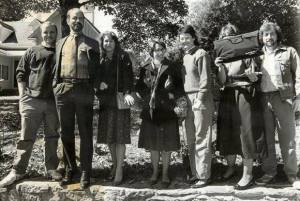
So on Thursday after work, as the News-Topic newsroom staff lined up in downtown Lenoir for a group photo on the next-to-last day at work for one of our reporters – Briana Adhikusuma, who is getting married in two weeks and moving to southeastern Virginia – I felt pangs of memory. I looked back at a similar photo from nearly 30 years earlier, and I found myself thinking about the lives of not just the people in the photo but people here in Caldwell County who grew up here and every day are confronted with reminders of their past, what has changed and how they fit into it.

In the 1987 photo, seven members of the News-Topic’s newsroom staff stand atop a stone wall in downtown Blowing Rock in front of what used to be Tijuana Fats, where we sometimes went on Fridays after work. I’m on the far right, the most junior reporter on the staff, just a few months out of college. Second from the far left is the editor, Lee Barnes. I have long hair, combed to the side but hanging down over my forehead. It’s a black-and-white photo – our press couldn’t print color, so the staff photographer shot only black-and-white film – but if it were in color my beard would be rust-colored. I’m skinny.

In the 2017 color photo, we stand near the square in downtown Lenoir. I’m on the far left, now the editor of the same newspaper where I started. Everyone else in the photo is at least 25 years younger than I am. My hair isn’t as long (I need a haircut), it’s graying, and it’s swept back from my forehead. My beard is gray.

Looking at the two photos together, I feel the presence of the many dozens of people who have passed through this newsroom during the intervening 30 years, though I never met most of them.

I think about where the people in the 1987 photo have gone – Lee to Florida; the sports editor to far western North Carolina; the city reporter to the Charlotte area; the city editor to South Carolina; the lifestyle editor to New York; the photographer, who took that photo but wasn’t in it, also to New York. The education reporter died a few years ago. Most have changed careers.

I think about where the people in the 2017 photo might be in a few years. One just left and drives off Saturday with her fiancé, and I already miss her.

Reflecting on it too long, as I write this column about it, I feel a creeping sense of mortality that blends with the permanence of this place, like standing waist-deep in the ocean as the rushing current pulls at you. It takes effort to hold your place, and though where you are is the same as when you got there, everything about it is moving, swirling, shifting, even the grains of sand under your heels.


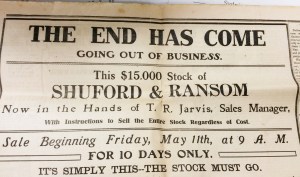
What was it about May 9, 1917, that made Zenith Wilson tuck the day’s copy of The Lenoir Topic away in a box and keep it for the rest of his life?

There are too many A1 headlines to list, but the ones at the top of the page:

Mr. Cilley Volunteers

The Tunnel Method of Keeping Sweet Potatoes

Give the Children Some Patches of Their Own This Year

STRONG EVIDENCE / Is the Statement of This Lenoir Woman (this was on an ad for kidney pills)

TAX LISTING

Notice of Sale

Perusing the local items, presumably written by editor W.M. Moore, because none carry a byline but are written in a personal style, again nothing much stands out. Perhaps this one, which has some history:

“Mr. Frank Osborn, of Mortimer, visited our home the other night. He made the trip in a very short time as it was the first automobile that ever visited this section.”

But it’s not circled, and it’s on an inside page. If that’s all he wanted, he could have just cut it out, or saved just the page.

Other local news is more pedestrian:

“The bond issue for road improvement in Caldwell lost yesterday by a small majority. Watauga is reported to have voted for good roads by a majority of about 400. All the counties adjoining Caldwell have either already built good roads or have arranged for their construction at an early date. This leaves our good county temporarily alone in the mud.”

Under the all-capital-letters headline “FREE TYPHOID VACCINATION”:

“A matter of very great importance to the people of Caldwell was passed upon Monday by our board of county commissioners when they decided to wage a campaign this summer against typhoid, offering free vaccination to everyone for thirty days. The date of the campaign will be announced later. In the meantime, every one is asked to co-operate heartily with the authorities in their efforts to prevent the ravages of this terrible disease which costs many lives and much sickness every year.”

Maybe it was page 6, which was entirely wire service stories about preparations for World War I, including the new military draft. One of the stories described “the first war army organized under the selective draft bill,” more than 528,000 men.

Another dealt with Congress’ war preparations, including the U.S. House passing “an omnibus emergency war bill carrying nearly $3,000,000,000” that doubled the pay for enlisted men from $15 a month to $30.

Or maybe it was nothing at all, just a personal aversion to throwing anything away. There’s evidence for the latter – Mr. Wilson folded the paper over to one-sixth its full, open size and tucked it inside an old wooden box containing many other kinds of papers. Over time more and more accumulated – an 1854 property deed, receipts for over 30 years of subscriptions to the Lenoir Topic (one year’s subscription in 1904 cost $1), a century-old sheriff’s office burglary report, the user’s manual for a circa-1920 water pump, an 1898 copy of North Carolina road rules, a 1918 car registration, and the minutes from 1888 to 1950 of the Caldwell Baptist Association, to name a few.

That box of accumulation was but one small part of a lifetime of accumulation, and all of it came up for sale last May. That’s when Gary Wieland came across it at an estate sale.

Wieland, who moved to Lenoir in late 2015 after retiring from a job in Texas, bought the old wooden box almost on a lark. It was $50.

The box turned out to be a field desk from the Civil War era. Wieland has since sold it.

He has also sold other items. Now he’s going through what’s left and giving them away to people who might appreciate them, such as the burglary report, which he took to the Caldwell County Sheriff’s Office, and the May 9, 1917, newspaper, still fairly supple and not nearly as yellow as you would expect, which has been in my drawer the past two weeks but soon will make its way to the Caldwell Heritage Museum. So too may the plastic bag of Lenoir Topic receipts, the oldest of which is dated April 16, 1904, for a subscription sold to Monroe Wilson by George Kincaid of the Topic.

Wieland said it has been entertaining to look through all the old papers that were in that box. But Wieland lacks Mr. Wilson’s instinct to hold on to things.

“I figured all they’re doing is sitting in a drawer now,” he said.

He bought them, he read them, and then he felt he had an obligation to share them.

Is Howard Dean grossly ill-informed about our nation’s bedrock freedoms, or was he merely pandering to the Democratic Party’s base when he tweeted out an ignorant statement?

Dean, a former governor of Vermont, rocketed from obscurity in 2004, when he ran for the Democratic presidential nomination. He harnessed a populist energy, much like Bernie Sanders did last year, and briefly emerged as the apparent front-runner. Then at a campaign rally he screamed like a Muppet (the infamous “Dean Scream”) and everything kind of fell apart.

He recovered to become head of the Democratic National Committee from 2005 to 2009, and since then has been a favored liberal commentator on television. As such, his comments – both on-camera and off, spoken or written or tweeted – are scrutinized, and he surely realizes this.

On April 20, he chose to comment on Twitter about conservative Ann Coulter, amid controversy generated by the University of California at Berkeley’s decision to postpone a speech by Coulter, who uses intentionally provocative terms to belittle and mock her opponents. Administrators said they needed more time for security preparations because of expected violent protests by liberal activists. Conservatives said the university was buckling to those who think the First Amendment shouldn’t apply to political views they oppose.

Dean seemed to side with not allowing Coulter to speak, tweeting, “Hate speech is not protected by the First Amendment.”

Dean, 68, is beyond old enough to know better.

The Supreme Court has made clear repeatedly, in cases involving both the political far left and the far right, that hateful speech is protected.

That is why Nazis and the Ku Klux Klan can’t be stopped from holding rallies on public streets.

That is why Westboro Baptist Church can’t be prevented from going to the funerals of soldiers and holding up signs saying the soldiers died because of God’s hate.

As Lauren Carroll of PolitiFact wrote, there’s no universal definition of “hate speech,” so you might debate whether Coulter’s history of explosive rhetoric qualifies, but it really doesn’t matter. The courts’ track record on the First Amendment is clear: You can be as hateful as you want, as long as you don’t make a threat of violence. Threats and violence are not protected.

But when talking about the First Amendment, you also have to be clear about what exactly it protects. The First Amendment specifically says, “Congress shall make no law … abridging the freedom of speech.” Courts have ruled repeatedly that the wording means that the government can’t tell Ann Coulter what she can or can’t say.

It does not mean that Coulter has the right to stand on your front porch and say whatever she wants. It’s your house. You can kick her off the property. But then she can stand on the public right of way and yell at you – unless she’s so loud she violates a noise ordinance. Then she has to lower her voice.

It does not mean that Coulter can invite herself without warning to speak in any government-run auditorium. But she can walk onto a public university campus uninvited, stand on the student commons and talk. Even yell. In fact this is what street preachers, among others, do at colleges all over the country.

In Berkeley’s case, she was invited by the school’s College Republicans, who are able to reserve speaking space. The university runs afoul of the law, then, only if it treats Coulter differently than anyone else invited by a college-affiliated group – which it does not appear to be doing because it provided an alternate speaking date.

But here’s something the First Amendment does NOT do: If Ann Coulter walks onto a college campus, stands in the commons and starts her usual spiel denigrating minorities and immigrants in the most inflammatory, provocative way and generally making people mad, the First Amendment says only that the government can’t stop her. It does not say that some person not employed by the government who is standing nearby and getting angry can’t pelt her with eggs and rotten tomatoes — or punch her.

That would be assault. It’s wrong, and it should result in a criminal penalty, but it’s not a First Amendment violation.

Some Republicans in North Carolina’s General Assembly are so exercised about the First Amendment lately that they want to pass a law requiring the University of North Carolina system to formally institute punishments for students whose protests interfere with others’ free speech rights. Let that sink in. As in George Orwell’s “Animal Farm,” apparently some people’s First Amendment rights are more equal than others’.

The legislators’ proposal is government overreach, but I agree with their underlying point: The correct response to speech you oppose, even that you consider hateful, is not silencing the speech or reacting violently to it.

Regarding Coulter – and similar rhetorical bomb-throwers who seem to revel in the anger they generate – I agree with the response suggested in the Washington Post by Alyssa Rosenberg, who described Coulter as a “boring performance artist” rather than someone with ideas that should be taken seriously:

“Coulter is like a distorted Tinker Bell: It’s not applause that saves her from fading out of existence, it’s shock and jeers. These days, her ability to elicit that reaction seems to be the main reason Coulter gets campus bookings in the first place. If it’s not, and if campus conservative groups have mistaken Coulter for any sort of serious or interesting thinker, then the campus right may be in even graver trouble than the campus left. Being willing to say anything deemed outrageous is not the same thing as having significant ideas.”


I no longer get press releases about medical research in Scotland, but I still get some from far-flung places where I have trouble believing anyone even knows where Lenoir is.

On Friday one came from a fashion designer in Leicester, England. I’m sure your first thought is that this designer clearly recognizes that whatever the upper crust in New York, London and Milan might say, fashion isn’t fashion until the Lenoir News-Topic says so. I’ve heard it many times.

She wanted me — or presumably anyone anywhere in the world on the massive list of email addresses swept up by computers maintained by whatever public relations hacks she is paying — to interview her about “athleisure.”

I’ll give her this: She increased my word power.

Without the context of the press release, I might have thought “athleisure” was the sound of a complicated sneeze. Or it could be a term for a type of seizure common among athletes.

Instead, athleisure is defined in this press release riddled with punctuation errors as “modern comfortable sport’s inspired” clothing. In other words, leisure clothing that is vaguely athletic-looking. In the case of this press release, that would be leggings.

Leggings came to be in the news recently because United Airlines refused to let two girls who were traveling on a free ticket board the plane because they were wearing leggings rather than pants.

The English fashion designer argues that leggings ought to be allowed not only on planes but in a great many places: “As more people are becoming interested in healthy living, it is increasingly acceptable for dress codes to be relaxed in order to facilitate popular on-the-go lifestyles.”

My mother used to talk about how people once dressed up to travel because going on a plane was a big deal. Now, as Norm in the old TV show “Cheers” might say, it’s just another darn reason to put your pants on.

It’s not just air travel, though, it’s everywhere. Go to your local courthouse and see what some people wear when they have to plead their case before a judge.

There are places you shouldn’t arrive looking as though you either just rolled out of bed or are about to mow the lawn.

But I digress.

Curious about what athleisure — or, another term this designer used, “sports luxe” — looks like, I went to the designer’s website, www.okayla.co.uk. There on the home page it was: a young woman in a gray hoodie, her face pale, her heavily painted eyes closed, her head tilted slightly, her dark-purple lips parted, her shoulders slouched, hands hanging limp. She looked like a corpse in rigor mortis having been stood upright.

I wouldn’t want her on a plane either, but mainly because I’d be afraid she’d try to eat my brain.

Let’s be honest: No one wants a camera and a hose shoved up his rear end.

And the very idea is why so many people are resistant to getting a colonoscopy, a procedure in which a doctor snakes a tube up inside you to see what business you have going on down there. Or up there, I guess.

The idea gave me the willies.

Turns out I was just being stubborn, ignorant and childish. If you’re worried about it too, don’t be. Here’s why.

When I was 49, the doctor brought up the topic as a suggestion.

No, I don’t think I will, I said.

When I was 50, he brought it up again.

Eh, I said.

Then last fall I had some sudden, severe abdominal pain. Frighteningly severe.

The pain passed, but the doctor now had allies in my wife and every relative. I lost the ability to choose. The colonoscopy was on the calendar.

I had to reschedule once. I hoped I would again.

No luck.

Last Monday, I went to the pharmacy to pick up the prescription liquid you have to drink to clean your system out, which means exactly what you think it does. The pharmacist talked to me about the process and what to do and said the box had not just instructions but IKEA-like picture instructions.

Then, as I was about to leave, she said, “I hope everything comes out OK.”

Of all the pharmacists in the world, I get Lenoir’s answer to Henny Youngman.

I chuckled.

As I walked away, she said, “Have fun.”

You stop eating solid food about two days before your procedure. My instructions said that I could have breakfast and lunch, but after that, for the rest of the day and the entire next day, I could have only certain liquids. The most satisfying of these was broth.

Broth.

Just broth.

Surprisingly, though, broth is pretty tasty as long as you don’t get the low-sodium kind. You can keep your stomach full and stave off hunger pangs, and it tastes really, really good.

But even if you feel “full,” you won’t feel full. A belly full of broth, water, 7-Up and Gatorade feels like someone stole your stomach and replaced it with a water balloon.

So by the evening before your procedure, when you are supposed to take the medicine, you may feel like a monk. You have been abstaining. You yearn for the sensual pleasure of pizza, or cheese, or a little meat. You look forward to the procedure just to get the whole thing over with and begin feasting.

Now, the medicine: It will clean you out. That sounds scary. You may remember bouts of stomach flu when you got cleaned out. You will dread it.

Don’t.

Remember: You have ingested nothing but liquids for well over 24 hours. And there are no cramps like there are with stomach flu.

In the morning you will take more of the medicine. But that morning is the hardest because after drinking the medicine and prescribed amount of water, you are now done. No water, no broth, no nothing, for hours. Time has rarely moved as slowly for me as those five hours did.

By the time I reached the gastroenterologist’s office, I was eager for the procedure, because once it was done I would be free. I could eat. I had fantasies of food like prisoners and castaways have. I plotted my lunch with the eagerness of a first date.

And my eagerness was rewarded: It was the shortest wait in a doctor’s office I have had in my entire life.

They took me back to a room. There were a few questions. Did I have any questions? I did not. I put all my clothes in a bag and put on the ties-in-the-back gown. Shortly, a nurse came back, told me to lie down and covered me with a warm blanket.

When another nurse came back and took me to the room for the procedure, the anesthetist greeted me and in a cheery voice explained what she was going to do. One thing she said was the name of the drug propofol, which triggered a memory, and when she paused I said, “Wasn’t it propofol that killed Michael Jackson?

“Yes,” she said, “yes it was.”

From across the room a nurse called out, “It was a cardiologist who killed Michael Jackson!”

And on it went.

I was just joking, but the anesthetist explained aaaaaaaaaaaalll about propofol and what went wrong with Michael and his doctor.

Then they had me turn on my side, get in a certain place.

And then I was asleep. It’s almost as if I was snatched by aliens, because my memory in that room simply ends at that moment I situated myself on the bed.

The next thing I knew, I woke in a different room with Mrs. Lucas.

I was groggy. It felt a bit like being drunk, except it wore off faster.

So much worry over so little. And on the bright side, I learned a lot about propofol. The whole thing was a win-win.

Words do not justify violence


If only Martin Luther King Jr. had started knocking heads, imagine how much he would have accomplished.

Or so seems to be much of the most joyous thinking on the left in the wake of a viral video that grew out of the anti-Trump protests on Jan. 20.

If you haven’t seen it, a television reporter was interviewing Richard Spencer — who leads a white supremacist movement and not long ago headlined a conference in Washington, D.C., that ended with those assembled giving a classic Nazi “heil” salute — when suddenly someone lunged at Spencer from his right and sucker-punched him. Spencer staggered away, the attacker leaped back, and that was the end of it.

That brief video has been circulated widely and applauded. That celebration drew quick, but not wide, condemnation by others on both the left and right, which led to a question that also spread in a viral manner on social media:

Is it OK to punch a Nazi?

Those asking the question often answered it themselves in the affirmative, and most others chiming in said essentially that the answer was not only yes but hell yes. Those answers sometimes came attached to images of comic book hero Captain America punching Hitler and movie hero Indiana Jones punching a Nazi.

Those giving a contrary answer included Newsweek, which called ethicists and posed the question to them, prompting one, Randy Cohen, to say, “Do you really not know if it’s ethical to punch someone even though they have odious politics? I mean, should we call your mother?”

Apparently we should call a lot of people’s mothers. One response on Twitter that captured the overall sentiment was this:

//platform.twitter.com/widgets.js

One hopes that if the person who wrote that thought about it a while she would change her position because she could easily find herself targeted by it.

The problem with saying you support punching Nazis is you take a step onto a slippery slope. For one thing, Spencer does not belong to the Nazi party; the label of “Nazi” has been applied to him because of his racist views. If it’s OK to punch someone who isn’t a Nazi but is labeled one, who then who determines what other people get that label applied to them?

Regardless of whether he is a Nazi, Spencer has not engaged in violence or called for it. Who gets to decide that a person’s views go far beyond what the person states and actually encompass “eradication” of other people? Spencer’s views are extreme, but who gets to decide that someone’s views are extreme enough to warrant violence? President Obama was labeled a socialist and extremist with long-term goals described at times in nearly apocolyptic terms. Would it be OK to punch Obama?

If it’s OK to punch someone, what is the goal of the punch? To change his mind? To punish him? If punching him won’t change his mind or change his ways, then what? Should he be killed?

The American Civil Liberties Union is perceived by many on the right as the ultimate liberal special interest group, but many liberals can’t stand that the ACLU will stand up for the free-speech rights of right-wing extremists. On both the left and the right, people want free speech for their own views, but any views that stray too far from theirs make them uneasy. Unfortunately, the First Amendment doesn’t come with an asterisk and a footnote saying that it doesn’t apply to racists, thugs and religious extremists.

The First Amendment right of free speech has repeatedly and frequently been interpreted by the courts as guaranteeing anyone the right to espouse even horrific views — not the right to do horrific things, but to talk about them. In other words, the First Amendment provides everyone a forum to talk about anything they wish.

Of course, the First Amendment says only that the government may not censor your views. It does not say that there will not be non-government repercussions for your views. What you say may, for instance, anger others enough that they want to punch you. That’s where we are now.

The irony is that this all happened less than a week after the day America remembers King, who met hate with love and met violence with peace and in 1964 won the Nobel Peace Prize. Spencer is a milk-fed, baby-faced poser compared to the people King had to deal with, vicious thugs with a badge such as Eugene “Bull” Connor, whose Birmingham police turned high-pressure fire hoses and attack dogs on African Americans. We don’t have to imagine how King would have answered the question “Is it OK to punch a Nazi?” because he answered it over and over. Just a few of those answers:

“The ultimate weakness of violence is that it is a descending spiral, begetting the very thing it seeks to destroy. Instead of diminishing evil, it multiplies it.”

“Man was born into barbarism when killing his fellow man was a normal condition of existence. He became endowed with a conscience. And he has now reached the day when violence toward another human being must become as abhorrent as eating another’s flesh.”

“Hate multiplies hate, violence multiplies violence, and toughness multiplies toughness in a descending spiral of destruction.”

Is it OK to punch someone hateful? I understand the impulse, but the answer is not just no, but hell no.

For every situation we face, there are choices with bad outcomes and other corresponding choices with good outcomes. We tell ourselves this all the time.

If a choice turned out to be a bad one, we feel sure that if we had made a different choice, what happened would have been a better result.

But life is more complicated. You can make a choice that turns out to be a mistake, but if you had it to do over there might be more than one choice, and it’s not a given that there is always a choice that brings the result you desire, or that the correct choice is easy to recognize. All of the choices might have outcomes you don’t like – a giant series of chutes that all ultimately feed into a single, spiral slide downward to the same destination, or to a variety of slides and destinations, all of them bad.

That’s where I’m left when thinking about Jack Shafer’s much-shared column in Politico about a paper by H. Iris Chyi and Ori Tenenboim of the University of Texas and published in the journal Journalism Practice.

“The paper cracks open the watchworks of the newspaper industry to make a convincing case that the tech-heavy Web strategy pursued by most papers has been a bust,” Shafer writes. “The key to the newspaper future might reside in its past and not in smartphones, iPads and VR. ‘Digital first,’ the authors claim, has been a losing proposition for most newspapers.”

Shafer contends that the newspaper industry “should have stuck with its strengths—the print editions where the vast majority of their readers still reside and where the overwhelming majority of advertising and subscription revenue come from—instead of chasing the online chimera.”

I’m generally sympathetic to the argument, but I have trouble seeing how simply not putting content on the web would have done much more than slow the bleed of readers because it assumes news from traditional sources is competing with other news for readers’ attention, not with the larger ecosystem of things that are available to occupy readers’ time, which skyrocketed in number and especially convenience due to the mobile web.

The larger problem for the argument posed by Shafer, who is only the latest to make it, is that the ultimate problem for news is not the bleed of readers leaving print but the bleed of advertisers. As Jim Brady noted in a tweet, “There’s a reason you can put 50 cents in a newspaper machine and take ALL OF THEM. That wasn’t where real revenue was.”

To this day, the Charlotte Observer loses money, when comparing what the subscriber pays to the cost of paper, ink and gasoline, on every paper it delivers to my town. The Observer does it to preserve the size of its print audience, which helps it prop up advertising rates.

Advertising has left print faster than print’s audience has, not because print didn’t serve advertisers’ needs but because online offers shinier, cheaper, easier-to-measure and easier-to-target options in a vastly larger array of attention-getting offerings, even if the measures are bots and smoke and the audiences are diffuse. Put news behind a digital Great Wall of China and it wouldn’t change that.

Defending the idea that print would have been better off keeping the web at arm’s length depends on believing that the departure of advertisers especially not only would have been a great deal less than it has been but also that advertising revenues would – and perhaps still could, if only there were more paywalls – level out at a higher level than they are at now.

You have to consider the possibility that if the newspaper industry had done as Shafer wishes it had, today its overall circulation might be – might be – somewhat higher than it is now, but free online options other than news still would have peeled away many casual subscribers; advertising still would be a fraction of what it once was, which would have driven both staff and content cuts, which would further have driven away readers; and there still would be no end in sight to revenue declines; that the chute might be less steep, but it still would lead the same direction.

Furthermore, there’s also the issue addressed by Steve Buttry that Shafer, Chyi and Tenenboim look at what the news industry has done online and conclude the industry actually strongly pursued a digital strategy, while those like Buttry and Brady who have advocated for a digital-first approach feel the industry pursued less-than-half-hearted measures that were doomed from the start.

“The colossal mistake that the newspaper industry made,” Buttry writes, “was responding to digital challenges and opportunities with defensive measures intended to protect newspapers, and timid experiments with posting print-first content online, rather than truly exploring and pursuing digital possibilities.”

A few, in that view, have actually approached the digital-first chute, including the former Digital First Media that Buttry and Brady worked for.

Buttry again: “When I worked at Digital First, I described our company’s name as an aspiration, rather than an achievement. I applaud our former CEO John Paton and our former Editor-in-Chief Jim Brady for leading us further and faster down the digital path than any other newspaper company. But that barely took us to the outskirts of digital experimentation.”

In other words, most who have even approached the true digital-first chute jumped off, and even those still on it have not yet ridden it all the way. We don’t know where it would end up.

Buttry, Brady and others who see things as they do might still be proven wrong about where that chute goes, but there is less evidence that they are wrong than that Shafer is.

UPDATE: Another view, by Matthew Ingram writing in Fortune:

“As tempting as it is to re-imagine history, however, it’s a virtual certainty that even if most newspapers had focused more of their resources on print and less on digital, the outcome would have been more or less identical.”

AND THIS: A good summary of the debate online from Poynter.

nora
I don’t remember who told me I should write about Nora McGee.

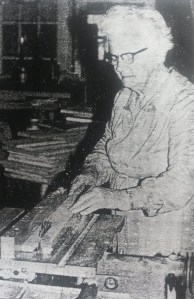
I remember it had something to do with the 81-year-old woman’s woodworking, that she had taken it up as a child in an age when grown women rarely did that work. Among other things, she built several floor-to-ceiling cabinets for her kitchen. I remembered the feminist gist of what she told me about growing up as a tomboy in the early 20th century, but until re-reading the story not the wonderful phrasing she used.

“Back in my day, women weren’t supposed to do that,” she said. “I just decided, instead of knitting when I didn’t want to, I would hammer when I wanted to.”

I liked doing stories of women striking out into men’s territory. Around the same time, 1987, I wrote about the only four women in Lenoir who were criminal defense attorneys. It’s still a men’s field – I think I have seen more women at the Caldwell County Courthouse working as prosecutors than defense attorneys in the past three years.

Until a relative of McGee’s sent me a photocopy of her story recently I didn’t remember her name, but when that relative mentioned McGee’s name to me a week or so earlier I wondered if that was the woman I wrote about who did the woodworking. It sounded familiar.

When the photocopy arrived in the mail I recognized it, and yet it differed from my memory.

I shot the photo the News-Topic ran of her moving wood on a saw, but I remembered shooting it at a different angle. I remembered she wore a dress at the time, and I would have described it as sort of dark and plain, yet when I saw the black-and-white image I could tell it must have been gray or, more likely, light blue with a simple floral pattern. As I sat at home Saturday morning thinking about writing about the difference between my memory and the photo, I thought her hair was darker and longer than it actually is in the photo.

We all like to think of our memory as a video recorder. Everything that goes in is played back reliably and the same way every time, unless it gets erased. Then it’s just gone. But what we recall, that’s what was. That happened.

With rare exceptions, though, we have fluid memories. Even in the events we remember, details change. People change. Some things fade out, while new details may emerge.

I remember from that group of women defense attorneys just one name, Nancy Epstein, maybe because that stood out as not a local name. I remember I thought she was attractive. Maybe that’s the only reason she’s the only one I can remember – or maybe I have told myself she was attractive because hers is the only name I remember, and I can’t think of another reason I would forget the other three.

Or was her name Nancy? Google can’t find her.

Were there really four women in that group? Maybe there were three.

I don’t have the newspaper clipping of that story, only the memory of the photo I shot, the women standing together somewhere in front of the courthouse.

Maybe I was meant to work as a reporter because even as a teenager I knew that memories weren’t always reliable. I often said when telling people what I recall, “If I remember accurately …”

In a poetry writing class in college, one of our assignments was to describe our earliest memory. Mine has always been a few moments in a medical setting when I must have been an infant. I wrote my description of it as best I could but couched all of my details with qualifiers, saying that this is how I remember it, and pointing out the gaps that I didn’t remember. The professor read each student’s submission without telling who wrote it, and after reading mine he told the class he knew exactly the procedure being described – one that, as he talked about it, I had no idea existed. Then he declared that the careful insistence that the memory’s details might be flawed clearly indicated that the entire thing was a work of fiction because no one said things like that when describing a memory.

No one knew I had written it, so I could not feel humiliated at being called a fabulist (I should note I got a good grade in the class – lies in poetry are not a bad thing, apparently). Mainly I wondered: Had I learned about that procedure at some point and forgot about it? Had I seen it on TV and internalized the imagery? I’ll never know.

The memory feels as real as my interviews with “Miss Nora” and Nancy Epstein. That’s why I have to couch my words. That’s why we all should.

NOTE: After this was published, a reader emailed me and said I probably was thinking of Nancy Einstein, who now practices law in Morganton. She was correct.

Bill Tate, Meadowood Studios
One thing that hasn’t changed about newspapers is errors.

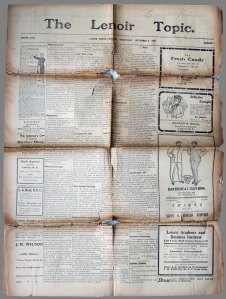
On page 1 of the yellowed, disintegrating copy of the Lenoir Topic, one of the weekly predecessors of the News-Topic, donated by Frank Coffey and recently posted by Bill Tate on the “Lenoir and Caldwell County History” Facebook page, the paper’s publication date appears as Wednesday, Sept. 6, 1905, but on page 2 it says Wednesday, Aug. 30, 1905.

That makes me feel better about the much more recent times the News-Topic has carried the wrong day, date or both.

Nothing on the 1905 front page was about anything in Caldwell County, except for all of the local ads – and there were quite a few. One was a long, text ad for Dr. Pierce’s Golden Medical Discovery, a pill that supposedly protected you against germs:

“It increases the vital power, cleanses the system of clogging impurities, enriches the blood, puts the stomach and organs of digestion and nutrition in working condition, so that the germ finds no weak or tainted spot in which to break. … Only one or two a day will regulate and cleanse and invigorate a bad Stomach, torpid Liver, or sluggish Bowels.”

That was just one of many ads throughout the paper for “cures” of various kinds — Cuticura Soap, Ointment and Pills, Mozley’s Lemon Elixir (another for “torpid liver”), Dyspepsia by Crab Orchard Water, Cascarets Candy Cathartic (for your bowels, “They work while you sleep”), Sloan’s Liniment and Lydia E. Pinkham’s Vegetable Compound, which pitched itself exclusively to women starting with the headline, “STOP, WOMAN!” by promising confidential advice by mail for health issues that women would not feel comfortable confiding to male doctors.

Page 2 carried in the top left corner, under the incorrect date, two important items of information: The subscription cost, $1 a year, and the Topic’s telephone number, 7.

Page 2 also carried a mix of news, from the newly brokered peace treaty between Russia and Japan to the General Assembly passing a measure for a referendum in Lenoir on issuing $50,000 in bonds for streets, sidewalks, sewer lines or an electrical plant.

Page 3 started with the heading “OF LOCAL INTEREST” and listed people who had been somewhere or were on their way:

“Mrs. Harper Beall has returned from a visit to Chester S.C.

“R.A. Ramseur has been on a trip to Mitchell.

“Carroll Rapp went to Guilford College Monday.

“Mr. J. Gorden Ballew returned to Baltimore last Friday.”

Farther down, under the headline “Sweet Girl Freshmen and Sophomores,” was a short paragraph:

“It was a sad pity that the Topic reporter belongs to the wrong ‘sect’ (to quote Samantha) Tuesday, for a whole carload of sweetness came up billed for Davenport College. It sho’ was a pretty sight to behold all those nice girls at once. The conductor did look so happy.”

Under that was the news of “the terrible damage done by a mad dog” rampaging from Lenoir to Patterson, which was finally shot and killed under the Crisp, Cilly & Co. store in Patterson.

With that news was a message issued by Lenoir Mayor Edgar Allan Poe saying that, because no one knew how many other dogs the rabid dog may have bitten, “Notice is hereby given that all dogs found on the streets of Lenoir unmuzzled for the next thirty days will be shot.”

Ads on this page included one for a 12-room house in Granite Falls for sale for $1,000. “We stake our reputation on the assertion that you cannot duplicate this for $1,500.00,” it said.

Page 4 brought more details on the Russia-Japan peace, including a separate wire story on world leaders crediting Teddy Roosevelt with brokering the peace, and a mix of state, national and international wire items, then some “filler” (the news term for short things used to fill inconvenient space), including some one-liners that also appeared as filler on at least one other page in the same issue, such as, “A woman’s idea of heaven is five parts wavy hair and five parts a good figure,” and, “A useful thing about automobiles is all the new cuss words you learn when they won’t work.”

The news largely petered out by page 5, where there was a long piece of fiction, “Luke Hammond, the Miser,” by Prof. William Henry Peck, and other apparently syndicated specialty feature items. One, “With the Funny Fellows,” relayed short, presumably fictitious anecdotes supplied by papers around the country:

“I was surprised,” said the Rev. Mr. Goodman, sternly, “to see you playing golf last Sabbath. I should think you’d do better –”

“Oh!” replied Hardcase, “I usually do. I was in wretched form last Sunday.” – Philadelphia Press.

Page 6 was what we would call today the religion page, with lots of inspirational messages and lines (“You have no right to elect His work if you reject His word”). Curiously, it also was the home to the highest number of “cure” ads.

Page 7 was the business page, aside from a wide column down the left side made up of pseudo-scientific pronouncements, including the headline “Mars Inhabited,” with a short description of what scientists know of Mars “By Camille Flammarion, the Famous Astronomer,” which described a wondrously pleasant climate on Mars and concluded, “We know the globe of Mars perfectly; in fact, far better than the earth.”

Bill said there were a total of only seven pages to be posted. I have yet to figure out how that can be so, since every piece of paper I’ve ever seen from any era has both a front and a back, making two pages. Perhaps that’s one thing about newspapers that has changed.