Feeds:
Posts
Comments

Posts Tagged ‘audience’

Warren Buffett
I would wager you would have a difficult time finding an employee of any Media General newsroom that is soon to become part of Berkshire Hathaway’s BH Media Group who wasn’t thrilled by Warren Buffett’s letter to his company’s publishers and editors. It declares what he calls a “hands-off principle” in the management of the newspapers. As far as it is defined, it sounds as good as any management declaration that living journalists who don’t own their own papers would be able to remember.

On content:

“I believe newspapers that intensively cover their communities will have a good future. It’s your job to make your paper indispensable to anyone who cares about what is going on in your city or town.
“That will mean both maintaining your news hole — a newspaper that reduces its coverage of the news important to its community is certain to reduce its readership as well — and thoroughly covering all aspects of area life, particularly local sports. No one has ever stopped reading when half-way through a story that was about them or their neighbors.
“You should treat public policy issues just as you have in the past. I have some strong political views, but Berkshire owns the paper — I don’t. And Berkshire will always be non-political.
“… Our job is to reign supreme in matters of local importance.”

On the possibility of duplicating the debt levels that could not be maintained as revenue shrank:

“We shun levels of debt that could ever impose problems. Therefore, you will determine your paper’s destiny; outsiders will never dictate it.”

Read that again: “You will determine your paper’s destiny; outsiders will never dictate it.” That is where the rubber meets the road in this story, because it’s not entirely true, and the real question is to what extent editors and publishers understand that.

What is it that is driving the industry’s decline? The debt was a factor, so its removal is a great help and provides breathing room, but it’s not the driver. The level of debt that Media General had incurred might have been manageable at the levels of revenue that were coming in 10 or 15 years ago, and if those had kept up then everything would have been peachy. What changed? Buffett’s letter somewhat addresses this:

“We must rethink the industry’s initial response to the Internet. The original instinct of newspapers then was to offer free in digital form what they were charging for in print. This is an unsustainable model and certain of our papers are already making progress in moving to something that makes more sense. We want your best thinking as we work out the blend of digital and print that will attract both the audience and the revenue we need.”

Clearly the experiments with online paywalls now under way at a number of these newspapers will continue, but that doesn’t address the real driver. If you find the formula for paywalls of any kind that get you back to the paid-content equivalent of whatever your paid circulation was 15 years ago, you are not fixing the problem because paid circulation has never, at least since the 19th century, come close to paying the cost of producing the news. If you drop $1 in a newspaper box, the actual per-unit cost of creating that newspaper probably was $3 or $4. Traditionally, the bulk of that cost is covered by advertising because advertisers have thought it was well worth it to reach the mass audience. Newspapers produce news, but their business has always (at least since the 19th century) been selling eyeballs to advertisers, not selling newspapers.

Paywalls may help, to the extent that they provide at least some revenue and the lack of free local news online can stem the loss of print circulation, which in turn helps justify the rates charged to advertisers. But advertising has been declining for years for reasons that have nothing to do with drops in print circulation.

The real driver behind the industry’s trouble is that the Internet is not just an alternate delivery medium. As Jeffrey Cole of the University of Southern California’s Center for the Digital Future has put it, the advent of high-speed Internet is driving changes in society and personal behavior just as the advent of television did. That, not the decision by newspapers “to offer free in digital form what they were charging for in print,” is the force behind the growth of 24/7 news on mobile devices and tablets. If you somehow could put every newspaper in the world behind a hard paywall, that wouldn’t address all the TV networks, local TV stations, radio networks (NPR, to name one), web-only news sites, local place blogs, topic-oriented websites, and on and on and on. People expect to find everything they want to know online not because newspapers are there but because, as I said in a post last month, everything else is there. And because everything and everyone else is there, that is where many advertisers increasingly want to be – and they are not just trading print news sites for online news sites, they are exploring the Internet’s plethora of options for reaching an audience.

Buffett knows all this, I think. As he told the Richmond Times-Dispatch in an interview Thursday, “(Print) circulation for the industry will decline,” and experimentation is necessary:

“Some newspapers are experimenting with various pay-for-content models in their digital editions. Buffett didn’t specify what sort of model should be adopted, saying that is something the company’s newspapers will have to work out themselves.
“‘I think there is a better formula’ than the current revenue model, Buffett said in the interview. ‘I don’t think staying free over the next 10 years is the sound choice.’”

So we have to circle back to the “hands-off principle.” Here’s what the directive to publishers and editors boils down to in plain English: You make the decisions, as long as you maintain both your news hole (that’s one of the few things specifically spelled out in the letter) and profitability (not spelled out, but Buffett’s not running a charity, so it’s assumed).

The situation, then, is not much changed from what it was before, for these papers and any others: If advertising continues to migrate not just to other platforms but to non-news venues, what’s left is higher prices for readers, in print and online. Can a paywall for a small or medium-size news organization bring enough revenue to cover all production costs that are not covered by the remaining advertising? I hope so. I think so. If it can’t, hands-off or hands-on won’t matter.

Which brings us to this portion of Buffett’s letter:

“American papers have only failed when one or more of the following factors was present: (1) The town or city had two or more competing dailies; (2) the paper lost its position as the primary source of information important to its readers or (3) the town or city did not have a pervasive self-identity. We don’t face those problems.”

No, we don’t. But that doesn’t mean we won’t discover a No. 4 reason: The publisher and editor failed to recognize what the problem really was.

Read Full Post »

Stijn Debrouwere helps explain “the mess the news industry is in,” going over tangible examples of how the way people — primarily young people, but not just them — have changed the way they look for information and where they look. It’s a post solidly in the mainstream of examinations of industry disruption, which continue to be useful for helping traditional journalists look past their immediate source of distress: layoffs/buyouts and budget cuts (the latest example, from AdAge about a situation at the Washington Post). Those problems are just symptoms resulting from what Stijn calls the “death by nibbles.” He also does address the issue of what journalists should be doing, including stressing storytelling and personality; “joining the revolution” by considering alternate ways of distributing information, ways that you would not call journalism; become less boring (seriously, that is a huge issue); and “Do stuff that does still matter.”

5/8/12 UPDATE: It’s interesting to compare the above with what the CEO of the Deseret News Publishing Co. — which is seeing circulation gains — says are big ideas changing the media industry. One of the two he cited for content can, I think, wind up getting dismissed:

“Differentiate your content: Invest where you can be ‘the best in the world.’”

Don’t let “best in the world” send you off a cliff, particularly if you run a small newsroom. No one is saying a 20,000-circulation paper or small website needs to compete with the New York Times — or even the Deseret News. But what exactly is it your audience expects you to be best at? Probably not the food page. Town council coverage? Local youth sports? Much more likely. Put your efforts where they can make a difference.

Read Full Post »

Elon University
A new survey by Elon University’s Imagining the Internet Center and the Pew Research Center’s Internet & American Life Project paints a picture of a future population that largely won’t be geared to consume news as it currently is produced. That’s not exactly the way it’s put, but draw your own conclusion:

“Young people accustomed to a diet of quick-fix information nuggets will be less likely to undertake deep, critical analysis of issues and challenging information. Shallow choices, an expectation of instant gratification, a lack of patience, are likely to be common results. One possible outcome is stagnation in innovation.”

On the bright side, it proposes the possibility of “evolving social structures (that) will create a new ‘division of labor’ that rewards those who make swift, correct decisions as they exploit new information streams and rewards the specialists who retain the skills of focused, deep thinking.” That sounds like what good journalists are geared to do, potentially putting them in the category of “new winners … in this reconfigured environment.” Let us hope.

Read Full Post »

U.K.’s The Guardian, which is on the forefront in many experiments with public participation and transparency in the news, recently launched a variation on opening daily story budgets to the public. Jeff Sonderman writes for Poynter.org:

“This is a noteworthy experiment in both form and function. Readers can quickly gauge the leading stories of the day, how they’re unfolding and what the public might contribute. The result is a pleasant mix of facts, analysis, process and discussion — an illustration of news as a process, not a product.”

I can easily see how this would be burdensome for a small newsroom, but it’s not an all-or-nothing idea. The interaction and transparency is what’s important, regardless of how frequent the contact is.

Read Full Post »


I’ve been meaning to get to this very short, simple post for a week, so let me tell anyone out there who is considering administering a contest: Even if it’s only an annual contest, it’s going to suck up your time, and if you are diligent about keeping time for yourself you will find you don’t get much done on the contest.

Anyway: I found the above TED talk extremely interesting for the context it lends to the current disruption in media. It tells about the advent of pop-up books for children. If you think about it, that is the beginning of animation — someone creates drawings with parts that the users can see move in front of them. You can understand how children’s literature is forever changed by this, just as the first motion picture, the first talking motion picture, the first television program, etc., changed how people conceived of how stories could reach them. As I have pointed out often, we are in an accelerated period of evolution in the changing nature of storytelling. It’s important to remember it didn’t start when we entered the business, otherwise we would all go crazy (not that we won’t anyway).

Related to this, last week Nieman Journalism Lab highlighted some stats from Facebook about one element of the current curve in storytelling’s evolution, reporting + social media interaction. The good news: commentary and analysis — in other words, depth, produced by people who know what they are talking about — does well. The hazard: so does humor. People, if you have just one takeaway today, let it be this: Funny is hard. If you try the humor route, start soft, start slow, start very non-partisan, and pretend every member of every branch of your family not only will read it but has your cell phone number.

Read Full Post »

John Robinson fooled me. He started a post about the need for innovation with questions that seemed geared to curmudgeonly, 20th-century answers. For instance:

What would you do if:
* Half of your employees — including those in circulation — don’t subscribe?
* Half of your employees — including those in the newsroom — don’t read the paper (except for their own stories)?
* Half of your employees don’t subscribe to your e-newsletters?

I worked up a good, frothy dudgeon and was thinking to myself, “What has happened to John since he left newspapers that he is taking such a troglodyte approach?” — and then I got to the end of his post. So, spoiler alert, he was not writing in inverted-pyramid-style. It was more like pyramid-style. The end held the answers to my questions.

The “troglodyte” approach would be to require employees to subscribe and read (maybe quiz them, to test whether they really read), but, as John writes, a better idea is to ask your employees why: Why don’t they subscribe? Why don’t they read? If the only thing they read is the stories that carry their byline, then the only thing they care about is what was changed between writing and publishing, which means they don’t care about the content. If the reporters don’t care, why should anyone else? Ask them that. Ask what they SHOULD be writing about to make people read.

Related to this, Peter Osnos had an article in The Atlantic resurrecting the idea that aggregators should pay for the news they aggregate, which ignores the fact that no one pays the aggregators, except advertisers, which are not at current ad rates a source of revenue that would sustain news organizations. Paying for aggregation is an idea that traditional journalists love, but if most news organizations started charging with a hard paywall, almost all aggregators would stop looking and aggregating — just as most people do not subscribe.

Get to the basics: Whether or not your site has a paywall or a metered paywall, it’s important to ask what people will pay for and what will make them keep coming back. The same things that make your site worth aggregating are the things that make someone consider subscribing, so in the end whether you go the free model or the paywall model you hit the same capitalist question: Is it worth it?

And you can’t change what people want to read. Among the gathering evidence: a Washington Post story.

Read Full Post »

2011 in review


Below is a WordPress automated summary of my blog’s year, although it’s actually less than eight months. What lessons can I draw from it? One, I should say, “Hola, España,” since apparently viewers in Spain rank right behind U.S. and Canadian viewers, though I can’t tell whether that amounts to many people (my bet is that it does not). I post this not because I think it tells very much but just because it’s a beginning data point. We’ll see what comes later:

The WordPress.com stats helper monkeys prepared a 2011 annual report for this blog.

Here’s an excerpt:

A San Francisco cable car holds 60 people. This blog was viewed about 1,100 times in 2011. If it were a cable car, it would take about 18 trips to carry that many people.

Click here to see the complete report.

Read Full Post »

Google Mobile Ads Blog image
Google has analyzed how people are using tablets and what they are using them for, and easily the least surprising but most trumpeted fact is that people use their tablets rather than booting up a computer (ditto here). Uhhhhh. Really? Do any of these people own a tablet? Once you own any tablet, any of them, using a laptop or desktop computer is like moving from fiber-optic Internet back to dial-up. Computers have to boot up. You wait and wait and wait, sometimes for a whole 60 seconds (!!!), while the tablet — like your phone — is on instantly, but unlike your phone the screen is large enough to let you actually SEE things.

Tablets are not more useful overall than laptops or computers, but for the simple stuff you want to do to fill your time, it is utterly unsurprising that people refuse to boot up rather than simply grab a tablet.

Read Full Post »


For better or worse, this is how new technology is framing the terms of the media-development debate

Read Full Post »

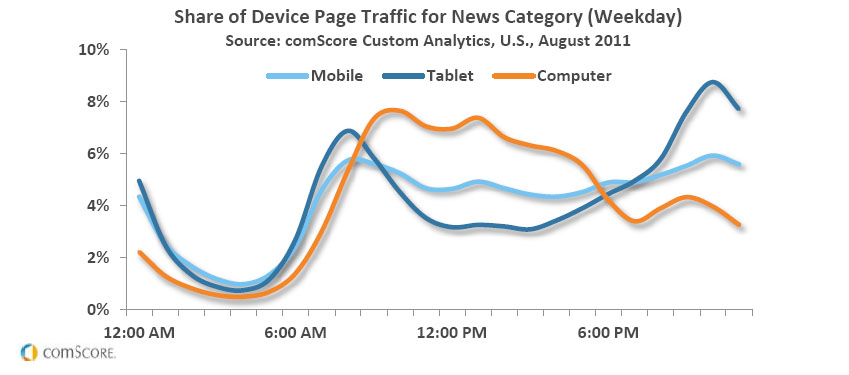
After my junior year of college, I had a summer internship at what was, unbeknownst to me at the time, one of the last PM daily papers in the United States, the Phoenix Gazette. The Gazette was down to about 1/10 of the circulation of its morning rival, The Arizona Republic – both were owned by the same company but maintained separate staff – but was hanging on. Given the trends underscored by the latest report from comScore, Digital Omnivores, we may be in a window where people one day will say they were at one of the last newspaper organizations NOT to have an online PM strategy.

For those of you too young to remember, a brief summary of the relevant history: A little more than a generation ago, more newspapers were sold in the afternoon than the morning, and many cities had both a morning-delivered paper and an afternoon-delivered paper, the latter of which originally was dominant. As lifestyles changed, the afternoon paper faded and the morning paper became dominant, and by the ‘80s few PM papers were left. Whatever news had happened in the wee hours overnight, people heard on the radio or TV in the morning, and whatever happened during the day, people heard on the radio on the drive home or on TV shortly after arriving home. In recent years (as many have observed) the Internet is accelerating the adaptation of news-consumption habits to peoples’ lifestyles and schedules – so much so, it seems, that there now is renewed and growing demand for a late update on the news, but later than the old PM paper and later than the evening TV news.

One of the highlighted elements of the comScore report is the rapid growth in mobile and especially tablet use. This is important because, as the chart shown above illustrates, when people use their computers to check online news, the pattern rises and falls according to the day’s work schedule – peaking in the mid- to late morning and declining late in the day. But mobile use hangs on later – especially tablets, which actually peak later in the night.

A danger of drawing too many conclusions about where the trend goes from here is that the current batch of tablet users are mostly young, male and affluent – not the typical computer user, let alone mobile user, let alone the average person. But they are typical of early adopters, and to that extent, you can look at their usage with an eye to what past early adoptive behaviors indicated was the shape of things to come.

For news producers, the news is hopeful:


News is relatively high on the list of what people do on mobile devices. True, it’s below e-mail … Facebook … games … Google and Yelp and other search … maps … . But still, it’s a solid third or more of the market.

Not only that, but it’s among the higher percentage of uses in a month, especially among tablet owners (and the report emphasizes the growth and potential of the tablet audience):

“Nearly 3 out of 5 tablet owners consume news on their tablets. 58 percent of tablet owners consumed world, national or local news on their devices, with 1 in 4 consuming this content on a near-daily basis on their tablets.”

(Note: Among tablet owners, “TV remained the most prominent source for news content, with 52 percent of respondents typically consuming news in this fashion. Computer use followed closely with 48 percent of tablet owners consuming news content via desktop or laptop computers, while 28 percent reported receiving their news from print publications. Mobile and tablet consumption of news were nearly equal in audience penetration, with 22 and 21 percent of respondents accessing news via their mobile or tablet devices.”)

And finally, a word of hope for the news organizations formally known as newspapers (yeah, I’m a few years ahead of myself, but that’s where we’re going): Newspapers, blogs and technology sites stand out as examples of categories in the U.S. exhibiting high relative mobile (phone and tablet) traffic.


“In August 2011, 7.7 percent of total traffic going to Newspaper sites came from mobile devices – 3.3-percentage points higher than the amount of mobile traffic going to the total Internet. As consumers continue to seek out breaking news and updated information on the go, it is likely that this share of traffic could grow further.”

In summary: It’s early, but this is another data point backing up indications that the trend is that at least a significant portion of the people using mobile devices (notably including the portion most likely to appeal to advertisers, or with the income to pay for access) have an appetite for news that extends late into the evening, and they go online to find it. When do you do your final online updates for the day?

Read Full Post »

« Newer Posts - Older Posts »