Feeds:
Posts
Comments

Posts Tagged ‘engagement’


A quick note: Chris Dixon of Hunch has posted the full text of a memo sent by BuzzFeed’s CEO, Jonah Peretti, to his staff listing what he sees as the strengths of BuzzFeed. The site has plenty of detractors – not a few of whom added their comments and criticism onto Dixon’s post. It is not overall a site that the typical news organization could or should try to duplicate on a local level. But there is much in the memo that resonated with me as philosophically sound approaches to media, at all levels, in the digital age, and just because a whole thing is not something to try to duplicate doesn’t mean there aren’t parts and practices you could learn from.

How I would summarize the parts of the memo that resonate with me: The goal is building something sustainable in the long term. To do this, you pursue practices that build your credibility with your audience. Driving traffic is nice, but if it undermines what you want your audience to associate with you, it’s not sustainable.

What BuzzFeed wants its audience to associate with it is “the most talked about items” on the Web. You can argue about the choices the site’s staff make in that pursuit, but being in the thick of the buzz of your community has to be one of your main goals. If you aren’t in it, you’re on the periphery of everyone’s attention, and it’s hard to build a sustainable business out there.

Highlights of what stood out to me:

“When you compare web publishing today with what Hearst and Conde Nast built in the last century, it is clear that online publishing has a long long way to go. As sites like Facebook and Twitter mature, the moment is right to build a defining company for a world where content is distributed through sharing and social media instead of transitional print and broadcast channels.”

“We care about the experience of people who read BuzzFeed and we don’t try to trick them for short term gain. This approach is surprisingly rare.

“How does this matter in practice? First of all, we don’t publish slideshows. Instead we publish scrollable lists so readers don’t have to click a million times and can easily scroll through a post. The primary reason to publish slideshows, as far as I can tell, is to juice page views and banner ad impressions. Slideshows are super annoying and lists are awesome so we do lists!

“For the same reason, we don’t show crappy display ads and we make all our revenue from social advertising that users love and share. We never launched one of those ‘frictionless sharing’ apps on Facebook that automatically shares the stories you click because those apps are super annoying. We don’t post deceptive, manipulative headlines that trick people into reading a story. We don’t focus on SEO or gaming search engines or filling our pages with millions of keywords and tags that only a robot will read. We avoid anything that is bad for our readers and can only be justified by short term business interests.

“Instead, we focus on publishing content our readers love so much they think it is worth sharing. It sounds simple but it’s hard to do and it is the metric that aligns our company with our readers. In the long term is good for readers and good for business.”

“[D]oing something hard can actually be an advantage for a business. It means that there are not that many other people trying to do what we do or capable of doing what we do. … There are lots and lots of things that random, unpaid web users suck at doing. In particular, the best reporting and the most entertaining media is usually created by people who do it for a living – that means us!”

“BuzzFeed is unique in that we are equally obsessed with 1) entertaining content, 2) substantive content, and 3) social advertising. The teams that focus on each of these areas are equally important which is a key part of our success. We want our cute animals, humor, and animated gifs to be the best of their kind on the web – they aren’t just a cheap way to generate traffic. We want our reporters to have the best scoops, the smartest analysis, and the most talked about items – they aren’t just a hood ornament to lend the site prestige. And we want our advertising to be innovative, inspiring, and lead the shift to social – and not just be a necessary evil that pays the bills.

“Some companies only care about journalism and as a result the people focusing on lighter editorial fare or advertising are second class citizens. Some companies only care about traffic which creates an environment where good journalists can’t take the time to talk to sources or do substantive work. Some companies only care about ad revenue and actually force editors to create new sections or content just because brands want to sponsor it.”

7/26/12 UPDATE: The Nieman Journalism Lab has a related article on BuzzFeed’s experiments to reinvent the wire story for the social Web. I think the key thing for others, especially local media organizations, to keep an eye on is the principal of looking for the best way to convey the information at hand, not just defaulting to a traditional, paragraph-based story:

“[O]n any given day news on the site doesn’t have to take a predictable shape. It could be a collection of photos, a dominant photo with links, or a collection of quotes.

“ ‘It’s something that does the work of a wire story and informs people about this very important piece of international news in this way that was authentically in the language of the social web,’ Smith said.

“While Smith wants BuzzFeed to tinker with wire stories and try new ideas, that doesn’t mean the site won’t be producing more traditional looking stories. He told me one reason he wants his reporters to think smarter about wire stories is to free them up for original reporting.”

Read Full Post »

Clearing my email this morning after a week away on vacation — during which I managed for the first time in 11 years to stay off the Internet (well, except for my 2-year-old non-smartphone’s minimal connectivity) — I found a link to an Editor & Publisher article about how to increase the number of young people who subscribe to a newspaper. There are some good nuggets from the two contributors in that article, but I remain skeptical that many newspapers are geared for this effort, for the simple reason that when push comes to shove, they are still putting out print products aimed at an audience that doesn’t watch TV or read anything on the Internet. Last week’s massacre at a movie theater in Aurora, Colo., provided the latest, but surely not last, major example. I woke on vacation, checked my phone and found a Washington Post news alert sent overnight about the shootings. We turned on CNN and watched coverage for several hours, until it seemed that little new detail was likely to come out soon, and then turned it off and went about our vacation day. The next morning I went out and bought a newspaper — a major regional newspaper based in a metropolitan area. The shooting coverage was the centerpiece, the top headline, and took up the majority of the page — and there was NOT ONE SINGLE WORD on the front page that told me anything I had not heard on TV before noon the previous day. Turning inside, there was a sidebar of new information — new to me, at least, who had not been watching TV or reading the Internet since before noon. The experience angered me, both as a reader who expected better and as an editor.

My patience with newspapers was tried again when we returned home to find that our newspaper carrier had either not gotten word of our “vacation stop” or had ignored it and continued to deliver our paper. Why does anyone want to pay to have a daily alert to burglars piled up by the front door?

Older readers who are already newspaper junkies may brush these off and keep their subscriptions, but a combination of spotty service and old news is no way to win new readers.

Read Full Post »

USA Today app
The 2012 RJI Mobile Media News Consumption Survey brings some interesting mileposts on the evolution of mobile news use, but to me it seems to raise some questions too.

In a post at poynter.org, Jeff Sonderman writes that certain results of the survey “makes tablet readers seem the best hope for print publishers that want to make a digital transition based on paid content.” Along with a finding that tablets are strongly favored for news consumption by people over 35, Jeff highlights three findings of the survey:

“More than half [52 percent] of the mobile news consumers who said they used their large media tablet most frequently for news also subscribed to a printed newspaper and/or newsmagazine. …
“Those who said they use their large media tablet most frequently for consuming news also are much more likely to subscribe to digital news products than those who said they use their smartphone most frequently for news. …
“About 60 percent of owners who favored large media tablets consider their experience consuming news on their tablets better than reading a printed newspaper.”

Among the questions I have is whether print news organizations should be focusing on where their current audience is or where the potential audience is – and that’s a question that goes back decades.

Among people who already subscribe to newspapers or news magazines, and who are over 35, tablets are a strong favorite – but if you focus on going after that group, what about the people under 35, who much more strongly favor using their smartphones rather than a tablet (57 percent vs. 28 percent)?

Smartphones also are nearly ubiquitous – owned by 92 percent of mobile news consumers, compared to the 40 percent who own tablets.

Maybe if your mobile site is good, it doesn’t matter, but I haven’t heard that the industry is approaching the point where most mobile sites are considered to deliver a good experience. Until then, the few news sites that are good would seem to have an advantage in building a reading habit among a larger segment of the potential audience, leaving the industry still relying on a shrinking portion of the population.

A focus on the tablet also could simply reinforce the old print newsroom habit of tailoring the work toward a particular time of day – except with tablets it is evening instead of morning. Smartphone users are roughly equally likely to check for news at various times of day, while half of tablet users wait until evening.

Ultimately, this may come down to whether you think news will (or should) wind up primarily supported by subscriptions and some type of paywall or will (or should) remain largely free and supported by advertising. If the former, the ready niche – of older, presumably better-off readers accustomed to your style of product – is tablets.

But even if that’s the better path in the short-term because it based on paid content now, not the promise of something uncertain later, it’s less of a digital transition unless your theory is that it is the best way to convince stubbornly print-oriented editors and publishers to begin tailoring their work toward a tablet-based digital audience, and that from there it then would be easier to get to an all-digital orientation from there than from where they are now.

7/11/12 UPDATE: I think my own view comes closer to what the deputy publisher of TPM expressed in May to Nieman Journalism Lab:

“We’re giving a lot of thought to three different kinds of consumption: Active consumption being at the desktop, on-the-go consumption being on your mobile phone, and passive consumption being in your bed, on your tablet, something like that.”

7/13/12 UPDATE: I’d like to see more studies of the effects of paywalls on demographics, but one from Our Hometown about what happened to the online audience of the Times Record in Brunswick, Maine (that link goes to a PDF), should give everyone pause: When the paper’s website was free, the average age of users was 43, but after a paywall went up the number of young site visitors dropped off a cliff and the average age rose to 59.

Read Full Post »

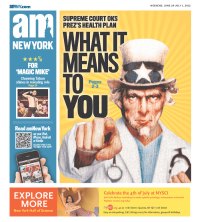
Times Herald-Record vs. am New York
Today is one of those days when you can look across the country and ask again, “What is the purpose of a newspaper’s front page?” On the most basic level, it’s for the biggest news of the day. On a practical level, though, the front-page treatment of the Supreme Court decision on the Affordable Care Act offers a stark example of different approaches to handling the big news of the day, and at this level the front page is either for what happened yesterday or it’s for what the big event is going to mean down the road.

If you look over today’s front pages at the Newseum (note that the pages change automatically, so after Friday June 29 you’ll see different pages than I’m referring to), it’s clear that most editors took the former approach. A sample of the headlines on this theme:

Court upholds health care law
Court upholds health mandate
OBAMACARE UPHELD
HEALTH LAW STILL STANDS
Health care law stands
COURT UPHOLDS OBAMACARE
OBAMACARE LIVES
Health Law Survives
Obama’s health care law upheld
Court: Health care law passes muster
Top court upholds law
Landmark victory for health care law
Health reform survives
Health-care law upheld
UPHELD
STILL STANDING
IT’S THE LAW
THE LAW STANDS
Upheld 5-4

But this court decision did not come out Thursday night. It was shortly after 10 a.m. when it became the top item of discussion on every TV and radio news network and it exploded across the Internet. The kinds of people who buy newspapers do not live in caves. By the time the morning paper showed up, they already knew the law had been found constitutional, and they likely had heard tons of reaction and explanation.

Given all that, what purpose does the front page with headlines like those above hold? Perhaps it becomes a keepsake for them, something to file away in a box to pass on to the grandkids.

But if one of the purposes of the front page is to entice people to read, I don’t think the headlines trumpeting what the reader already knows do that. Especially for single-copy sales, the above headlines are not going to draw the occasional reader – the people who care about news but may not subscribe.

Scattered among the day’s pages you can find a notable minority with headlines that spun the news forward to answer the question, “What does this mean for me?” especially in the context of what your particular state now has to do – even papers that took the “yesterday’s news” approach generally answered this question in story or Q&A form, but if there was a headline addressing it, it was small – and a few that focused on analysis, such as the surprise role of Chief Justice John Roberts casting the decisive vote. Those would seem to be much more promising territory for finding things that the typical person would still want more information about.

We’ve been saying for years now that newspapers are competing for attention in an environment when people are saturated with breaking news, yet at times like this it seems we struggle not to fall back on old habits. Agree or disagree?

A post at Poynter.org has a compilation of some of the day’s more notable front pages if you are late in looking for them.

7/9/12 UPDATE: Sam Kirkland, a Dow Jones News Fund copy desk intern for the Tampa Bay Times, makes a similar point in a July 6 post at Poynter.org, saying that most of the headlines on the health care ruling may serve the role of scrapbook material but they didn’t make him want to read:

“… the louder a headline shouts, the less likely I am to read the story, because a story commanding a 120-point headline likely commanded my attention yesterday, when it was fresh.”

Read Full Post »

Somehow I had missed the perfectly respectable, safe-for-work New York magazine story in 2009 about the porn industry’s Internet-driven woes and, allegedly, what the news industry could learn from them. Much thanks to JimRomenesko.com for helping me find it, because how often do people in mainstream journalism get a chance to learn about porn and be able to say with a straight face that it’s work-related research?

The quick summary: While porn initially benefitted from the Internet, over time the improving technology, bandwidth and cameras have meant that free or extremely cheap amateur video is blowing up the revenue stream.

And although the 2009 article indicates that what I guess you’d call porn industry officials felt they had some ideas for dealing with the downturn, a new article in The Atlantic indicates the problem continues unabated:

“What holds for journalism in this case holds for sex. In both cases, the competition is so broad that customers are likely to go elsewhere rather than pay. There are, obviously, exceptions in the case of newspapers — the Wall Street Journal has a profitable paywall, and the New York Times appears to be having some early success with its own.”

While I think there’s a certain amount of fun in the porn/journalism comparison, it’s a fundamentally flawed comparison. You will never find 12-year-old boys huddling in one friend’s room with the door closed to pass around a copy of the New York Times that one of them snuck from under his father’s mattress. Sex is a biological pursuit of primitive urges. Seeking out writing and information is an intellectual pursuit (partisan froth aside). Journalism may have a better chance of finding a niche of people willing to embrace paying for worthwhile presentation of worthwhile information. In other words, as The Atlantic’s article put it, I think people do have slightly higher standards for their news than for their porn. Slightly.

Read Full Post »


I hesitate a little to dive into attempting an answer to the question from Steve Buttry and Mandy Jenkins, “How should a news curation team work?” As the comments on many of Steve’s posts the past couple of years make clear, use of terms such as “curation” invites debates that often boil down to semantics and people talking past each other, even agreeing at times on general practices but disagreeing at the edges like alien cultures trying for but not quite achieving mutual understanding. But I’ll wade in anyway.

The idea of news curation has always seemed to me just the continuing evolution of what has long been standard operating procedure. In the 1990s at the Winston-Salem (N.C.) Journal during the summer, when a hurricane approached we usually had staff at the coast, and unless the storm was hitting point-blank where our staff was, the state editor (me) would blend staff reports with elements of several other wire stories, adding attribution where needed. As technology advanced and we all had access via the Internet to more news sources, we could blend in elements from more places. For instance, during the 2004 Democratic and Republican conventions, in addition to editing stories from Media General’s Washington reporters I supplied a one-column at-a-glance collection of highlights, a mix of my own reporting (whatever eye-catching protests were going on around the convention site), a detail or two lifted from advance copies of the night’s big speeches, and elements from wire services and the National Journal.

Technology now, though, opens a vastly wider world, including live conversations. Limiting your news gathering to a few wire services or mainstream news sources may be easier, but it leaves out a huge amount of perspective. All of this information of course is available for people to find on their own, but isn’t it a logical extension of the role of a journalist to help people sort through it? It’s the role of a journalist to say, “I can help you make sense of all this and point you to the best places for more.” Automatic tools can only do so much – Tweetdeck, Twitter search, Google alerts and the like can bring you a river of information, but it can be a torrent, or a swirling jumble. Human intervention to sort it, done right, is valuable.

That said, when I get to the specific questions Steve and Mandy ask – “How should we …?” – I find myself reminded of and answering instead a different question, one I saw recently on Twitter (I thought it was raised by Stijn Debrouwere, but at the moment I can’t find it – if someone out there has curated it already, please point me to it), which essentially was this: Why after years of people talking about all these ideas for remaking news is it taking so long for anyone to do much with them? As much as anything, I think it’s just the daily crush – you run around like crazy trying to keep up with everything that you already have to do, and you want to try these new things people are talking about … but you look up and suddenly you have already been at your desk nine hours or more. “Maybe this weekend,” you think. Of all the newsrooms I have visited over the past 11 years, there were only a few where suggestions for new things to try online met with resistance to the idea itself; usually it was more a matter of “where will the time come from?” There are exceptions – where the boss makes it a priority to try new things, which means being willing to drop some of the old, new things get done.

Most of the time, you learn things that are truly new by doing them, and something else then occurs to you, so you try it, and on and on, not because someone showed or told you what you should do – if there were a great mass of people out there who knew all about doing this thing, it wouldn’t be new, would it? So assuming you are among the vast majority of journalists or soon-to-be-journalists who have no actual experience curating the news on the fly, and you have no concrete answers to the “How” questions, doesn’t mean you shouldn’t try. I believe that at some point, good curation will be a key ingredient of any successful news organization. So go ahead, answer them.

Read Full Post »


I will take issue with the poynter.org headline The one chart that should scare the hell out of print media, for two reasons. First, it’s actually two charts, the second of which is above, from a presentation by KPCB’s Mary Meeker. The two illustrate what appears not to be a blip but a trend in the money end of the news business. The one above extrapolates the advertising revenue.

You may question whether it is reasonable to extrapolate a trend from the greatest economic collapse since the Depression. I would argue yes both because it started before the economic collapse and because of the second chart, comparing where advertising revenue is spent and where consumers spend their time:

Note on the far left: People spend 7 percent of their time with print media, but print gets 25 percent of the advertising revenue. Note on the far right: People spend a combined 36 percent of their time with Internet and mobile media, but those get just 23 percent of the ad revenue. Even if print will be perceived as a better buy (not a bet I would make), at some point those numbers seem likely to come closer to equalizing.


First conclusion: The ad revenue decline of recent years seems likely to continue.

This leads to a point made by Ken Doctor at the Nieman Journalism Lab: Money coming to news organizations from readers (paid circulation/online access) is growing as a percentage of revenue. Partly this is because of declining ad revenue — if you’re total revenue is $100, then $20 is a small percentage, but if your revenue drops to $50 then $20 is pretty big – but it’s also from the growth of various kinds of paywalls. I remain convinced that an all-or-nothing paywall closes a newspaper off from the possibility of luring new customers, but the trend toward metered paywalls seems able to draw in both avid readers and those who wouldn’t pay even for the bigger headlines of the day.

What the combination seems to lead us toward, as Doctor indicates, is a model where many news organizations will be asking for subscriptions more on the basis that NPR stations ask for memberships — not because they have something every day that you want know, but because you want free access because they regularly do. Advertising, in this scenario, becomes an increasingly less important revenue source; readers drive the revenue.

One fear I have read often in the past is that a news model driven by what is popular would gravitate toward the lurid and celebrity gossip, but I don’t think the above situation would do that. The kind of readers drawn by that kind of news would not be the ones who pay for regular access. Those readers would want at least the occasional substantial bit of civic journalism or in-depth news. You might make a living (a la TMZ) if you are at the top level of celebrity gossip, but at the local level that won’t cut it.

But what also seems likely is that the new level of revenue may not support seven-days-a-week newspapers in many markets, as Clay Shirky argued will eventually be the case even with the Washington Post. If that becomes the common model, then would mere daily scarcity of news drive enough people to buy online subscriptions to get news from “newspapers”? After all, in many markets there are TV and radio stations, which already send out news for free, and in many cases there may be small sites such as Homicide Watch (cited by Shirky) that focus on certain high-interest news areas more thoroughly. What then would spur people to pay for access to the mainstream non-TV news site?

Aggregation is part of the equation — if a news organization shows that no matter the source, it will round up all the news in the community, it could gain a loyal local following. But that seems not enough, to me. If less frequency is key, I wonder whether a higher quality of writing in the reduced number of publication days will be a major factor. If that’s the case, then the frequent publishers’ first instinct of holding down news salaries when budgets constrict could be counterproductive.

The keystone of my evidence, besides any manager’s common sense, is from a story by NPR’s “Morning Edition” in early May about new research measuring human performance in groups, which found that a minority of any group typically will account for a majority of the group’s performance. In other words, a few stars get more done at better quality than a larger group of more typical people. That runs counter to my experience of what managers at all levels do in the face of budget pressures, which is to replace departing staffers with someone who costs a lot less and is deemed “good enough.” “Good enough” hires, if you extend the logic of this study, actually cost more in the long run because they are not just a little but a great deal less capable.

There’s a tantalizing hint of this thinking in the memo from Jim Amoss to the Times-Picayune newsroom about changes in New Orleans from the paper’s reduction in days of print:

“Concerning pay in the new companies, I want to dispel some rumors: There could be some salary adjustments, depending on changes in job descriptions. But most people will make what they make today, if not more.”

I will repeat the relevant part: “most people will make what they make today, if not more.” In a world where the competition for eyeballs is not just local, the need for writers who can catch a reader’s attention is heightened, and it would make sense that if you find you have someone who can both produce the daily bits of news needed to keep a news site relevant while also producing stories worthwhile to the remaining partial-week readership, you would pay that person better than someone who could do only one of the two functions.

For that reason, I would reach back all the way to the early 2000s for a piece of advice I heard an executive repeatedly give (mostly in vain) to publishers: You get what you pay for. If you cut the size of your staff but increase the pay of the remaining people, so that your payroll overall is the same, you might be able to attract and retain the people you need. It is guaranteed that if you cut the staff size and hold the line on the pay – or, worse, cut it – you will never have the people you need, and who would want to pay to read your sorry rag at that point?

6/12/12 UPDATE: I’m gaining some hope about the above from an INMA article about the Star-Tribune boosting reader revenue closer to 50 percent:

“We’re asking users to pay more of the freight. But for that strategy to work, we knew we needed to focus on high-quality customers who see value in our products and have low churn. And to get those high-quality customers, we’ve focused on three areas: our core print audience, pricing/retention, and accessibility.”

If you’re going to focus on high-quality customers, you have to have high-quality staff to provide the value needed to hold onto those customers:

“The content we provide isn’t available anywhere else. This is local reporting — business, local sports, city council meetings. You are doing that, and you are relevant. Differentiate yourself from your competitors. Once you do that, you’re going to get people and you’re going to get them to pay.”

But it’s beyond content to a smart strategy on pricing and marketing. Those are not my areas of expertise, but the article’s points sound good to this journalist.

Read Full Post »

Gail Tabor at Lockbourne Air Force Base
My mother told me not to go into journalism. She made herself crystal clear. I remember when I told her I thought I wanted to study journalism in college. She fixed me with the kind of look teenagers usually get for breaking the news they are gay, and she said something like, “You don’t want to do that. You’ll never have any money.” She was a divorced mother of two boys, working for the Arizona Republic, so she knew her subject matter well.

She started her career at the Columbus (Ohio) Citizen-Journal, where in 1961 her job as society editor took her to cover an “Officers’ Wives” luncheon at Lockbourne Air Force Base, and during her visit she was given a tour of the restricted area where all the planes were kept, and she got the idea to ask for a ride in one of the planes — a supersonic F-101B. Her account of her exchange with Lt. Don Fullerton, the assistant information officer at the base, sums up her life:

Gail Tabor in flight helmet“Ha,” said Fullerton, “you’d faint on takeoff.”

That did it. I just had to get that flight.

She got the flight, becoming the first woman to fly in an F-101 and the fifth woman to break the sound barrier. The experience so exhilarated her that she kept damn near everything about it — from her typed draft, covered with edit marks, to copies of the three first-person stories she wrote about the experience (bearing the two-column logo, featuring fancy cursive-style type, of “Women’s Features”) — in a folder the rest of her life.

She interrupted her career to raise two boys. One had the sense to go into sales and other business-oriented pursuits. The other liked to write and felt the same sort of exhilaration that led to that folder of yellowing paper, so when she said, “You don’t want to do that,” he thought, “Yes I do.” He has second thoughts nowadays, but when it comes down to it, he still hasn’t been able to follow her advice.

Read Full Post »

Stijn Debrouwere helps explain “the mess the news industry is in,” going over tangible examples of how the way people — primarily young people, but not just them — have changed the way they look for information and where they look. It’s a post solidly in the mainstream of examinations of industry disruption, which continue to be useful for helping traditional journalists look past their immediate source of distress: layoffs/buyouts and budget cuts (the latest example, from AdAge about a situation at the Washington Post). Those problems are just symptoms resulting from what Stijn calls the “death by nibbles.” He also does address the issue of what journalists should be doing, including stressing storytelling and personality; “joining the revolution” by considering alternate ways of distributing information, ways that you would not call journalism; become less boring (seriously, that is a huge issue); and “Do stuff that does still matter.”

5/8/12 UPDATE: It’s interesting to compare the above with what the CEO of the Deseret News Publishing Co. — which is seeing circulation gains — says are big ideas changing the media industry. One of the two he cited for content can, I think, wind up getting dismissed:

“Differentiate your content: Invest where you can be ‘the best in the world.’”

Don’t let “best in the world” send you off a cliff, particularly if you run a small newsroom. No one is saying a 20,000-circulation paper or small website needs to compete with the New York Times — or even the Deseret News. But what exactly is it your audience expects you to be best at? Probably not the food page. Town council coverage? Local youth sports? Much more likely. Put your efforts where they can make a difference.

Read Full Post »

Niagara Falls
This morning brought me a good composite illustration of the evolving media landscape, at least a snapshot of it, that is so challenging for traditional news organizations to adapt to.

On Facebook, a journalist friend vented about local sites’ aggregation practices, which several times a day summarize and link to news her staff has reported: “It’s my reporters doing all the hard work! Am I looking at this wrong?” It’s a type of heartburn, but keep it in perspective: It has been going on since the first time a radio talker read the news on the air.

Nieman Journalism Lab reports on how NPR is trying a new strategy for rolling out new shows, aiming to simplify the process and lower the cost while also making use of social media. My first thought was it just shows that NPR, perhaps because it relies on grants and donations rather than advertising, has been somewhat insulated from the economic issues confronting print and commercial broadcast news organizations because it has been several years since I became used to hearing the idea of “fail fast, fail cheap.” But my second thought was that it illustrates one problem for traditional media: We don’t like to do anything just one time. I don’t mean stories, I mean columns, features, shows, sections, segments. We’re used to the idea of stand-alone news and features, but anything that we would do more than once, but not at least weekly and not for the foreseeable future, is a giant barrier. Any traditional news source is tremendously structured and formatted. The idea of predictability is roundly accepted as a plus, that people want to know what they are getting before they even try. Try telling a newspaper editor (not to pick on newspapers; this is just an example) that certain stories should run in larger type. At best, he’ll convene a committee to discuss it for a few weeks, and if they tend to agree they’ll run off test copies on the press and discuss it some more. So in that sense, even though many organizations have been preaching “fail fast, fail cheap,” almost no one really practices it. “Fail fast, fail cheap” means you go ahead and do it, and if it clear quickly that it isn’t working, you stop.

Finally, John Robinson explains what I would call the cognitive dissonance in a Pew study of news habits, which reported that “31 percent of people ages 18-24 get no news on an average day, and 22 percent of 30-34-year-olds get none either.” The nut of John’s argument:

“The 18-24 year-old age group is the ‘if-the-news-is-that-important-it-will-find-me’ generation. Those folks are on Facebook. They get news every time they log on. Their friends tell them the news in their worlds. (And for you not on Facebook, don’t think that they talk about what they had for breakfast.) This generation doesn’t immediately call it news the way we old-timers do, but when they watch, say, the president slow jammin’ the news, it is news. When they see the ‘Trending Articles’ foisted upon them by Facebook, that’s news. (Well, some of them are.)

“But if you ask them where they get news, the answer is Google and Yahoo and Jon Stewart and Huffington Post. It’s rarely actual, traditional, mainstream news organizations. The news may originate there, but they don’t identify those as the sources. And that’s one of the problems with using the generic term ‘news’ in a survey.”

And that right there is the larger issue: Not just young people but almost everyone now picks up news everywhere throughout the day. It used to be far more structured; the morning paper (or, before that, the afternoon paper), the evening TV news and whatever people talked about during the day that was passed on by word of mouth or that was big enough to warrant a news break on TV or radio in the middle of the day. It’s all atomized now, or it’s increasingly so.

A further illustration: Although I started my day with the morning paper, all of the above was stimulated by things I found online — starting with Facebook.

Read Full Post »

« Newer Posts - Older Posts »