Feeds:
Posts
Comments

Posts Tagged ‘not work’

The fashion world seeks my input


I no longer get press releases about medical research in Scotland, but I still get some from far-flung places where I have trouble believing anyone even knows where Lenoir is.

On Friday one came from a fashion designer in Leicester, England. I’m sure your first thought is that this designer clearly recognizes that whatever the upper crust in New York, London and Milan might say, fashion isn’t fashion until the Lenoir News-Topic says so. I’ve heard it many times.

She wanted me — or presumably anyone anywhere in the world on the massive list of email addresses swept up by computers maintained by whatever public relations hacks she is paying — to interview her about “athleisure.”

I’ll give her this: She increased my word power.

Without the context of the press release, I might have thought “athleisure” was the sound of a complicated sneeze. Or it could be a term for a type of seizure common among athletes.

Instead, athleisure is defined in this press release riddled with punctuation errors as “modern comfortable sport’s inspired” clothing. In other words, leisure clothing that is vaguely athletic-looking. In the case of this press release, that would be leggings.

Leggings came to be in the news recently because United Airlines refused to let two girls who were traveling on a free ticket board the plane because they were wearing leggings rather than pants.

The English fashion designer argues that leggings ought to be allowed not only on planes but in a great many places: “As more people are becoming interested in healthy living, it is increasingly acceptable for dress codes to be relaxed in order to facilitate popular on-the-go lifestyles.”

My mother used to talk about how people once dressed up to travel because going on a plane was a big deal. Now, as Norm in the old TV show “Cheers” might say, it’s just another darn reason to put your pants on.

It’s not just air travel, though, it’s everywhere. Go to your local courthouse and see what some people wear when they have to plead their case before a judge.

There are places you shouldn’t arrive looking as though you either just rolled out of bed or are about to mow the lawn.

But I digress.

Curious about what athleisure — or, another term this designer used, “sports luxe” — looks like, I went to the designer’s website, www.okayla.co.uk. There on the home page it was: a young woman in a gray hoodie, her face pale, her heavily painted eyes closed, her head tilted slightly, her dark-purple lips parted, her shoulders slouched, hands hanging limp. She looked like a corpse in rigor mortis having been stood upright.

I wouldn’t want her on a plane either, but mainly because I’d be afraid she’d try to eat my brain.

Read Full Post »

Let’s be honest: No one wants a camera and a hose shoved up his rear end.

And the very idea is why so many people are resistant to getting a colonoscopy, a procedure in which a doctor snakes a tube up inside you to see what business you have going on down there. Or up there, I guess.

The idea gave me the willies.

Turns out I was just being stubborn, ignorant and childish. If you’re worried about it too, don’t be. Here’s why.

When I was 49, the doctor brought up the topic as a suggestion.

No, I don’t think I will, I said.

When I was 50, he brought it up again.

Eh, I said.

Then last fall I had some sudden, severe abdominal pain. Frighteningly severe.

The pain passed, but the doctor now had allies in my wife and every relative. I lost the ability to choose. The colonoscopy was on the calendar.

I had to reschedule once. I hoped I would again.

No luck.

Last Monday, I went to the pharmacy to pick up the prescription liquid you have to drink to clean your system out, which means exactly what you think it does. The pharmacist talked to me about the process and what to do and said the box had not just instructions but IKEA-like picture instructions.

Then, as I was about to leave, she said, “I hope everything comes out OK.”

Of all the pharmacists in the world, I get Lenoir’s answer to Henny Youngman.

I chuckled.

As I walked away, she said, “Have fun.”

You stop eating solid food about two days before your procedure. My instructions said that I could have breakfast and lunch, but after that, for the rest of the day and the entire next day, I could have only certain liquids. The most satisfying of these was broth.

Broth.

Just broth.

Surprisingly, though, broth is pretty tasty as long as you don’t get the low-sodium kind. You can keep your stomach full and stave off hunger pangs, and it tastes really, really good.

But even if you feel “full,” you won’t feel full. A belly full of broth, water, 7-Up and Gatorade feels like someone stole your stomach and replaced it with a water balloon.

So by the evening before your procedure, when you are supposed to take the medicine, you may feel like a monk. You have been abstaining. You yearn for the sensual pleasure of pizza, or cheese, or a little meat. You look forward to the procedure just to get the whole thing over with and begin feasting.

Now, the medicine: It will clean you out. That sounds scary. You may remember bouts of stomach flu when you got cleaned out. You will dread it.

Don’t.

Remember: You have ingested nothing but liquids for well over 24 hours. And there are no cramps like there are with stomach flu.

In the morning you will take more of the medicine. But that morning is the hardest because after drinking the medicine and prescribed amount of water, you are now done. No water, no broth, no nothing, for hours. Time has rarely moved as slowly for me as those five hours did.

By the time I reached the gastroenterologist’s office, I was eager for the procedure, because once it was done I would be free. I could eat. I had fantasies of food like prisoners and castaways have. I plotted my lunch with the eagerness of a first date.

And my eagerness was rewarded: It was the shortest wait in a doctor’s office I have had in my entire life.

They took me back to a room. There were a few questions. Did I have any questions? I did not. I put all my clothes in a bag and put on the ties-in-the-back gown. Shortly, a nurse came back, told me to lie down and covered me with a warm blanket.

When another nurse came back and took me to the room for the procedure, the anesthetist greeted me and in a cheery voice explained what she was going to do. One thing she said was the name of the drug propofol, which triggered a memory, and when she paused I said, “Wasn’t it propofol that killed Michael Jackson?

“Yes,” she said, “yes it was.”

From across the room a nurse called out, “It was a cardiologist who killed Michael Jackson!”

And on it went.

I was just joking, but the anesthetist explained aaaaaaaaaaaalll about propofol and what went wrong with Michael and his doctor.

Then they had me turn on my side, get in a certain place.

And then I was asleep. It’s almost as if I was snatched by aliens, because my memory in that room simply ends at that moment I situated myself on the bed.

The next thing I knew, I woke in a different room with Mrs. Lucas.

I was groggy. It felt a bit like being drunk, except it wore off faster.

So much worry over so little. And on the bright side, I learned a lot about propofol. The whole thing was a win-win.

Read Full Post »


If only Martin Luther King Jr. had started knocking heads, imagine how much he would have accomplished.

Or so seems to be much of the most joyous thinking on the left in the wake of a viral video that grew out of the anti-Trump protests on Jan. 20.

If you haven’t seen it, a television reporter was interviewing Richard Spencer — who leads a white supremacist movement and not long ago headlined a conference in Washington, D.C., that ended with those assembled giving a classic Nazi “heil” salute — when suddenly someone lunged at Spencer from his right and sucker-punched him. Spencer staggered away, the attacker leaped back, and that was the end of it.

That brief video has been circulated widely and applauded. That celebration drew quick, but not wide, condemnation by others on both the left and right, which led to a question that also spread in a viral manner on social media:

Is it OK to punch a Nazi?

Those asking the question often answered it themselves in the affirmative, and most others chiming in said essentially that the answer was not only yes but hell yes. Those answers sometimes came attached to images of comic book hero Captain America punching Hitler and movie hero Indiana Jones punching a Nazi.

Those giving a contrary answer included Newsweek, which called ethicists and posed the question to them, prompting one, Randy Cohen, to say, “Do you really not know if it’s ethical to punch someone even though they have odious politics? I mean, should we call your mother?”

Apparently we should call a lot of people’s mothers. One response on Twitter that captured the overall sentiment was this:

//platform.twitter.com/widgets.js

One hopes that if the person who wrote that thought about it a while she would change her position because she could easily find herself targeted by it.

The problem with saying you support punching Nazis is you take a step onto a slippery slope. For one thing, Spencer does not belong to the Nazi party; the label of “Nazi” has been applied to him because of his racist views. If it’s OK to punch someone who isn’t a Nazi but is labeled one, who then who determines what other people get that label applied to them?

Regardless of whether he is a Nazi, Spencer has not engaged in violence or called for it. Who gets to decide that a person’s views go far beyond what the person states and actually encompass “eradication” of other people? Spencer’s views are extreme, but who gets to decide that someone’s views are extreme enough to warrant violence? President Obama was labeled a socialist and extremist with long-term goals described at times in nearly apocolyptic terms. Would it be OK to punch Obama?

If it’s OK to punch someone, what is the goal of the punch? To change his mind? To punish him? If punching him won’t change his mind or change his ways, then what? Should he be killed?

The American Civil Liberties Union is perceived by many on the right as the ultimate liberal special interest group, but many liberals can’t stand that the ACLU will stand up for the free-speech rights of right-wing extremists. On both the left and the right, people want free speech for their own views, but any views that stray too far from theirs make them uneasy. Unfortunately, the First Amendment doesn’t come with an asterisk and a footnote saying that it doesn’t apply to racists, thugs and religious extremists.

The First Amendment right of free speech has repeatedly and frequently been interpreted by the courts as guaranteeing anyone the right to espouse even horrific views — not the right to do horrific things, but to talk about them. In other words, the First Amendment provides everyone a forum to talk about anything they wish.

Of course, the First Amendment says only that the government may not censor your views. It does not say that there will not be non-government repercussions for your views. What you say may, for instance, anger others enough that they want to punch you. That’s where we are now.

The irony is that this all happened less than a week after the day America remembers King, who met hate with love and met violence with peace and in 1964 won the Nobel Peace Prize. Spencer is a milk-fed, baby-faced poser compared to the people King had to deal with, vicious thugs with a badge such as Eugene “Bull” Connor, whose Birmingham police turned high-pressure fire hoses and attack dogs on African Americans. We don’t have to imagine how King would have answered the question “Is it OK to punch a Nazi?” because he answered it over and over. Just a few of those answers:

“The ultimate weakness of violence is that it is a descending spiral, begetting the very thing it seeks to destroy. Instead of diminishing evil, it multiplies it.”

“Man was born into barbarism when killing his fellow man was a normal condition of existence. He became endowed with a conscience. And he has now reached the day when violence toward another human being must become as abhorrent as eating another’s flesh.”

“Hate multiplies hate, violence multiplies violence, and toughness multiplies toughness in a descending spiral of destruction.”

Is it OK to punch someone hateful? I understand the impulse, but the answer is not just no, but hell no.

Read Full Post »

Bill Tate, Meadowood Studios
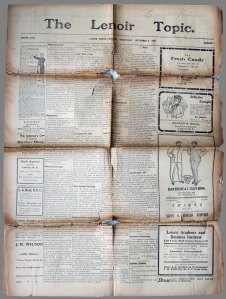
One thing that hasn’t changed about newspapers is errors.

On page 1 of the yellowed, disintegrating copy of the Lenoir Topic, one of the weekly predecessors of the News-Topic, donated by Frank Coffey and recently posted by Bill Tate on the “Lenoir and Caldwell County History” Facebook page, the paper’s publication date appears as Wednesday, Sept. 6, 1905, but on page 2 it says Wednesday, Aug. 30, 1905.

That makes me feel better about the much more recent times the News-Topic has carried the wrong day, date or both.

Nothing on the 1905 front page was about anything in Caldwell County, except for all of the local ads – and there were quite a few. One was a long, text ad for Dr. Pierce’s Golden Medical Discovery, a pill that supposedly protected you against germs:

“It increases the vital power, cleanses the system of clogging impurities, enriches the blood, puts the stomach and organs of digestion and nutrition in working condition, so that the germ finds no weak or tainted spot in which to break. … Only one or two a day will regulate and cleanse and invigorate a bad Stomach, torpid Liver, or sluggish Bowels.”

That was just one of many ads throughout the paper for “cures” of various kinds — Cuticura Soap, Ointment and Pills, Mozley’s Lemon Elixir (another for “torpid liver”), Dyspepsia by Crab Orchard Water, Cascarets Candy Cathartic (for your bowels, “They work while you sleep”), Sloan’s Liniment and Lydia E. Pinkham’s Vegetable Compound, which pitched itself exclusively to women starting with the headline, “STOP, WOMAN!” by promising confidential advice by mail for health issues that women would not feel comfortable confiding to male doctors.

Page 2 carried in the top left corner, under the incorrect date, two important items of information: The subscription cost, $1 a year, and the Topic’s telephone number, 7.

Page 2 also carried a mix of news, from the newly brokered peace treaty between Russia and Japan to the General Assembly passing a measure for a referendum in Lenoir on issuing $50,000 in bonds for streets, sidewalks, sewer lines or an electrical plant.

Page 3 started with the heading “OF LOCAL INTEREST” and listed people who had been somewhere or were on their way:

“Mrs. Harper Beall has returned from a visit to Chester S.C.

“R.A. Ramseur has been on a trip to Mitchell.

“Carroll Rapp went to Guilford College Monday.

“Mr. J. Gorden Ballew returned to Baltimore last Friday.”

Farther down, under the headline “Sweet Girl Freshmen and Sophomores,” was a short paragraph:

“It was a sad pity that the Topic reporter belongs to the wrong ‘sect’ (to quote Samantha) Tuesday, for a whole carload of sweetness came up billed for Davenport College. It sho’ was a pretty sight to behold all those nice girls at once. The conductor did look so happy.”

Under that was the news of “the terrible damage done by a mad dog” rampaging from Lenoir to Patterson, which was finally shot and killed under the Crisp, Cilly & Co. store in Patterson.

With that news was a message issued by Lenoir Mayor Edgar Allan Poe saying that, because no one knew how many other dogs the rabid dog may have bitten, “Notice is hereby given that all dogs found on the streets of Lenoir unmuzzled for the next thirty days will be shot.”

Ads on this page included one for a 12-room house in Granite Falls for sale for $1,000. “We stake our reputation on the assertion that you cannot duplicate this for $1,500.00,” it said.

Page 4 brought more details on the Russia-Japan peace, including a separate wire story on world leaders crediting Teddy Roosevelt with brokering the peace, and a mix of state, national and international wire items, then some “filler” (the news term for short things used to fill inconvenient space), including some one-liners that also appeared as filler on at least one other page in the same issue, such as, “A woman’s idea of heaven is five parts wavy hair and five parts a good figure,” and, “A useful thing about automobiles is all the new cuss words you learn when they won’t work.”

The news largely petered out by page 5, where there was a long piece of fiction, “Luke Hammond, the Miser,” by Prof. William Henry Peck, and other apparently syndicated specialty feature items. One, “With the Funny Fellows,” relayed short, presumably fictitious anecdotes supplied by papers around the country:

“I was surprised,” said the Rev. Mr. Goodman, sternly, “to see you playing golf last Sabbath. I should think you’d do better –”

“Oh!” replied Hardcase, “I usually do. I was in wretched form last Sunday.” – Philadelphia Press.

Page 6 was what we would call today the religion page, with lots of inspirational messages and lines (“You have no right to elect His work if you reject His word”). Curiously, it also was the home to the highest number of “cure” ads.

Page 7 was the business page, aside from a wide column down the left side made up of pseudo-scientific pronouncements, including the headline “Mars Inhabited,” with a short description of what scientists know of Mars “By Camille Flammarion, the Famous Astronomer,” which described a wondrously pleasant climate on Mars and concluded, “We know the globe of Mars perfectly; in fact, far better than the earth.”

Bill said there were a total of only seven pages to be posted. I have yet to figure out how that can be so, since every piece of paper I’ve ever seen from any era has both a front and a back, making two pages. Perhaps that’s one thing about newspapers that has changed.

Read Full Post »

When I first heard that the local Republican Party was moving into the vacant space beside Lenoir City Hall that most recently was the Azteca Burrito restaurant, I had a thought.

Perhaps, I thought, the party is one-upping the Democrats, who lately have been having a number of functions at Howard Brewing. When Azteca Burrito was open, its owners built a bar, so that space not only has a bar to match Howard Brewing, it also has a kitchen!

“The Democrats have beer, but so do we, AND we have freshly grilled burgers,” the Republicans could say.

The Democrats then would have to raise the ante and find a way to provide food too, and probably more variety if they wanted to lure people their way.

Of course, I know the idea is too good to be true.

The result would be another bidding war between the parties, except the kind they have now tends to benefit lobbyists and interest groups, while the average person feels forgotten and left behind, as any supporter of Donald Trump or Bernie Sanders will tell you.

But how much better would it be if, instead of pandering by promising trade wars or free college or other trinkets costing trillions, what the parties provided was an ever-expanding list of options on an actual menu?

“Don’t go to McDonald’s, now GOP stands for ‘Get your Order Personalized,’ and we won’t make you use a kiosk either!”

The Republican menu might lean toward the bold, the barbecue, the Tex-Mex and brisket and steak.

The Democratic menu might have more ethnic specialties, more unusual spices and ingredients, plus vegetarian options.

Or maybe I’m exposing my preconceptions.

What they would cook would be less important than the fact that everyone would have no doubt at all what the effect of their political preference was. It wouldn’t be an idea or policy, it would be on a plate, right there in front of them.

“Make America Great Again”? Make America’s steaks, man. We’ll decide whether they’re great, and if they’re not we’ll go across the street and see if the other guys do better “Fighting For Us” against indigestion.

I’d work in the slogans of the Libertarian and Green Party candidates too if I could find them.

I think this is the ideal recipe, so to speak, for political reform.

Read Full Post »

King for a day, or so

As I stooped over this morning, a plastic scoop in my hand and the smell of cat pee and poop rising from the litter box in front of me, I couldn’t help but think this was no job for a king.

And that’s what they called me less than 48 hours earlier – king.

I blame them.

They gave me what folks call “the big head.”

When I decided a few weeks ago to enter the Caldwell County Rotary Club’s annual chili cookoff, it had been partly just to get it out of my system. I love to cook chili, I have been to over a dozen chili cookoffs, from small affairs like Rotary’s to large events alongside Richmond International Raceway sponsored by a rock station and drawing professional teams, and I always thought my own chili stacked up relatively well. Finally, when Rotary sent out its cookoff entry deadline, I kept reading over it and I decided I should put up or shut up. Enter that chili or stop humble-bragging about it.

There were 12 other entries in Rotary’s cookoff. I stuck around to watch the judging, and as the minutes ticked by I noticed that the four judges seemed to keep going back for second or third tastes from other pots, but not mine.

After Rotary member Charles Beck told the judges that their time was up and they needed to make a decision, the judges huddled at their table, whispered a few things, and I prepared for disappointment. Then they straightened and looked at Beck, and I heard them say the number assigned to my pot of chili. My chili won.

It felt pretty good. It was my first-ever cookoff, and I joked that I ought to never enter another cookoff so I could say I am undefeated in chili cookoffs.

But people kept coming up to shake my hand. “What’s your secret?” I was asked under a spotlight on the stage. Praise washed over me, and it felt good.

My wife texted me, “Congratulations, chili king!”

Later that day at work, my boss came out of her office as I walked past. She smiled broadly and said, “There’s the chili king!”

“Chili king.” It had a nice ring. I called my mom and left a message starting, “This is the Chili King of Caldwell County …”

I got home before my wife. When I saw her walking to the door, I opened it to greet her and bellowed, “BOW BEFORE YOUR CHILI KING!”

She gave a half-smile, stepped slightly to one side and said, “’kay.” But she didn’t bow. Not even a curtsy.

It all went downhill from there, and at the bottom of the hill was a litter box.

Mel Brooks was right, “It’s good to be the king.” But it doesn’t last long.

Read Full Post »

It’s good that the presidential election is nearly 11 months away because I am just lost when it comes to the current political discussions.

I’m especially confused why lately so much of the argument and debate among candidates and on TV talk shows involves fabric choices.

It blew up especially last week after Donald Trump proposed banning from the U.S. all muslin.

I’ve tried to take part in the political discussions locally, but every time I say something like, “Does Donald Trump not realize what that would do to the domestic cotton industry?” all I get is blank stares.

But it’s true. The South was built on agricultural fortunes, and among the largest was cotton. King Cotton, they called it. Generations of Americans have had livelihoods either growing cotton or working in factories that weaved it into fabric or turned the fabric into garments.

Even here in North Carolina, cotton used to be the most lucrative crop after tobacco. Maybe it still is. As I said, I have not kept up on the latest in cotton-related news and developments. Surely if I had I would know why muslin arouses such anger today.

Just the other day my wife and I were out around town and heard a heated conversation between two men who were just ripping into the topic of muslin. As is my habit, I butted in and asked what the big deal was, hoping one of them could explain it to me. They kept saying things about “what happened in San Bernadino.”

Finally, I said, “Yes, but how do you know what the attackers were wearing was made of cotton?”

There were those blank stares again, and for the umpteenth time I was told, “You’re such a complete idiot,” and I’ll be honest, even after nearly 17 years of marriage it still stings when she says that.

Clearly, I needed to do my own research, so like all Americans desperate for reliable information and proper context I turned to the Internet.

I confirmed that muslin is indeed a lightweight cotton fabric in a plain weave. I felt better, at least, that I had a baseline of knowledge.

But no matter where I turned, I could find no information explaining why people are so angry about it.

I also am unsure why banning muslin would help. Wouldn’t people who are prone to violence at least be in a slightly better mood, and therefore less likely to act out, wearing cotton than if they were forced to wear polyester? Or, God forbid, wool? A scratchy collar makes me short-tempered.

And if you’re going to ban muslin, can you stop at just the new fabric and imports? Is the government going to go around to every house and apartment to search all your drawers and closets to find the muslin that’s already here in our country? Isn’t our government big and intrusive enough already without creating a fabric police?

I’m just going to have to keep trying to research this on my own. I’ve given up having any kind of discussion about it even at home. I can’t take the verbal abuse.

Read Full Post »

(The city of Lenoir played host last weekend to the first Smoking in the Foothills Barbecue Competition and Festival, a new event sanctioned by the Kansas City Barbecue Society. Though the event overall has been called a success, it was not without its rookie-year hiccups, including a lack of lighting the first night at the tent were people were supposed to sample chicken wings and vote for their favorite.)

The first sign that I had erred was the screaming.

It seems that in the impenetrable darkness of the People’s Choice tent on the first night of the Smoking in the Foothills festival, instead of a chicken wing I had grabbed a woman’s wrist.

I apologized as quickly as I could remove my teeth from her tender flesh, which though lacking sufficient smoke lingered nicely on the palate. As I said, it was extremely dark, so I do not know whom I bit or whether she actually looked like a chicken — though by her springy texture and light flavor I would guess she was in her mid-20s and would pair nicely with a medium-bodied white wine — but I could hear quite clearly, which is how I know my apology was not only not accepted but profanely rejected, despite my also complimenting her repeatedly on her seasoning.

After that, before I bit into any piece of chicken that night I first asked it how it was enjoying the food. If it didn’t answer, I assumed it was a chicken leg.

On the third try, though, I learned I had to listen more closely because that lady was still chewing and unable to answer except by a grunt, and by then my teeth had nearly plunged in. Unable to see how close she was to being a snack, she simply pulled back her arm and moved on.

Casting my hands about in the dark, I listened for the sound of foil, which I knew from the brief glimpse before darkness fell was a sign of where the containers of wings were. “One, please,” I said, and pushed one of my 10 tickets toward a slightly darker area that looked like it perhaps was one of the trick-or-treat pumpkins that had been placed around the table for gathering tickets, though once it turned out to be a man’s rear end. If it were not so dark, that would not have ended well, but he couldn’t find me any better than I could find chicken legs in that abyss.

I stumbled away from him as quickly as I could, bouncing against others who were similarly blind in the dark like we were one large, slow-motion mosh pit, and when I got what I felt was a safe distance, I lifted my last chicken leg and bit into it. It crunched dryly, and my mouth filled with the taste of carbon.

Emerging into light cast by a street lamp, I blinked like a mole and looked in my hand, finding what more closely resembled a charcoal briquette than a piece of meat. Perhaps it had been chicken at one time.

A couple nearby came blinking toward the light, and the man looked down into his hand and said, “No, it’s the white ticket we’re supposed to use for voting, not a red ticket for another chicken wing.”

“Who should we vote for?” the woman said.

The man looked back into the dark mass of people, where amid the bumps and stumbling I could still hear the slurps of eating.

“I don’t know,” he said. “I don’t even know how to find the table.”

A woman walked up, rubbing her wrist. She stood directly under the light and held her wrist close to her face.

“I was right!” she yelled, turning to face a large figure in the dark as I started to edge away toward the end of the street. “These are teeth marks!”

Read Full Post »

The Confederate memorial in downtown Lenoir was erected in May 1910, though originally it sat at the middle of the intersection of Main Street and West Avenue. It was paid for by the local chapter of the United Daughters of the Confederacy.

The Confederate memorial in downtown Lenoir was erected in May 1910, though originally it sat at the middle of the intersection of Main Street and West Avenue. It was paid for by the local chapter of the United Daughters of the Confederacy.


No version of the Confederate flag appears on the memorial obelisk that the United Daughters of the Confederacy paid to have erected at downtown Lenoir’s main intersection in May 1910.

In many ways, it resembles a cemetery memorial. Near the top on the side facing the intersection are the letters CSA, for Confederate States of America, above a bas relief image of a cloth or shroud similar to depictions on many decorative headstones from the early 20th century, and on either side are 1861 and 1865, the short-lived nation’s year of birth and year of death.

On the front of the base of the memorial are four lines from Theodore O’Hara’s poem “Bivouac of the Dead,” written in 1847 in honor of troops killed in the U.S. war with Mexico. Excerpts from that poem appear on both Union and Confederate memorials around the nation, as well as throughout Arlington National Cemetery. Below that it says, “In honor of the men who wore gray.”

On the back of the base are listed the regiments where men from Caldwell County served, and below that is “Erected by the Vance Chapter of the United Daughters of the Confederacy of Caldwell County, N.C. May 1910” — the only place where either “Confederate” or “Confederacy” appears.

The obelisk is surrounded by a flat lawn and hidden a bit from West Avenue by a row of crape myrtles. It is a small but park-like setting, quiet, spartan and even a bit funereal.

Directly south of that is Lenoir’s veterans memorial, which has a larger obelisk, an eternal flame within a sleek, dark pyramid, the flags of all services with a plaque at the base of each, the state and U.S. flags, and pavers with individual names. This corner commands attention, calling passersby to investigate, and yet it is solumn and stately. It is not just a memorial marker but a tribute to all the generations who helped ensure the survival of the United States of America.

In that context, the Confederate memorial had always struck me as a historical marker honoring the dead, not celebrating the cause for which they fought. Whatever their beliefs or motivation, these were fathers, sons, brothers and neighbors. They had lives before the battlefield, and that is the loss the monument mourns.

But on Thursday a woman from somewhere else in North Carolina — if she gave her name and where she was, it was so briefly that it never registered, but her accent was familiar — asking whether the News-Topic had reported on whether Lenoir was going to dismantle and remove what she called the city’s “Confederate statue.”

I surmised she meant that, in light of the sharp shift of attitudes against the Confederate battle flag since the shootings in Charleston, S.C., all things Confederate may be considered suspect.

I told her that no one to my knowledge had raised the suggestion, that since there is no depiction of the “Stars and Bars” on the monument I had not made a connection with the flag controversy, and that the monument is an obelisk, not a statue depicting a soldier defiantly standing ready to fight, as exist in many other towns.

She then insisted that, yes, the memorial actually is connected to the controversy “because the word Confederate is on it,” and she launched into an explanation of why, “soon,” people “all across the state” will be calling for such monuments to be removed. Without pausing, she said she would put my response “in my paper. Thank you,” and hung up.

I reeled a bit. “My paper”? Had I just been the victim of drive-by advocacy journalism? Or was she writing a research paper on the topic as an academic exercise?

I suppose I’ll find out sooner or later, Google help me.

Read Full Post »

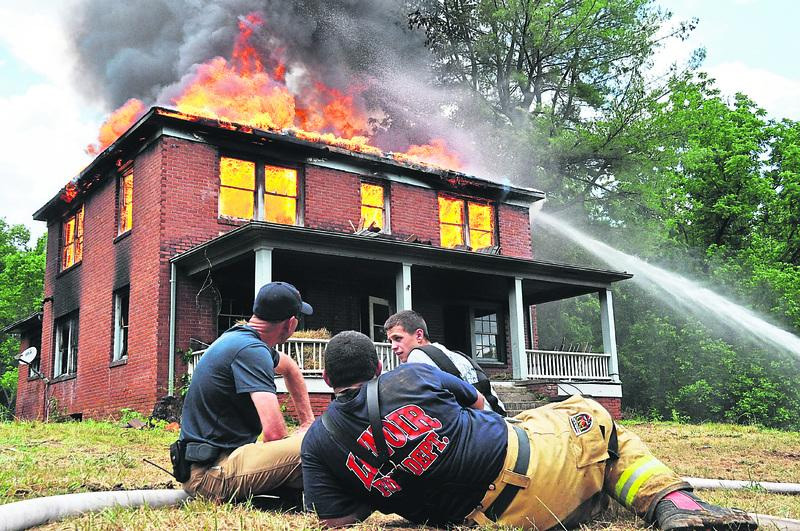
Smith fire
I didn’t stay to watch the old Smith family home at the corner of Abington Road and Harper Avenue burn all the way to the ground.

But it was long enough to be reminded that in fire, beauty and horror are siblings.

This is especially true when an old house like this one burns.

The house was a two-story, brick American Foursquare, an architectural style that was especially popular in the early 20th century. It was built in the 1930s. A firefighter on the scene said some of the interior walls and ceilings were beadboard.

I would imagine the interior woodwork remained a sight to behold right up to when the flames touched it, even if the view out the front door had changed significantly since the 1930s, where what must have once been a quiet, two-lane road now is a four-lane bypass.

As someone put it in an understated comment on a Facebook photo of the fire, the house looked like it had a lot of potential.

Unfortunately, the lot it sits on also has a lot of potential, but not for single-family uses such as that house.

The developers who bought it plan to begin work in July to build a three-story apartment complex intended for low-income adults over 55. The house’s footprint is where one end of the L-shaped building will be, said Roy Helm, president of Wesley Community Development, a Methodist-based company that is planning the apartments together with the Western North Carolina Housing Partnership.

The developers let firefighters use the house for training. Battalion Chief Ken Nelson of the Lenoir Fire Department said that nine teams of firefighters from Lenoir, Hudson and Gamewell each had at least two training sessions finding and fighting fires that were set inside the house.

A two-story house like this one is especially valuable for training, Nelson said, because fire behaves differently where there are stairs, which act like a chimney. Fire creates its own weather, and the structure of a house influences it. Firefighters need to be able to see how fire behaves in different kinds of structures.

By about noon, after setting and putting out 20 or more fires, the firefighters set the final one, then stepped back.

Eventually I had to step back too. I kept stepping back. Once the flames burned through the roof, the heat emanating into the front yard — even against the wind — felt uncomfortably hot. I wondered whether the lenses in my glasses would warp, even as I watched Chief Ken Briscoe, wearing glasses, stand his ground 20 feet closer than I was.

Many of the firefighters, standing in T-shirts, remained closer to the fire than I could bear. Perhaps that’s good training too. They get used to the heat.

One things I’m not sure I could get used to is the burning. That beautiful wood, those stately bricks, that old, crinkled glass. The things that would evoke memories and provoke stories from those who grew up here.

In a couple of months, even the ashes will be gone.

Read Full Post »

« Newer Posts - Older Posts »