Feeds:
Posts
Comments

Posts Tagged ‘not work’

sc01029f78
Journalists tend to be pack rats. Past News-Topic editors were no exception, so I gradually have been emptying drawers in my office the past six weeks.

Last weekend, emptying the top drawer of a file cabinet otherwise full of news clips dating from at least 1994, I found a pile of old photos. Not just old but historic, some from the early part of the 20th century. One or two look like tintypes.

They clearly seem not to be part of the News-Topic’s old files, sitting here in a cabinet filled with material from the 1980s and ‘90s. They look like people sent them in. A couple have notes saying as much, such as a photo of the 1923-24 Hudson High School basketball team, in an envelope postmarked Sept. 17, 1991. The handwritten note inside identifying the players in the photo says at the end, “Please return the picture to me at the above address. Thank you.”

Why the picture wasn’t returned I can only guess. I wanted to return it, but it has been over 21 years, and the handwriting in the letter looked old and frail already. I found no listing for the same person in the phone book, so I turned to the Internet’s phone-book-and-Encyclopedia-Brittanica, Google. There I think I found a match – unfortunately, an obituary: Mary Eunice Query of Hudson. The name on the letter was Eunice Query. One of the basketball players was Hunter Query, and in the 2007 obituary I found online, it mentions a brother named Hunter. It also lists no survivors. But what a life of accomplishment it alludes to. Degrees from Duke University and the University of North Carolina at Chapel Hill, a master’s from Appalachian State, where she also taught for 25 years; awards from UNC and from the state; multiple scholarships established either by her or in her honor.

Another photo in the drawer has a stamp on the back saying it is a Kodacolor Print made in January 1960. On the front, three young women recline in hospital beds lined up in a living room, each of them in a contraption enclosing their torsos that had what looks like a vacuum hose attached in the middle of it. The contraptions were the respirators polio victims used, a more advanced, mobile version of the iron lung that more people likely have heard of. A handwritten note on the back identifies the photo as “Alta & other polio patients in ‘We Made Our Peace With Polio’ by Luther Robinson.” The book pops up at the top of a search of Google – one site lists it as scarce, but Barnes & Noble says you can buy it in paperback.

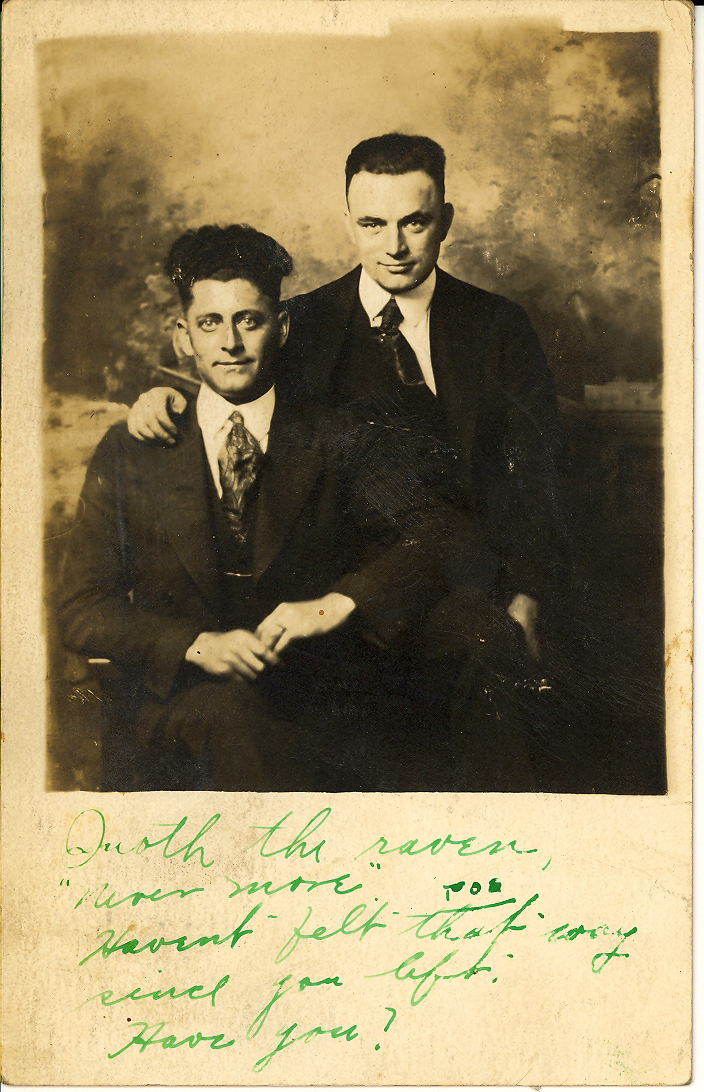
Nothing at all comes up online in a search for L.R. York of Harmony, who received a post card in July 1920 that came to be in the same News-Topic drawer as the photos above. The sender signed his name only as Doug. The return address was in Oakland, Calif. The front of the card shows two men, perhaps 25-30 years old, in nice suits, seated and facing the camera, one seated just behind the other, his hand casually resting on the other’s shoulder. A style of the time was to put personal photos on post cards, so who knows, perhaps the men are L.R. and Doug. Under the photo is written in green ink: “Quoth the raven, ‘never more.’ Haven’t felt that way since you left. Have you?”

Each of the photos in that drawer is but a moment, like a window on the side of a time machine. You catch a glimpse and the machine moves on to another moment. You see a detail but no context. You see a person but learn no story. You can tell how things looked, but not how they were. Even where something is written to provide some additional information, there is no place to turn for what was left out.

What does the quote on the post card mean, that code between friends? The faces gaze out from the photo, smiling softly, not revealing the answer. Was it a greeting on a cloudy-minded morning, an abbreviated way of saying, “We should never do that again, but wasn’t it a fun time”? Was it an exclamation on rejoining a friend: Eat, drink and be merry, for tomorrow … ? Google doesn’t know the answer to that one. That story stayed with the men, gone like footprints left in sand dunes.

Quoth the raven, “Nevermore.”

Read Full Post »

John Robinson, former editor of the News & Record in Greensboro, N.C., has perfectly captured, in a very short blog post, the mythic spirit of the print newsroom. I get a little misty.

Read Full Post »

FamousQuotesAbout.com/on/Newspaper
Newspaper columnists always seem to remember that Thomas Jefferson once said, “Were it left to me to decide whether we should have a government without newspapers, or newspapers without a government, I should not hesitate a moment to prefer the latter.” What I’ve never seen in a newspaper are any of the other things Jefferson said about newspapers, such as:

“Advertisements … contain the only truths to be relied on in a newspaper.”

“I do not take a single newspaper, nor read one a month, and I feel myself infinitely the happier for it.”

“The man who reads nothing at all is better educated than the man who reads nothing but newspapers.”

“Nothing can now be believed which is seen in a newspaper. Truth itself becomes suspicious by being put into that polluted vehicle.”

I’m not the first to notice this (among others, in 2009 Jay Rosen discussed the first quote and why it is the only one you ever see in newspapers), but it came to mind today in a copyediting context (yet another columnist citing the first quote).

6/28/12 UPDATE: Googling that last quote led me to the full text of the letter that it came from, which included a suggestion for a better way to section a newspaper:

“Perhaps an editor might begin a reformation in some such way as this. Divide his paper into four chapters, heading the first, Truths; the second, Probabilities; the third, Possibilities; the fourth, Lies. The first chapter would be very short, as it would contain little more than authentic papers and information from such sources as the editor would be willing to risk his own reputation for their truth. The second would contain what, from a mature consideration of all circumstances, his judgment should conclude to be probably true. This, however, should rather contain too little than too much. The third and fourth should be professedly for those readers who would rather have lies for their money than the blank paper they would occupy.”

Read Full Post »

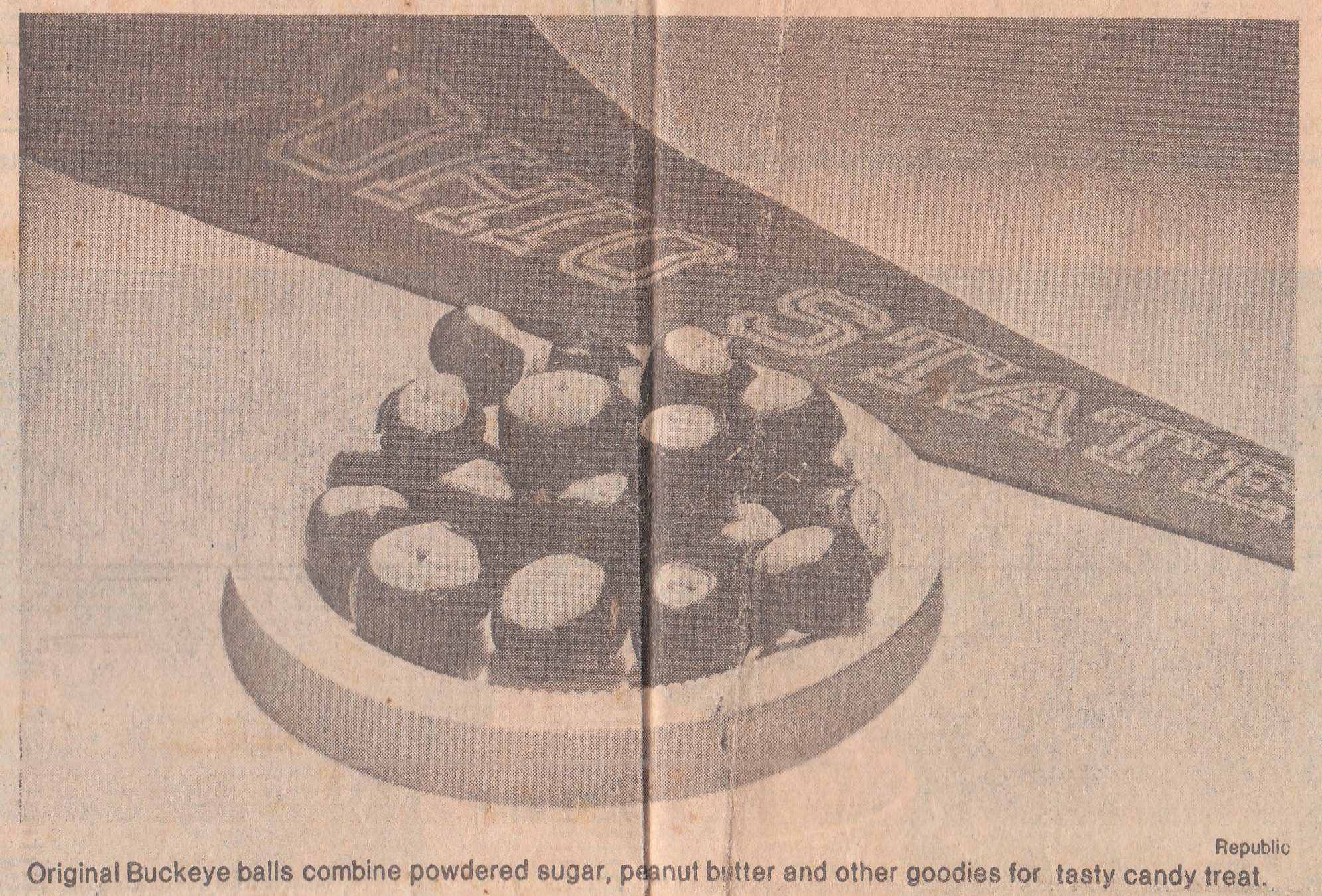
Photo from Dec. 28, 1983, Arizona Republic
Going through a huge box of my mother’s papers — personal, financial and some of her newspaper clips — I came across a column she wrote for the Arizona Republic in 1983 (under the byline Gail Tabor) claiming to be the person who first made a dessert that became popular among Ohio State fans, Buckeye Balls, which are peanut-butter balls dipped in chocolate with just a circle uncovered on the top so they look like buckeyes. A portion of the clipping was torn, and the whole was too long to fit on my flatbed scanner, so I’m typing in the text below. Note that if you try making them, the key in the recipe is “6 or more tablespoons peanut butter.” You start with six, then keep adding peanut butter to taste.

The story about where popular Buckeye balls started

By Gail Tabor

It is time, Ohio State fans, that you hear the truth about your favorite nibbling food, the Buckeye Ball. (A buckeye, for those who need explanation, looks somewhat like a bloated chestnut.)

Had it not been for me, you wouldn’t have the pleasure of gorging on those mouth-watering, chocolate-covered peanut-butter-flavored morsels.

As is so often the case concerning valuable and coveted items, the recipe was claimed by a conniving woman from Oklahoma. She fibbed and said it was hers, after promising me under oath that she would never let that recipe out of her hands.

Not only was she a dishonest purloiner, she instilled in me a deep distrust of everybody from Oklahoma, a fault that stays with me to this day.

It all began in 1964, when I married a rabid Ohio State fan whose idea of fun was sitting in the rain and snow watching football games. Oh, those memories: Finding the seat, wrapping sock-and-boot-clad feet and legs first in plastic, then in a layer of newspapers, and covering everything with a blanket. You didn’t dare move an inch the rest of the game for fear of disturbing the wrappings and letting in the cold air.

Christmas of that year, my mother brought us some candy. I begged her for the recipe, which she gladly shared. (Actually, you can say the whole thing started with her.)

When I was ready to start dipping the small balls of batter, I didn’t get the first one completely covered. I held it up on the toothpick and said to then-husband, “Hey, it looks like a buckeye.”

Thus it was christened. We gave batches away to friends, and they fell in love.

“How did you make them?” they would beg. But I was selfish and refused to part with the information. I wanted to be the only one in the world to have the secret of making candy-lovers happy.

In 1971, ex-husband graduated and we moved from Ohio. Before we left, the wife of a man who studied with my ex, and who was also graduating, pestered me unmercifully for the recipe.

“We’re returning to Oklahoma, and you will still be the only one over here who knows how to make them,” she said. “I promise I’ll never tell anyone else. Please, please, please,” she said, or words to that effect. All I know is, she pledged a solemn oath to keep her mouth shut. I relented.

Dates get fuzzy in retrospect, but it may have been 1973 when a visit was paid to Columbus during football season. Imagine my surprise when I picked up the local newspaper and saw an entire story on Buckeye balls. How in the world, I wondered, did somebody else figure them out?

“Well,” said a friend, “I didn’t want to tell you because I knew you would be furious. But (woman from Oklahoma) sent in the recipe to the Ohio State alumni magazine, under her name.”

Furious is an understatement. I felt deceived, betrayed, put-upon, hornswoggled and just plain enraged. I swore revenge.

That took a back seat. In the confusion during and following divorce and resettlement, the Buckeye ball donnybrook was forgotten until it came time to make them again. Every year, for 17 years, it has been a tradition in my house to make the delicacy on the day of the Ohio State-Michigan game. And every year my children, who have heard the story a million times, would help me make the balls and dip them in chocolate, saying all the while, “Mom, why in the world did you trust that woman?”

This year, I was in Columbus on assignment when the big day rolled around. While Ohio State and Michigan were slugging it out, I met a friend for lunch and moaned over another tradition going down the drain. This year, the making of Buckeye balls would be delayed a week.

“Gail,” my friend said, “this whole state has gone crazy over Buckeye balls. I think you ought to find some way to tell the real story about how they got started.”

So now you know. Today, and forevermore, as the scrumptious little bites disappear into eager mouths, bow to the West and give thanks to the woman in Phoenix (certainly not Oklahoma) who made such joy possible.

As one matures, one grows out of childish shortcomings like selfishness, so here is my original Buckeye ball recipe, for all the world to see. (But if you think I’m going to share my secret recipe for West Virginia Christmas pickles, you’re crazy.)

Buckeye Balls

4 pounds powdered sugar
1 pound butter
6 or more tablespoons peanut butter
2 teaspoons vanilla
12 ounces chocolate chips
1 block canning wax

Combine first four ingredients, adding a bit of milk if necessary. Rolls into small balls. Melt chocolate chips and canning wax in top of double boiler. Make sure chocolate and wax are mixed well so wax doesn’t rise to the top. With toothpick, dip the balls into the chocolate, but do not cover completely. Chill in refrigerator. After chocolate is hardened, store candy in plastic bags in freezer.

Read Full Post »

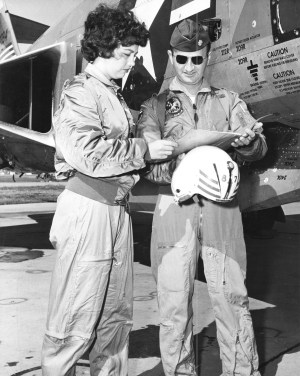
Gail Tabor at Lockbourne Air Force Base
My mother told me not to go into journalism. She made herself crystal clear. I remember when I told her I thought I wanted to study journalism in college. She fixed me with the kind of look teenagers usually get for breaking the news they are gay, and she said something like, “You don’t want to do that. You’ll never have any money.” She was a divorced mother of two boys, working for the Arizona Republic, so she knew her subject matter well.

She started her career at the Columbus (Ohio) Citizen-Journal, where in 1961 her job as society editor took her to cover an “Officers’ Wives” luncheon at Lockbourne Air Force Base, and during her visit she was given a tour of the restricted area where all the planes were kept, and she got the idea to ask for a ride in one of the planes — a supersonic F-101B. Her account of her exchange with Lt. Don Fullerton, the assistant information officer at the base, sums up her life:

Gail Tabor in flight helmet“Ha,” said Fullerton, “you’d faint on takeoff.”
That did it. I just had to get that flight.

She got the flight, becoming the first woman to fly in an F-101 and the fifth woman to break the sound barrier. The experience so exhilarated her that she kept damn near everything about it — from her typed draft, covered with edit marks, to copies of the three first-person stories she wrote about the experience (bearing the two-column logo, featuring fancy cursive-style type, of “Women’s Features”) — in a folder the rest of her life.

She interrupted her career to raise two boys. One had the sense to go into sales and other business-oriented pursuits. The other liked to write and felt the same sort of exhilaration that led to that folder of yellowing paper, so when she said, “You don’t want to do that,” he thought, “Yes I do.” He has second thoughts nowadays, but when it comes down to it, he still hasn’t been able to follow her advice.

Read Full Post »

A damp Wednesday morning in a small town in central North Carolina. People file into a tiny church (seating capacity approximately 100) for the funeral of a beloved writer, who was my wife’s mentor. A woman sits down next to me. She is a writer, from Winston-Salem. We three chat. She asks whether I, like my wife, am a writer too. I explain I am in the netherworld between newspapers and online: “I have a website where all of my company’s newspapers, which include the Winston-Salem Journal, can share th–”

“You ruined a perfectly good newspaper,” she says.

“I didn’t do it.”

“Ruined.”

Somehow I don’t feel up to a discourse on the economics of advertising, especially classified advertising, and how little any newspaper reader actually pays of the total cost of producing a newspaper.

Read Full Post »


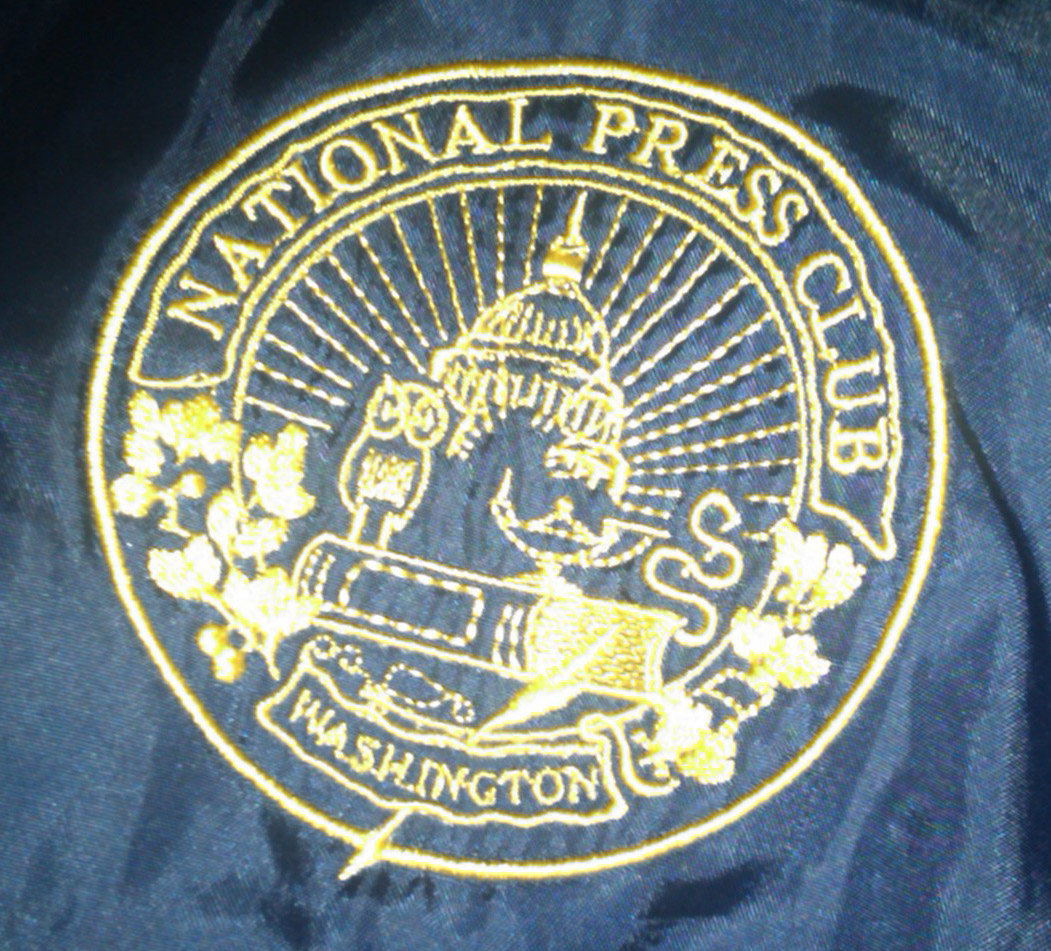
Around 10 years ago, when I found myself traveling several times a year to Washington, D.C., I joined the National Press Club, and I bought my dad a blue windbreaker with the club’s logo on it. After my dad died two years ago, the windbreaker came back to me, and in this mild winter I find myself wearing it a lot. Today at the convenience store near my office, the young man at the cash register looked at the gold logo and asked, “What’s the National Press Club?” I explained it is a group based in Washington for reporters and editors. “Oh, so you’re a reporter!” he said, almost beaming, and I could imagine him going home after work and saying, “You’ll never guess who came into the store today! A journalist! I see them on TV all the time, but I never thought I’d meet one.”

“No,” I said, “I’m an editor.”

His face fell. “Oh.”

Read Full Post »

pelican
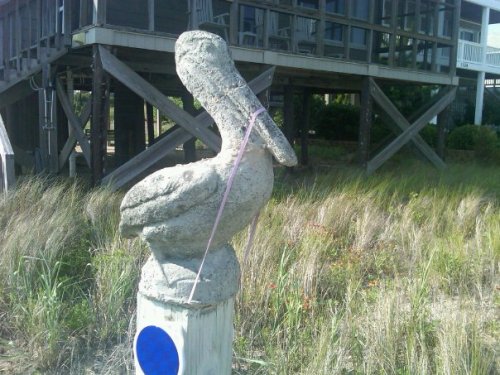
Sorry for the long lag without a post. I spent several days getting sunburned and repairing a pelican’s broken neck (above, with a rubber band providing tension to keep the head from tilting back until the cement in the neck set). After several days of sanity (and admiring how the Star-News in Wilmington, N.C., seems to have managed to hold on to a larger news hole than many papers its size in this economy), I am back to work. … Not that I have anything to say today.

Read Full Post »

« Newer Posts