Feeds:
Posts
Comments

Posts Tagged ‘reporting’

I don’t use this blog to comment on issues outside of the news media, so I won’t address the gun-control debate that has come after the elementary-school shootings in Connecticut, but one that I first came across last night through a conservative friend’s post on Facebook, and which I subsequently came across multiple times, is the argument that the media should refrain from ever again using the name or photos of a mass killer because that would rob him of the infamy he craves.

(Among the places I have seen this are the website created by a mass-shooting victim’s family; Steve Buttry’s blog; and by David Brooks in a segment of NPR’s Dec. 14 “All Things Considered.”)

I’m sympathetic to the argument, but ultimately I think it would be futile, for three reasons.

First, the one thing that people on all sides of the gun debate would agree on is that the people who have carried out mass killings are deeply unhinged. Is the argument, then, that although they are unhinged, they will pause in their determination to kill, put down their guns and go home quietly once they realize they won’t get their name on the national news? Explain that to me. Even if a craving for infamy is part of their motivation, and I think that’s an open question, you’re assuming a crazed mind can draw the straight line from a national boycott on that publicity to the futility of seeking that publicity.

Second, how exactly is this boycott to be carried out? As anyone in any news organization can tell you, the news media are as organized and monolithic as a herd of cats. In my last job, I couldn’t even get the editors at four newspapers in the same company that had a congressional district in common to have just one reporter instead of four do the quarterly story on the district’s campaign finance reports. How you could convince even the majority of major national news organizations – let alone not just the broadcast and 24-hour cable networks and all of the nation’s largest papers but ALL. OF. THEM, down to the smallest of the hundreds of mainstream print, broadcast and online news outlets that are out there – is beyond me.

Which leads me to the third, decisive reason: A huge number of people don’t really want you to keep the killer’s name secret, no matter what they think right now. My conservative friend asked me my take on the media’s role in this and other news events, and my take on the media’s role is that people get the media they deserve, which is demonstrated by the media they choose. (For instance, if you want to live in a world where science is optional and math doesn’t matter, there are outlets for that.) What the media does at a time of tragedy is try to answer the questions that the typical person has; if we don’t answer them, we get calls and email asking why, and people will seek out media that answer those questions. In greatly simplified terms, the nature of a free market drives media to answer those questions in order to retain audience, which pleases advertisers. If even one news outlet uses the name, that organization will see a surge in its audience, and one by one others will wonder why they are withholding a name that is rapidly becoming common knowledge.

In the 1990s, the Winston-Salem (N.C.) Journal ran a story revisiting a decades-old killing in which a woman took her young children down to a creek and one by one drowned them. It was chilling and riveting. Among the calls that came in to the newsroom was one by a woman complaining that the whole story was so awful it never should have been printed. The veteran reporter who answered the phone asked the woman, “Ma’am, did you read the story?” She answered firmly, as if scolding him, “I read every single word of it.” He replied, “Then you must have really enjoyed the story.” She hung up on him – but he was right.

Read Full Post »


Since for most of the past 12 years, a large part of my job has been trying to help journalists – especially in small newsrooms – make sense of the changes and new tools sweeping the industry, I’m going to take a crack at interpreting the imposing study Post-Industrial Journalism: Adapting to the Present, from the Tow Center for Digital Journalism.

So, do you need to read it? If you work in either the content (news) or business end of a journalism organization, you should read it. But realistically, it’s huge, so there’s a chance either you’ll start and won’t get far, then later think of it but won’t go get your computer or tablet to do it, and if you print it out it will go into your stack of magazines and you won’t touch it until spring, when you’ll put it in the recycling bin. So let’s prioritize: Pressed for time, what do you need to read? The whole thing is a tough slog for one sitting, both for its length and its academic style, and there are pretty good summaries out there, notably from Jeff Sonderman at Poynter, Josh Benton at Nieman Journalism Lab and Matthew Ingram at GigaOm.

Start with those summaries and then seek out the parts that in the summaries sound most interesting. My take:

The Introduction: If you are one of the people who think the industry’s whole problem is putting information online without charging for it, you seriously need to read the introduction because you have an incomplete understanding of the business end, its history and what’s happening to it.

Part 1: If you are unsure what exactly is changing about the role of a journalist, this helps fill in the blanks, though to me it seems overly focused on what I would call large newsrooms (Chicago, Boston, San Francisco, Philadelphia, Denver, Seattle and New Orleans, for instance), not the size of newsrooms that predominate across the country. However, to the extent that these larger newsrooms have resources and an ability to experiment that small newsrooms do not, it is important to be aware of what they should or may be trying to do because changing technology may make it easier for you later.

Part 2: If you have a big-picture job – an executive, an academic, a journalism think-tanker, writer for CJR, AJR, Nieman Lab, etc. – this section gets into some useful philosophical space about institutional change. It’s also helpful if you are trying unsuccessfully to manage up in a company that is resisting change; you’ll understand better why you can’t get the urgency of your message conveyed higher up. It is not as much immediate help to the typical ground-level journalist except for further context about the changing face of the industry.

Part 3: This attempts to use some recent examples to flesh out the larger picture of how the emerging models of journalism may work. It builds on part 1, so if you still aren’t sure what the changes there mean for you, read this part.

Conclusion: This takes up where the introduction left off, going from how things have already changed to trying to extrapolate into the future. If you found the introduction useful, read this.

To me, the essential message for journalists can be summed up with these passages:

Even as the old monopolies vanish, there is an increase in the amount of journalistically useful work to be achieved through collaboration with amateurs, crowds and machines.

… Figuring out the most useful role a journalist can play in the new news ecosystem requires asking two related questions: What can new entrants in the news ecosystem now do better than journalists could do under the old model, and what roles can journalists themselves best play?

… For many newsworthy events, it’s increasingly more likely that the first available description will be produced by a connected citizen than by a professional journalist. For some kinds of events – natural disasters, mass murders – the transition is complete.

In that sense, as with so many of the changes in journalism, the erosion of the old way of doing things is accompanied by an increase in new opportunities and new needs for journalistically important work. The journalist has not been replaced but displaced, moved higher up the editorial chain from the production of initial observations to a role that emphasizes verification and interpretation, bringing sense to the streams of text, audio, photos and video produced by the public.

… The availability of resources like citizen photos doesn’t obviate the need for journalism or journalists, but it does change the job from being the source of the initial capture of an image or observation to being the person who can make relevant requests, and then filter and contextualize the results.

… People follow people, and therefore just by ‘being human’ journalists create a more powerful role for themselves. It is a device personality-driven television has long relied on, but only in a one-way medium. In a networked world, the ability to inform, entertain and respond to feedback intelligently is a journalistic skill.

In September of last year, I saw what I think is a perfect example of what the above describes, and it came from a small newsroom, the News & Messenger and insidenova.com in Prince William County, Va. After severe flooding in the region, people found themselves without a clearinghouse for information and discussion — but they gravitated to the newspaper’s Facebook page and were filling it with just such information. So, seeing that, online editor Kari Pugh created a flood information clearinghouse page on Facebook (it’s still there). In just a few hours it had garnered about 250 “likes,” and the community discussion on it became mostly self-sustaining.

Though the newspaper’s circulation is something around 10,000, on Facebook it has more than 26,000 likes. And its users have remained an active community. Key to the online community’s activity has been the involvement of the journalists. You can see it in the back-and-forth between them and people in the community.

How the news staff reacted to the flooding and the community’s desire to share information is something at least close to, though less sophisticated than, what Jeff Jarvis said this week he wishes he saw in the New York area in the wake of Sandy. It’s not a complex skillset, it just takes a shift in the way you see what the role of journalists is in this world of mobile devices that let every person report on what’s happening right then and there.

The Tow Center report is massive, and the future it paints may feel at times overwhelming. But you don’t have to build that future in one day, just as video games didn’t get from Pong to “World of Warcraft” overnight. (BTW, Happy 40th birthday, Pong.) What’s one step you can take today? Engaging your “readers” is an easy one, and, as it did with the News & Messenger, it may point you to the next step.

Read Full Post »

Last week I traveled to Danville, Va., for a part of the job that disappeared in recent years because of the economy (no travel budget means no travel), meeting one-on-one with reporters to critique their writing and talk about what they can do to become better writers. When I meet with a reporter who honestly wants advice and will discuss his or her writing, it recharges me, and it had been a long time since I was able to have any meetings like this, so I was overdue for a charge. When I started doing these in 2002, I took a kitchen sink approach, addressing everything from style and grammar to storytelling. It didn’t take long for me to realize that was not a good approach. Being nitpicky helped no one and swamped the more worthwhile parts of the discussion. Since then, what I focus on is more or less what Ernest Hemingway described in a portion of “Monologue to the Maestro: A High Seas Letter,” which he wrote in 1935 for Esquire. (I read it in “Byline: Ernest Hemingway,” a collection of Hemingway’s journalism.) “Monologue” recounts a conversation between Hemingway (Y.C., for “your correspondent”) and a young writer he called Maestro (Mice) during a fishing trip. The relevant portion:

Mice: How can a writer train himself?

Y.C.: Watch what happens today. If we get into a fish see exactly what it is that everyone does. If you get a kick out of it while he is jumping remember back until you see exactly what the action was that gave you the emotion. Whether it was the rising of the line from the water and the way it tightened like a fiddle string until drops started from it, or the way he smashed and threw water when he jumped. Remember what the noises were and what was said. Find what gave you the emotion; what the action was that gave you the excitement. Then write it down making it clear so the reader will see it too and have the same feeling that you had. That’s a five finger exercise.

Mice: All right.

Y.C.: Then get in somebody else’s head for a change. If I bawl you out try to figure what I’m thinking about as well as how you feel about it. If Carlos curses Juan think what both their sides of it are. Don’t just think who is right. As a man things are as they should or shouldn’t be. As a man you know who is right and who is wrong. You have to make decisions and enforce them. As a writer you should not judge. You should understand.

Mice: All right.

Y.C.: Listen now. When people talk listen completely. Don’t be thinking what you’re going to say. Most people never listen. Nor do they observe. You should be able to go into a room and when you come out know everything that you saw there and not only that. If that room gave you any feeling you should know exactly what it was that gave you that feeling. Try that for practice. When you’re in town stand outside the theatre and see how the people differ in the way they get out of taxis or motor cars. There are a thousand ways to practice. And always think of other people.

Read Full Post »

As a rookie reporter, I once had the idea of doing a first-person feature about learning to ride a horse, and I called around to a few places. Once place I called, I asked about scheduling a visit, and the person was kind of nonchalant, sort of “Yeah, just come out, we’ll work something out,” sounding not very interested. I called another place and they scheduled something firm. So I never followed up on the first place, wrote my story entirely based on the second — and after the story ran, the first place called my boss and complained about how they had set aside time, scheduled a trainer to wait for me, etc. etc. I was mortified, and it burned a hole in my psyche, and ever since then I have been absolutely mystified — and mortified — by many reporters’ continuing habit to treat public interaction as if it’s a video they can just hit pause and stop on without worrying about how the people on the other end feel or what they are thinking. Last night a reporter told me another reporter would call me today. Still waiting. I work in the business, so I’m like a battered spouse — I’ll forgive anything. But be warned, reporters, whether they read your newspaper regularly or watch your TV show, they think it’s important to have been contacted, and they anticipate the promised follow-up. If you fail to follow through and treat people with this kind of indifference, most people will just write you off, if they are that lenient, and your colleagues with you. You dig your own industry’s grave.

Read Full Post »

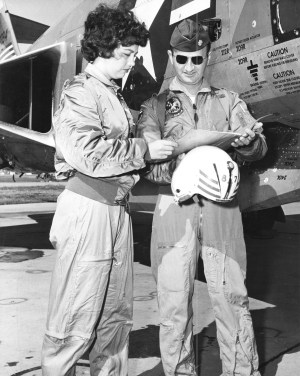
Gail Tabor at Lockbourne Air Force Base
My mother told me not to go into journalism. She made herself crystal clear. I remember when I told her I thought I wanted to study journalism in college. She fixed me with the kind of look teenagers usually get for breaking the news they are gay, and she said something like, “You don’t want to do that. You’ll never have any money.” She was a divorced mother of two boys, working for the Arizona Republic, so she knew her subject matter well.

She started her career at the Columbus (Ohio) Citizen-Journal, where in 1961 her job as society editor took her to cover an “Officers’ Wives” luncheon at Lockbourne Air Force Base, and during her visit she was given a tour of the restricted area where all the planes were kept, and she got the idea to ask for a ride in one of the planes — a supersonic F-101B. Her account of her exchange with Lt. Don Fullerton, the assistant information officer at the base, sums up her life:

Gail Tabor in flight helmet“Ha,” said Fullerton, “you’d faint on takeoff.”

That did it. I just had to get that flight.

She got the flight, becoming the first woman to fly in an F-101 and the fifth woman to break the sound barrier. The experience so exhilarated her that she kept damn near everything about it — from her typed draft, covered with edit marks, to copies of the three first-person stories she wrote about the experience (bearing the two-column logo, featuring fancy cursive-style type, of “Women’s Features”) — in a folder the rest of her life.

She interrupted her career to raise two boys. One had the sense to go into sales and other business-oriented pursuits. The other liked to write and felt the same sort of exhilaration that led to that folder of yellowing paper, so when she said, “You don’t want to do that,” he thought, “Yes I do.” He has second thoughts nowadays, but when it comes down to it, he still hasn’t been able to follow her advice.

Read Full Post »


Late in the documentary “Page One: Inside the New York Times” — the SPJ Virginia Pro chapter held a viewing Saturday night at the University of Richmond — Times reporter David Carr tells a room of journalists in Minnesota something like (the quote may not be exact because I’m going from memory): “Don’t think about all the people who are gone. Think about the fact that you are still here.” It’s partly encouragement, partly a warning not to succumb to survivor’s guilt. It can also be taken — whether or not Carr specifically meant it that way — as an instruction to newsroom leaders: If you spend all your time thinking about the beats your news organization used to cover and all the bureaus everyone used to have but doesn’t anymore, you’ll paralyze yourself. You can’t stretch your current resources to make up for what has been lost and will never return. You have to think about what you have and what you need to do to best achieve your newsroom’s goals. Change the entire beat structure if that’s what it takes to get people to stop thinking of how things used to be done.

Back in the mid-’90s when I was an assistant state editor (a job that no longer exists at that paper), there was a reporter we had who was covering a county by herself against daily competition from three other papers. She seemed overwhelmed and was turning in briefs that were a day behind the competition, and she was not getting many stories because she was always trying to catch up. I and another editor (in hindsight, it was overkill to have two of us do this) pulled her aside one day and told her she needed to choose her battles. She couldn’t, all by herself, outreport all of her competition, so she needed to set her own agenda, pick what she thought was important, and if she got beat on something, well, evaluate how important that is on a case-by-case basis. We made her cry, which was not the goal, but she changed her approach, found her footing and became the reporter we all believed she could be. The situation currently facing newsrooms is not very different: You can’t do everything you want to do, so choose your battles.

Read Full Post »


Most journalists seem to take it as a given that what is accurate and fair is true. But whether you agree apparently depends on what you mean by “true,” which became clear after several items in the news in the past month.

First came reports – such as this one from NPR – about “The Lifespan of a Fact,” a story drawn from the experience of John D’Agata, a writer, and Jim Fingal, who had been assigned to fact-check an essay by D’Agata. From NPR’s description:

“Ten years ago, D’Agata was in Las Vegas when a 16-year-old boy committed suicide by jumping off the Stratosphere Tower. D’Agata wrote an essay about the tragedy — but in the telling, he took a generous amount of artistic license.”

D’Agata fudged or fabricated details large and small, and distorted timelines and sequences of events. He defended his departures from accuracy by saying his version was “more dramatic” and that his essay was written in pursuit of a greater truth, an artistic truth.

Next came the horrifying (for journalists), full-show-length retraction by public radio’s “This American Life” for running a report by writer/performer Mike Daisey about Apple’s factories in China, which, similar to D’Agata’s essay, mixed and matched facts, locations, times and events without much regard to accuracy. Although clearly remorseful in the retraction episode, he remained stubbornly insistent that his error was only one of labeling, that ultimately he conveyed a larger truth that was important for people to feel connected to.

Neither of the above episodes would have caused a ripple of alarm if either had simply been labeled fiction. Much fiction is largely based is fact. You don’t have to watch very many movies or TV shows to understand that “based on a true story” has a wide variety of meanings, from “this is nearly entirely what really happened” to (more often) “there’s a nugget of reality here, but not a lot.”

Jeff Jarvis at BuzzMachine summed up what I feel about the two stories:

“You need not take a journalist’s oath to tell the truth. You need only be born to a mother such as mine, who told me and my sister often–very often–that ‘there’s nothing worse than a liar.’ It worked on us. My sister became a minister and I became a journalist.”

Then a third item entered the news, giving a twist to the idea of “truth vs. accuracy.” It turned out that the season-opening scene in AMC’s “Mad Men” last month, in which men in a New York advertising firm drop paper bags filled with water onto black civil rights protesters below, was drawn directly from the facts in a 1966 New York Times story – right down to one of the protesters, after coming up to the agency to find out who was dropping water bombs on them, saying, “And they call us savages.” That line of dialog, as it turned out, came in for harsh treatment from some TV critics. Said one, “When she said that, it just rings so false.”

How much truer can you get than reality? Must you fabricate to discover truth?

“Beauty is truth, truth beauty,” – that is all
Ye know on earth, and all ye need to know.

I supposed it’s appropriate that the meaning of those lines by John Keats “is disputed by everyone,” as englishhistory.net put it.

If only a journalist had been there to document what Keats intended.

Read Full Post »

I had two thoughts as I read, belatedly, Megan Garber’s piece from last month for Nieman Journalism Lab about the new political team at Buzzfeed and how they approach reporting. First: Wow, that really sounds like exactly the right model for the online world. Second: How the hell are they going to make money from that? Which of course is the eternal Underpants Gnomes issue of online news.

But then it occurred to me that the Buzzfeed strategy may be a key part of how more traditional news organizations might survive into the digital future. More on that in a minute. First, what Buzzfeed is doing, from Garber’s article:

“The idea is to continue the type of work he’s been doing at Politico — reported blogging — and to combine that content with the social elements of Buzzfeed. So: Reporting, amplified. Reporting, viral-ized. … [The political team] will be starting from the premise … that people are now mostly (and increasingly) getting their news from social sources like Twitter, Facebook, and aggregators. Journalism is increasingly part of the social web.

“… And within the social space, Smith points out, one of the things people most like to share is news that is actually, you know, new. … [P]eople are increasingly aware of themselves not just as consumers of content, but as curators of it. They increasingly appreciate the role they play as, if not breakers of news, then disseminators of it.”

Buzzfeed’s aim is to “build the first true social news organization … the definitive social news organization.”

An early return, from Philip Bump at Mediaite, is positive – the headline is “What Buzzfeed’s New Politics Team Is Doing Right.”

It helps, of course, not to have to worry about doing all that while still producing a traditional news product such as a newspaper or TV show. But what if you started from the premise of reporters doing as Buzzfeed envisions? From there, part of the role of an editor could be pulling items out of the stream to cobble them into what is needed for the traditional product. Of necessity, that might well look very different than a traditional news story – but as I often argue and Bump’s piece at Mediaite points out, the traditional news story isn’t always needed:

“The long news story is an artificial construct, one largely predicated on filling a certain amount of printed space. Articles often don’t need to be 400-500 words with compelling intros and robust context – they certainly don’t always need to be.”

The result could be an organization with the nimbleness to operate in the online environment and build the kind of audience engagement that keeps people coming back, both to the short updates you get in social media and whatever more you produce on your main site, in the paper or on the air.

That’s where the Gnomes come in.

This morning I was reading Clay Shirky’s thoughts about the “leaky paywall” or threshold model for news sites, which lets visitors see a set number of free articles before requiring a payment for any subsequent articles. Shirky is among those who have long been skeptical that an absolute paywall – requiring a payment for any and all viewing of content – would work for news sites, but he clearly sees merit in setting a threshold. But his main purpose in the post is examining how the threshold model might end up reshaping the content of news sites. This stems from the fact that a small minority of the online users are paying the freight, so keeping that audience engaged is key:

“Threshold charges subject the logic of the print bundle — a bit of everything for everybody, slathered with ads — to two new questions: What do our most committed users want? And what will turn our most frequent readers into committed users? Here are some things that won’t: More ads. More gossip. More syndicated copy. … When a paper abandons the standard paywall strategy, it gives up on selling news as a simple transaction. Instead, it must also appeal to its readers’ non-financial and non-transactional motivations: loyalty, gratitude, dedication to the mission, a sense of identification with the paper, an urge to preserve it as an institution rather than a business.”

In other words, most people do not – and will never – pay for content, but some will pay for some specific content, and much more importantly that small number of people will pay to ensure that the general type of content you produce is around when they need it, because they enjoy it or they think it makes their world a better place, or they just can’t imagine their world without you around.

That last part, at least, is something that traditional journalists can identify with.

Read Full Post »


If you work for a traditional newsroom, especially a newspaper, in all likelihood you are in a situation not that different than the Oakland A’s as depicted in “Moneyball.” You don’t have the money you feel you need to do the job the way you were brought up to believe it needs to be done, and that situation is never going to get better. The University of Southern California’s Center for the Digital Future even predicts the end of most printed newspapers in just a few years, owing not just to the economic factors hurting advertising but, more importantly, consumer habits shifting media use increasingly to digital platforms. I’m not so pessimistic myself, but I think it’s undeniable that technology is changing how people spend their time, and both reading and viewing are moving more and more to digital platforms.

News organizations face a stark choice. As expressed in “Moneyball” by Brad Pitt as the general manager of the A’s: “Adapt or die.”

That means going beyond seeing your website or social media channels as added tasks that take away from your real job. You have to think about news throughout the day in terms of people scanning for it on their phones, on their tablets, on their computers.

Steve Buttry of Digital First Media (aka Journal Register) has been posting a series on his blog this week detailing some of the practical changes of this approach, starting with how it would affect the ways a court reporter, photographer or sports reporter might do the job. (Dare I say this might be the first time anyone has written something suggesting a link in any way between Steve and Brad Pitt.)

Perhaps most important in Steve’s series is advice for editors leading a Digital First (or digital-first) newsroom. If the message doesn’t come from the top that digital-first is the new SOP, it won’t happen. If the message isn’t accompanied by evidence that those at the top are paying attention, it won’t happen.

Much of Steve’s advice echoes tips about coaching and leadership generally – there are sections on standards, listening, praise and collaboration.

One suggestion he makes that would be an important step for newroom leaders to drive the message because it would be a big change in newsroom habits:
“Focus your meetings on digital platforms. Ask what you’re covering live, who’s shooting video, what the social chatter is, what stories are getting good traffic. … Put tomorrow’s print Page One it its proper place: as an afterthought at the end of the meeting.”

Also good advice that newsroom leaders have to internalize:

“Don’t tell your staff they have to ‘do more with less’ unless you are providing tools for them to work more efficiently (in my career, a few things that have actually helped us do more with less are portable computers, spreadsheets, databases, cellphones and pagination). Usually, ‘do more with less’ is a management cliché that means we have failed to make tough decisions about priorities.

“As you focus more attention on digital platforms, you have to focus less on print. Consult with your staff and colleagues and make tough decisions about priorities. How are you going to change the newshole, design, editing process, content, staffing, etc. of the print product so you can focus more attention on digital.”

In other words, what are you really changing? You don’t have the staff you used to have, you never will again – “Newspaper companies have seen their advertising revenues drop by 58 percent from the third quarter of 2005 to the third quarter of this year (64 percent after adjusting for inflation). Any profits are achieved only by severe cuts in staff and other costs. That path is simply unsustainable.” – and you have a shifting audience.

What will adaptation look like in your newsroom?

Related: The Innovation Excellence website takes seven quotes from Moneyball and explains how they directly relate to driving innovation through an organization.

Read Full Post »


Nieman Journalism Lab has an interesting report on software that can detect lies or misleading statements in a story, and for a little bit I thought this was going to be a piece on the next step toward robot reporters. (For a diversion, here’s a link to a 2009 video about robot reporters.)

It’s not. *phew*

But it’s the kind of thing that could alter the reporting process:

“His software is not designed to determine lies from truth on its own. That remains primarily the province of real humans. The software is being designed to detect words and phrases that show up in PolitiFact’s database, relying on PolitiFact’s researchers for the truth-telling.”

In other words, the intitial step of fact-checking a statement remains the same, but thereafter the software automatically speeds the process for other reporters, potentially allowing more time and effort to be devoted to things that have not already been checked.

Read Full Post »

« Newer Posts - Older Posts »