Feeds:
Posts
Comments

Archive for the ‘Online media’ Category

The Guardian has a new advertisement for its “open journalism” (essentially the intersection of traditional journalism, crowdsourcing and social media) that is the most fun ad ever for a news outlet. I wish I could embed the video here, but it isn’t working. (Warning when you go to the page: It’s an extremely slow-loading page.) The ad’s explainer text:

“This advert for the Guardian’s open journalism, screened for the first time on 29 February 2012, imagines how we might cover the story of the Three Little Pigs in print and online. Follow the story from the paper’s front page headline, through a social media discussion and finally to an unexpected conclusion.”

Read Full Post »


The crude yet brilliant online comic The Oatmeal had a recent strip related to online piracy – inspired by the artist’s frustrated attempts to find a legal source for a show he wanted to buy – that actually had a moral highly relevant to traditional media companies trying to make their way in the new-media world: If you put all your focus on control instead of what your customers want, your customers will go elsewhere for what they want.

I thought it was great, and I wanted to post about it here, but it gets a bit far from the ground I usually stick to – but then the universe once again came through for me and showed me Jim Romenesko’s item about a Forbes piece that excerpts a much, much, much longer New York Times Magazine story and got a huge amount of traffic online. THIS IS EXACTLY WHAT I NEEDED! A journalist-level parallel!

From what Forbes writer Kashmir Hill sent Romenesko about her story on the Times story:

“Charles Duhigg’s piece is a masterful look at how Target gathers information about its customers and mines it to keep them loyal and better market to them. But as a writer who has covered the privacy beat for four years, what leaped out at me as the gold mine of the piece was the anecdote about Target data-mining its way into customers’ wombs so effectively that it picked up on a teen’s pregnancy before her father did. I ran with that anecdote and the sexy privacy issue Duhigg dug up — Target’s use of predictive analytics — distilling that from the larger piece for my privacy-interested audience. This is not a new or surprising practice in the world of online journalism – what has caught people’s attention is Forbes’ transparency. Thanks to our analytics being public, you can see the avalanche of social media love it triggered and the enviable million page views it garnered.”

So essentially, buried inside a nine-page story was a juicy nugget that had the potential to draw a huge audience. But that’s the thing – it was buried. And it had a dull headline, “How Companies Learn Your Secrets.” It’s information people would want, if only they knew it was there. Enter Hill:

“I suspect I drove a ton of traffic to the New York Times that they wouldn’t have otherwise gotten because they hadn’t sold their story quite as well as I did and didn’t create a short version of it that was easy to share and digest online. (Advice the NYT should consider is having their own bloggers tackle long pieces like this and chunk them up for the online crowd – a tactic the Wall Street Journal has effectively employed.)”

The difference between the comic strip and the Times/Forbes story is the artist knew what he wanted and the people who read the privacy story did not, but in both cases the originator of the content screwed up – in the comic strip, HBO made it impossible for the artist to find a legal source for “Game of Thrones” on DVD, limiting its audience to people willing to subscribe to the entire HBO universe; and the Times buried its best information in a story so long and dense that only its existing dedicated magazine customer base was likely to find it.

As journalists, we often don’t control a lot of business aspects of our industry, including whether our sites have paywalls or home delivery is available to everyone who wants it. But we are in charge of our own stories and photos — and making the best of it easy to find.

Read Full Post »


You’ll spend 18 minutes very well if you watch the talk by Kathryn Schulz, author of “Being Wrong: Adventures in the Margin of Error,” on the topic of what we learn by being wrong. In particular, it’s useful as a manager to remind yourself that different people see things differently, and your perspective might not be the best for understanding what’s going on. Or that events have changed beyond your plans, so you need to adjust. As a reporter or editor, you have to keep this in mind all the time so you don’t automatically ascribe motivations to people. As Schultz says, “It does feel like something to be wrong; it feels like being right.”

Her talk reminded me of the time I have most audibly been on the receiving end of someone assuming he was right and I was wrong. It was at the 2004 Republican National Convention, the night that Vice President Dick Cheney spoke, but the keynote speaker that night was a Democrat, Sen. Zell Miller of Georgia, whose speech rained fire and brimstone on the Democrats. I was there to serve as the editor for the Media General Washington Bureau staff covering the convention, and at some point as the fury of the speech became clear, the bureau chief, Marsha Mercer, looked and me, and I looked at her, and she said something like, “This is the lead, isn’t it?” There was no other way to see it, I thought. What Cheney eventually said that night was utterly expected. So Mercer wrote the story, I read it over, and I filed it. We packed up and headed out of the media area attached to Madison Square Garden, and my cellphone rang. A night editor at one of our papers was calling to ask, more or less, if we were out of our minds. “It’s the vice president’s night,” he said, and we simply should not have relegated the VP to the bottom half of the story. I wondered about it overnight and the next morning, when it was clear that almost everyone had done what that editor said we should have — led the story with Cheney’s speech. But for the next solid week, the only thing about the convention that got much discussion was Miller’s speech. I think you could make the case either way that night, but at that moment people making the different decisions felt just as sure that they made the right call and that the others were clearly wrong.

My point isn’t that Marsha and I were proved right, but that as an editor you have to remember that people have different perspectives, and even if your reporter has written a story completely opposite of how you think he or she should have, you have to understand why before you launch into a critique of what’s wrong with it.

Read Full Post »


I wasn’t going to post anything on Michael Kinsley’s post about a Felix Salmon article on the New York Observer, which (the Kinsley piece) focuses on the issue of whether the quality of writing on the Web matters. But I keep talking to people about it. At least five people in the past 24 hours. So it seems worth pausing and posing this question: Whether or not Kinsley is serious (I’m pretty sure he’s joking, but don’t ask me to put money on it), might the point of the following sentence be true?

“Never did it occur to me, until I read Felix’s blog post, that it might be possible, without seeming insane, to argue that all aspects of good writing — accuracy, logic, spelling, graceful turns of phrase, wisdom and insight, puns (only good ones), punctuation, proper grammar and syntax (and what’s the difference between those two again?) — are all overrated.” (And yes, it says “all aspects … are all overrated.” Move on.)

You can read Salmon’s piece here, which may help in the details if you don’t get exactly what is meant by this from Salmon:

“When you’re working online, more is more. If you have the cojones to throw up everything, more or less regardless of quality, you’ll be rewarded for it — even the bad posts get some traffic, and it’s impossible ex ante to know which posts are going to end up getting massive pageviews. The less you worry about quality control at the low end, the more opportunities you get to print stories which will be shared or searched for or just hit some kind of nerve.”

So the question raised here — again, whether or not Kinsley is serious — is how close is this to being correct? Undoubtedly, quality control in the media universe as described in the Salmon piece is lacking, but that quality is transitory anyway, as is the audience. If you as a publication are largely reliable, does it matter if you carry writers who really stink? In the online world, the Washington Post’s columnists and Cagle’s can appear side by side under the same set of links, and how many online reader really notice — or care — that the Post’s are better edited and cleaner? I don’t have answers to that yet.

Read Full Post »

U.K.’s The Guardian, which is on the forefront in many experiments with public participation and transparency in the news, recently launched a variation on opening daily story budgets to the public. Jeff Sonderman writes for Poynter.org:

“This is a noteworthy experiment in both form and function. Readers can quickly gauge the leading stories of the day, how they’re unfolding and what the public might contribute. The result is a pleasant mix of facts, analysis, process and discussion — an illustration of news as a process, not a product.”

I can easily see how this would be burdensome for a small newsroom, but it’s not an all-or-nothing idea. The interaction and transparency is what’s important, regardless of how frequent the contact is.

Read Full Post »


I’ve been meaning to get to this very short, simple post for a week, so let me tell anyone out there who is considering administering a contest: Even if it’s only an annual contest, it’s going to suck up your time, and if you are diligent about keeping time for yourself you will find you don’t get much done on the contest.

Anyway: I found the above TED talk extremely interesting for the context it lends to the current disruption in media. It tells about the advent of pop-up books for children. If you think about it, that is the beginning of animation — someone creates drawings with parts that the users can see move in front of them. You can understand how children’s literature is forever changed by this, just as the first motion picture, the first talking motion picture, the first television program, etc., changed how people conceived of how stories could reach them. As I have pointed out often, we are in an accelerated period of evolution in the changing nature of storytelling. It’s important to remember it didn’t start when we entered the business, otherwise we would all go crazy (not that we won’t anyway).

Related to this, last week Nieman Journalism Lab highlighted some stats from Facebook about one element of the current curve in storytelling’s evolution, reporting + social media interaction. The good news: commentary and analysis — in other words, depth, produced by people who know what they are talking about — does well. The hazard: so does humor. People, if you have just one takeaway today, let it be this: Funny is hard. If you try the humor route, start soft, start slow, start very non-partisan, and pretend every member of every branch of your family not only will read it but has your cell phone number.

Read Full Post »

John Robinson fooled me. He started a post about the need for innovation with questions that seemed geared to curmudgeonly, 20th-century answers. For instance:

What would you do if:
* Half of your employees — including those in circulation — don’t subscribe?
* Half of your employees — including those in the newsroom — don’t read the paper (except for their own stories)?
* Half of your employees don’t subscribe to your e-newsletters?

I worked up a good, frothy dudgeon and was thinking to myself, “What has happened to John since he left newspapers that he is taking such a troglodyte approach?” — and then I got to the end of his post. So, spoiler alert, he was not writing in inverted-pyramid-style. It was more like pyramid-style. The end held the answers to my questions.

The “troglodyte” approach would be to require employees to subscribe and read (maybe quiz them, to test whether they really read), but, as John writes, a better idea is to ask your employees why: Why don’t they subscribe? Why don’t they read? If the only thing they read is the stories that carry their byline, then the only thing they care about is what was changed between writing and publishing, which means they don’t care about the content. If the reporters don’t care, why should anyone else? Ask them that. Ask what they SHOULD be writing about to make people read.

Related to this, Peter Osnos had an article in The Atlantic resurrecting the idea that aggregators should pay for the news they aggregate, which ignores the fact that no one pays the aggregators, except advertisers, which are not at current ad rates a source of revenue that would sustain news organizations. Paying for aggregation is an idea that traditional journalists love, but if most news organizations started charging with a hard paywall, almost all aggregators would stop looking and aggregating — just as most people do not subscribe.

Get to the basics: Whether or not your site has a paywall or a metered paywall, it’s important to ask what people will pay for and what will make them keep coming back. The same things that make your site worth aggregating are the things that make someone consider subscribing, so in the end whether you go the free model or the paywall model you hit the same capitalist question: Is it worth it?

And you can’t change what people want to read. Among the gathering evidence: a Washington Post story.

Read Full Post »

Google logo
Writing for Poynter.org, Jeff Sonderman explains the longer-term implications of Google starting to incorporate your social connections in search results, so that whatever results Google might feed you for a search will be influenced by whatever your friends have looked at:

“The point for news organizations and journalists is that it’s more important than ever to build strong social followings and to optimize content for sharing. Social media is becoming an engine that drives more than just Facebook and Twitter’s own referrals.”

In other words, it’s another argument for engaging the audience, whether you like it or not.

However, I have a feeling the search model is going to change yet again. The whole “what your friends are reading will influence what you see” thing is wearing on me in my Washington Post Social Reader. Apparently a heck of a lot of my friends read not only celebrity gossip, which I don’t care to see at all, and Apple fanboy love but also a lot more fluff than I ever expected to come to me via anything with “Washington Post” in its name — of the top six headlines at the time of this writing, two are Apple stories, one is about a Korean pop group and one is about paparazzi photos of Kate Middleton’s sister. Social search, in other words, is making my social reader less and less useful to me, to the point I expect I’ll stop using it at all — until they fix it, at which point the model will shift again.

1/12/12 UPDATE: Good additional details from Justin Ellis at Nieman Journalism Lab. … Still haven’t seen anyone share my “Hell is other people” take on it.

Read Full Post »

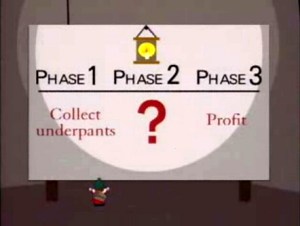
I had two thoughts as I read, belatedly, Megan Garber’s piece from last month for Nieman Journalism Lab about the new political team at Buzzfeed and how they approach reporting. First: Wow, that really sounds like exactly the right model for the online world. Second: How the hell are they going to make money from that? Which of course is the eternal Underpants Gnomes issue of online news.

But then it occurred to me that the Buzzfeed strategy may be a key part of how more traditional news organizations might survive into the digital future. More on that in a minute. First, what Buzzfeed is doing, from Garber’s article:

“The idea is to continue the type of work he’s been doing at Politico — reported blogging — and to combine that content with the social elements of Buzzfeed. So: Reporting, amplified. Reporting, viral-ized. … [The political team] will be starting from the premise … that people are now mostly (and increasingly) getting their news from social sources like Twitter, Facebook, and aggregators. Journalism is increasingly part of the social web.

“… And within the social space, Smith points out, one of the things people most like to share is news that is actually, you know, new. … [P]eople are increasingly aware of themselves not just as consumers of content, but as curators of it. They increasingly appreciate the role they play as, if not breakers of news, then disseminators of it.”

Buzzfeed’s aim is to “build the first true social news organization … the definitive social news organization.”

An early return, from Philip Bump at Mediaite, is positive – the headline is “What Buzzfeed’s New Politics Team Is Doing Right.”

It helps, of course, not to have to worry about doing all that while still producing a traditional news product such as a newspaper or TV show. But what if you started from the premise of reporters doing as Buzzfeed envisions? From there, part of the role of an editor could be pulling items out of the stream to cobble them into what is needed for the traditional product. Of necessity, that might well look very different than a traditional news story – but as I often argue and Bump’s piece at Mediaite points out, the traditional news story isn’t always needed:

“The long news story is an artificial construct, one largely predicated on filling a certain amount of printed space. Articles often don’t need to be 400-500 words with compelling intros and robust context – they certainly don’t always need to be.”

The result could be an organization with the nimbleness to operate in the online environment and build the kind of audience engagement that keeps people coming back, both to the short updates you get in social media and whatever more you produce on your main site, in the paper or on the air.

That’s where the Gnomes come in.

This morning I was reading Clay Shirky’s thoughts about the “leaky paywall” or threshold model for news sites, which lets visitors see a set number of free articles before requiring a payment for any subsequent articles. Shirky is among those who have long been skeptical that an absolute paywall – requiring a payment for any and all viewing of content – would work for news sites, but he clearly sees merit in setting a threshold. But his main purpose in the post is examining how the threshold model might end up reshaping the content of news sites. This stems from the fact that a small minority of the online users are paying the freight, so keeping that audience engaged is key:

“Threshold charges subject the logic of the print bundle — a bit of everything for everybody, slathered with ads — to two new questions: What do our most committed users want? And what will turn our most frequent readers into committed users? Here are some things that won’t: More ads. More gossip. More syndicated copy. … When a paper abandons the standard paywall strategy, it gives up on selling news as a simple transaction. Instead, it must also appeal to its readers’ non-financial and non-transactional motivations: loyalty, gratitude, dedication to the mission, a sense of identification with the paper, an urge to preserve it as an institution rather than a business.”

In other words, most people do not – and will never – pay for content, but some will pay for some specific content, and much more importantly that small number of people will pay to ensure that the general type of content you produce is around when they need it, because they enjoy it or they think it makes their world a better place, or they just can’t imagine their world without you around.

That last part, at least, is something that traditional journalists can identify with.

Read Full Post »

2011 in review


Below is a WordPress automated summary of my blog’s year, although it’s actually less than eight months. What lessons can I draw from it? One, I should say, “Hola, España,” since apparently viewers in Spain rank right behind U.S. and Canadian viewers, though I can’t tell whether that amounts to many people (my bet is that it does not). I post this not because I think it tells very much but just because it’s a beginning data point. We’ll see what comes later:

The WordPress.com stats helper monkeys prepared a 2011 annual report for this blog.

Here’s an excerpt:

A San Francisco cable car holds 60 people. This blog was viewed about 1,100 times in 2011. If it were a cable car, it would take about 18 trips to carry that many people.

Click here to see the complete report.

Read Full Post »

« Newer Posts - Older Posts »