Feeds:
Posts
Comments

Archive for the ‘Personal’ Category

As the warm weather pushed in here again last week, it reminded me of one duty of a small-town newspaper editor I learned about during my first stint at the News-Topic 25 years ago that I have not yet begun to prepare for.

At some point I have to designate a Big Bug and Weird Fruit Editor.

It’s more an honorary title than an official one. Certainly there’s no money attached.

My first editor, Lee Barnes, introduced me to the concept. When the weather gets warm, things start growing. Things that are able to move start moving.

Sometimes the growing things grow into odd shapes that perhaps look like Lyndon Baines Johnson, or Buddha, or Jim Nabors. They might not look like anything more than lumpy plant material to you, but to the one who grew it, it could practically start speaking.

Things that move are liable at some point to move into the path of a human who has never seen such a thing before. Maybe it looks like a Transformer, if those were only 2 inches long. Or a tank. Maybe the person just wants to know what it is but thought of us before thinking of the Cooperative Extension Service.

Or maybe it’s just that whenever people encounter vegetables that look like dead celebrities, fruit the size of a human head or insects that look like shrunken alien war machines, they all have one thought: If I don’t get a picture of this in the paper, something will happen to it and everyone will just say I’ve started drinking again.

So they come into the newspaper, often with a shoebox under one arm (for a big bug) or something large, ripe and maybe red in one hand (weird fruit). Sometimes the thing they brought is out in the pickup.

The job of the Big Bug and Weird Fruit Editor is to take a few photos of the Phenomenon of Nature presented and write down all the relevant information so we can run a photo in the paper. (We probably are not going to write a story, but you never know until you see what comes in the door.)

There actually is not a single person designated as Big Bug and Weird Fruit Editor (so you can relax, Kim), the duty falls to whomever is in the office. Back when I was a rookie, it often was the editor himself. But editors are well known as capricious despots, so one person might get picked on the most if I get tired of doing it (Kim).

I don’t know what the News-Topic’s policy previously has been on misshapen vegetables or scary bugs, but I plan to have an open door policy: Bring it here, but if it can fly then don’t open the door. I’ll come outside.

Read Full Post »

Until the ceremonial announcement April 19 that Google is going to expand its data center in Lenoir, I didn’t even realize where the data center was.

I had driven past it at least a dozen times since arriving here in January.

I don’t think anyone at Google intended for it to be poignant when they selected a site within Lenoir for the company’s data center, but that’s what happened. When you leave Google and turn left to Morganton Boulevard, you face Bernhardt Furniture’s Plant 3. There at the traffic light, you sit smack between looming symbols of this area’s past and what may be its future.

When I worked here as a reporter 25 years ago and furniture was at something close to its height, every afternoon around 3, black smoke poured from the smokestack at that Bernhardt plant. At least in my memory, a thick plume boiled against the sky for 20 or 30 minutes, and then it gradually eased. People I knew who had worked there or knew people who did said it was from workers clearing the scraps from their work area at the end of the shift, tossing everything into the incinerator.

I haven’t seen smoke like that since returning.

Out of curiosity, last Saturday morning I drove up Lynnhaven Drive past Google’s entrance and into the old neighborhood there. The juxtapositions can be striking. In certain places, it can feel as though a spaceship has landed and altered the landscape.

Tall chain-link fencing draped with concealing green fabric lines Google’s perimeter, but you can still glimpse the large, white buildings lined with towering cooling equipment, with an empty field between them and the fence. At one point along Overlook Drive, which has no overlooks, there is a sheer earthworks wall at least 50 feet high where a holler was filled in. It too is topped with fencing.

On the opposite side of the road, meanwhile, are woods or modest houses of the kind you might find on any country drive.

Before long the road passes out of range of Google, and you could be in any hilly spot in Caldwell County, if you didn’t know where you are.

I’m left with the lingering images of old and new. Old neighborhoods on one side of a winding residential road, new hillside and fencing on the other. Old Caldwell industry and new, almost face to face across a city thoroughfare.

The former Broyhill Furniture Industries headquarters on U.S. 321, soon to be home to a growing pharmaceutical company, still seems to me the greatest single symbol of the local economy’s transformation.

But there on the street outside Google’s gate you get a greater sense of the sweep of change. From the Google sign you can look at the company’s guarded, high-security gate and the almost-new buildings beyond them, look to one side at the Bernhardt smokestack, and then look to the other up the hill to houses where some people have lived since before the founder of Google was born.

Science-fiction writer Isaac Asimov said: “It is change, continuing change, inevitable change, that is the dominant factor in society today. No sensible decision can be made any longer without taking into account not only the world as it is, but the world as it will be.”

Who could have foreseen this world?

Read Full Post »

Before moving to Lenoir, N.C., I lived almost 12 years in Richmond, Va. Richmond is a beautiful city, a mix of Old South and mid-Atlantic, accents from hither and yon, a wonderful array of exceptionally good but reasonably priced restaurants, tons of historic sites, a city that can feel big, mid-sized or small depending on exactly where you are and who you’re with. In every positive way, it’s not Charlotte. It has a sense of place and history. And yet parts of it also are like so much of Charlotte — all sprawl and no sense of place.

Living there was a great experience.

But one thing I definitely will not miss from Richmond is the result of what I can only assume is the thrill that newspaper writers there get from referring to the region’s residents — everyone in the entire nearly-1-million-person region, not just in the fewer-than-200,000-person city — as Richmonders. Richmonders Richmonders Richmonders. You would think they earned money from every appearance of the word in an article.

Unlike “New Yorkers,” it does not roll off the tongue. I never once in 12 years there, as best I can recall, heard a single person in conversation use the term “Richmonder.”

I was reminded of this one day recently while reading a story a friend had forwarded to me from Richmond’s main alternative weekly newspaper, Style, about Virginia’s attorney general. Because I have been in Lenoir almost the entire time since Jan. 20 and don’t seek out news from Virginia, it was the first time I had seen the word “Richmonder” in nearly three months, and it struck me: In many other towns, including most of the ones where I have lived, no one even has a word for local residents. State residents, sure — North Carolinians, Virginians, Floridians, Oklahomans. But not so much the residents of most cities and towns.

What in the world would Lenoir residents be? I wondered.

Lenoirites? Lenoirians? Probably not Lenoirons, except to people from somewhere else trying to make fun of them. Lenoirlings? Nah.

If I were Hudson’s mayor, I might try to get people to adopt “Hudsonians.” It sounds like “Smithsonian.”

Sawmills would pose a particular challenge because of the s on the name. Sawmillsers? Sawmillsions? Sawmillsites? I’m not sure any of the usual endings for such things were intended for denoting residents of a place with a name that itself is a plural.

Similarly, what do you do with Granite Falls residents? Granite Fallsers?

Maybe Cajah’s Mountain residents are Cajah’s Mountaineers, although that sounds like a sports team.

The issue abounds in the larger region.

Consider Rhodhiss.

Blowing Rock.

Drexel.

Connelly Springs.

There are so many place names that don’t lend themselves to labels for who lives there.

Here’s this editor’s riddle and answer:

Question: What do you call residents of (fill in the blank)?

Answer: People.

That much has generally proven to be true everywhere.

Read Full Post »

They say Venezuela is going to keep Hugo Chavez’s body on display under glass.

How Soviet, I thought. Very retro. Just as no one builds Art Deco skyscrapers anymore, you just don’t hear nowadays about dictators being embalmed and placed under glass like an enormous butterfly, except not pretty, and not impaled. When was the last time? Lenin? Maybe that was the only time. I couldn’t think of another.

But as I thought on it, I had another thought.

I want to be under glass.

But I don’t want to wait until I die. Just go ahead and slide me into a glass box, but with a hole in the side to slide a tray through. Give me some hot wings every couple days. And beer. Leave the TV on, and give me the remote.

I’ll hear a knock on the door, footsteps, the door opening, followed shortly by a mumble, and then my wife’s answer. “I’m sorry, Guy is here, but he’s in a box.”

Which reminds me, unlike Chavez, I don’t want to be on display to the public. Who needs all the gawkers? “He’s in a box.” “Oh, that’s OK, I can talk to him through the glass.” And then in the person comes, leaning in, breath fogging my glass while I try to pretend I wasn’t ALL that interested in the Carolina game. (People who aren’t basketball fans: This is a hint. The ACC Tournament starts soon. Check the schedule before you either come see me or call me on the phone.) Is it OK to suck the wing sauce on your fingers while talking to someone through glass? It’s a whole new field of social traps.

Why would I want that? What’s the point of being under glass if you still have to interact? I’m not the boy in a bubble, I’m a man under glass; I’m not yearning to breathe free, I’m yearning to get away.

Of course, I couldn’t stay behind glass the whole time. The idea of using a toilet under glass, even if no one is in the room, doesn’t appeal. I’d have to come out. Ditto for showering.

I saw something on Facebook about tying yellow ribbons on the leashes of dogs that don’t get along well with people or other dogs. I need one of those, I thought. Why can’t I wear a yellow ribbon? Let people part like the Red Sea when they see me coming. “Uh oh,” they’d think, “that one has a yellow ribbon. Give him a wide berth.”

So then maybe that’s the solution. I don’t need to be under glass the whole time. I could come out to shower and use the rest room, maybe go out to dinner now and then, but I’d wear a yellow ribbon. I guess I might have to take it off for the waiter to come near the table. But before the check comes, the ribbon goes back on.

“So, could I interest you in some dessert?” the waiter says. I lean my head to the side to make the ribbon prominent, maybe point to it. The waiter backs slowly away, averting his gaze – eye contact can be threatening to an animal wearing a yellow ribbon.

Read Full Post »

sc01029f78
Journalists tend to be pack rats. Past News-Topic editors were no exception, so I gradually have been emptying drawers in my office the past six weeks.

Last weekend, emptying the top drawer of a file cabinet otherwise full of news clips dating from at least 1994, I found a pile of old photos. Not just old but historic, some from the early part of the 20th century. One or two look like tintypes.

They clearly seem not to be part of the News-Topic’s old files, sitting here in a cabinet filled with material from the 1980s and ‘90s. They look like people sent them in. A couple have notes saying as much, such as a photo of the 1923-24 Hudson High School basketball team, in an envelope postmarked Sept. 17, 1991. The handwritten note inside identifying the players in the photo says at the end, “Please return the picture to me at the above address. Thank you.”

Why the picture wasn’t returned I can only guess. I wanted to return it, but it has been over 21 years, and the handwriting in the letter looked old and frail already. I found no listing for the same person in the phone book, so I turned to the Internet’s phone-book-and-Encyclopedia-Brittanica, Google. There I think I found a match – unfortunately, an obituary: Mary Eunice Query of Hudson. The name on the letter was Eunice Query. One of the basketball players was Hunter Query, and in the 2007 obituary I found online, it mentions a brother named Hunter. It also lists no survivors. But what a life of accomplishment it alludes to. Degrees from Duke University and the University of North Carolina at Chapel Hill, a master’s from Appalachian State, where she also taught for 25 years; awards from UNC and from the state; multiple scholarships established either by her or in her honor.

Another photo in the drawer has a stamp on the back saying it is a Kodacolor Print made in January 1960. On the front, three young women recline in hospital beds lined up in a living room, each of them in a contraption enclosing their torsos that had what looks like a vacuum hose attached in the middle of it. The contraptions were the respirators polio victims used, a more advanced, mobile version of the iron lung that more people likely have heard of. A handwritten note on the back identifies the photo as “Alta & other polio patients in ‘We Made Our Peace With Polio’ by Luther Robinson.” The book pops up at the top of a search of Google – one site lists it as scarce, but Barnes & Noble says you can buy it in paperback.

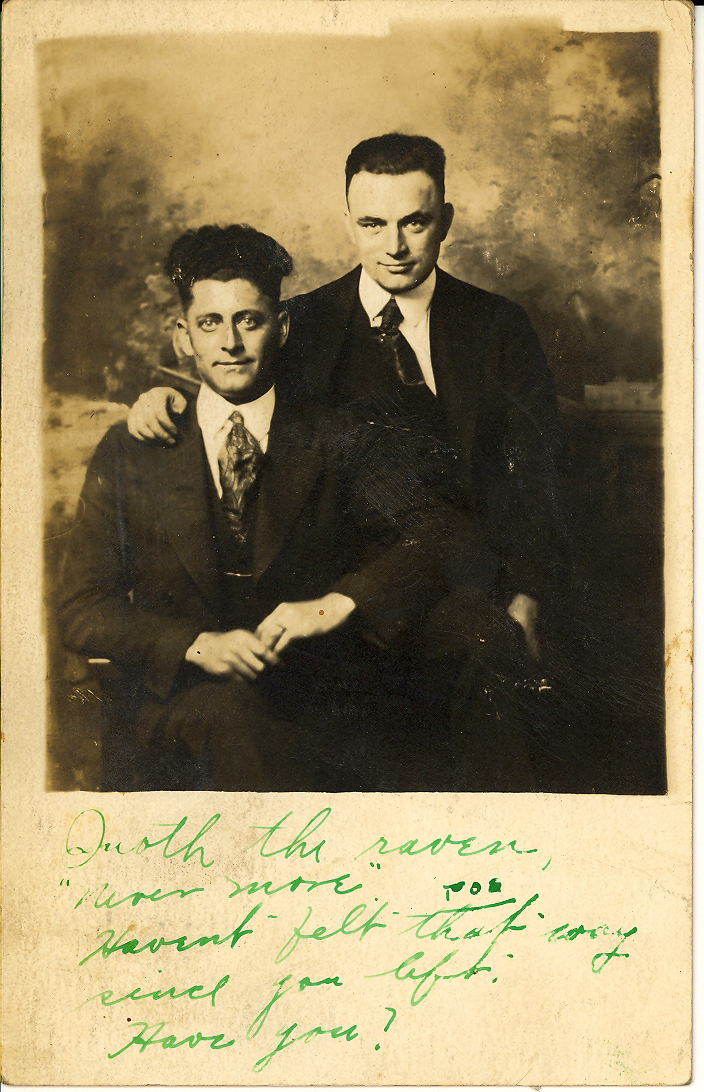
Nothing at all comes up online in a search for L.R. York of Harmony, who received a post card in July 1920 that came to be in the same News-Topic drawer as the photos above. The sender signed his name only as Doug. The return address was in Oakland, Calif. The front of the card shows two men, perhaps 25-30 years old, in nice suits, seated and facing the camera, one seated just behind the other, his hand casually resting on the other’s shoulder. A style of the time was to put personal photos on post cards, so who knows, perhaps the men are L.R. and Doug. Under the photo is written in green ink: “Quoth the raven, ‘never more.’ Haven’t felt that way since you left. Have you?”

Each of the photos in that drawer is but a moment, like a window on the side of a time machine. You catch a glimpse and the machine moves on to another moment. You see a detail but no context. You see a person but learn no story. You can tell how things looked, but not how they were. Even where something is written to provide some additional information, there is no place to turn for what was left out.

What does the quote on the post card mean, that code between friends? The faces gaze out from the photo, smiling softly, not revealing the answer. Was it a greeting on a cloudy-minded morning, an abbreviated way of saying, “We should never do that again, but wasn’t it a fun time”? Was it an exclamation on rejoining a friend: Eat, drink and be merry, for tomorrow … ? Google doesn’t know the answer to that one. That story stayed with the men, gone like footprints left in sand dunes.

Quoth the raven, “Nevermore.”

Read Full Post »

Interviewing young writers who are looking for a job, especially their first job, can be heartbreaking in a good kind of way. The youth, the energy, the enthusiasm, the optimism. I always hear echoes of myself, especially in the too-honest answers, the ones where you know the writer probably slapped herself in the forehead after hanging up the phone. Mentally, as I hang up I’m sending out a message to them: Don’t worry, I’ve given that kind of answer too, I once was young; I won’t hold it against you. Many of them express such great confidence that they have yet to come close to their own limits (perhaps they are good actors too). And then you get one like today, who, when I asked what she thought she ultimately might like to do, answered slowly, “At this point I’m really (pause), really not sure.” Such wisdom for one so young. Just remember that answer. You’ll do well.

Read Full Post »


I feel a bit like the teenage Henry Hill in “Goodfellas” after he was arrested for the first time, and Jimmy comes to greet him at the courthouse and tells Henry, “Congratulations.”

“Why? I got pinched.”

“Everyone does. You did it right.”

I’m not a hood, I’m a journalist, so instead of getting arrested, I got laid off. I think I did it right: I saw it coming literally six months ago, and even if I hadn’t, it was virtually telegraphed to me by the new ownership of the company (here’s a hint, in case you are ever in the same boat: When people stop communicating with you, you’re on the way out), but I was the good soldier and kept at the job every day. I kept quiet about what I saw coming — which hit another 104 people besides me today — and showed up early every day, worked at least a little most weekends. Just this morning a woman came by and asked me whether I ever went home. When the news came, I was ready, I had just a couple things at the desk to gather up, and I walked out without fuss.

So. What’s next?

Read Full Post »

UVa president Teresa Sullivan addresses students / Washington Post
The element that caught my eye from the outset in the uproar over the University of Virginia Board of Trustees forcing out the university president is the attention given in the trustees’ email exchanges to online education. Specifically, my attention was held one line quoted from a New York Times column by David Brooks, “The Campus Tsunami”:

“What happened to the newspaper and magazine business is about to happen to higher education: a rescrambling around the Web.”

The rest of Brooks’ column is not nearly so hyperbolic – yes, hyperbolic. Most of what happened to the newspaper and magazine business could not possibly happen to higher education. The root of the disruption in print media is the exodus of advertising, which traditionally accounted for something around 80 percent of the industry’s revenue. Education has no remotely similar parallel, so instantly you eliminate 80 percent of the chance that the devastation that happened to newspapers and magazines will happen to higher education.

The remaining 20 percent, however, is what Brooks spends the bulk of his column on, and as far as that goes, he makes a good case, and here I would say the trustees simply jumped too far.

When industries are disrupted by technological innovation, as the trustees seem to fear is about to happen to higher education, it’s usually because the business’s leaders didn’t understand what their business really was. Railroads didn’t diversify into trucking because they thought their business was railroads, not moving freight; IBM passed over the chance to make personal computers because they thought their business was making and maintaining mainframes, not helping businesses increase productivity through technology.

Disruption (the oversimplified explanation) happens when someone comes up with something that meets a need that the existing business does not, and it provides it at a low enough cost that any flaws in the product don’t matter to the customer.

In the newspaper and magazine business, disruption hit on two sides: the advertiser side, and the reader side. A number of advertisers (especially those who placed classified ads in newspapers) have found that the free ad sites online, or the kind of targeted online promotions that are much less expensive than print ad campaigns, either meet their needs as well as or better than print ads, or else they are good enough and cost a lot less, freeing up money for other kinds of promotions. At the same time, a number of readers have found that the proliferation of free information online – of all kinds, not just news – fills their need for information or entertainment better than does paying for a limited bundle of information on paper.

As I said, colleges don’t have advertisers, so the reader end of the print media’s disruption is the only part that seems to have any parallel to what may be coming to higher education. The situation print media face is that what they provide may not be perceived as holding enough value for the reader that those people are willing to pay for it. A growing number of news sites are testing that, sometimes gingerly, setting up paywalls, usually offering full access for those buying a subscription and allowing everyone else a small number of free views a month before a payment is required. The essential choice for the reader is whether to pay for the site’s staff-produced content or just get by with all the free content available everywhere else. The value of that staff-produced content depends entirely on the perception of the reader. I like to quote one of my early editors on the value issue: She said she decided at the end of the day whether she had done good work by asking whether she would pay 50 cents for what’s in the next day’s paper. That can be a tough argument to make some days, which is why the Readership Institute in 2005 or so was making presentations about the importance of creating an “Experience” newspaper, the idea being that if you focused more attention on section fronts, specifically centerpieces, and creating buzz-worthy presentations, it could elevate the value of the overall newspaper beyond the sum of its parts, and if you did it consistently you created a role for yourself in a person’s daily routine that went beyond the simple gathering of information.

The value of a college degree, however, is a bit similar. To some extent, a person goes to college for the experience, and it’s not hard to get people to recall fondly the experience elements of college that made it rewarding. But people don’t go into hock for $50,000 for the experience of college, they do it because they perceive there is a long-term payoff, which supposedly is backed up by the market – in other words, someone will hire a graduate of the University of Virginia (just to stick to the subject at hand) because a degree from there is perceived by that employer as being worth more than a degree from other schools. Or, especially, from online schools.

Unless employers suddenly decide that online degrees are as valuable as any other degree, there is a market-driven value behind getting a degree from bricks-and-mortar colleges.

So what exactly where the UVa trustees getting at? They’re not talking so far, so it’s hard to say. On May 31, Rector Helen Dragas sent the vice rector, Mark Kington, the URL for a Wall Street Journal column about the “massively online open course” movement. According to Inside Higher Ed’s summary:

“The column argues that the MOOCs have the potential to change the cost structure in higher education, as long as institutions are willing to replace some in-person education with online education. ‘[I]n this way, college X might have its students take calculus, computer science and many other lecture courses online from MIT-Harvard (or other suppliers), and have them take other classes with their own local professors for subjects that are better taught in small seminars. College X can thus offer stellar lectures from the best professors in the world — and do locally what it does best, person to person.’”
What that describes is outsourcing basic-level lecture classes – those where 200 students pile into a massive hall to hear a professor essentially talk at them, not with them, for an hour. Or, as the subhead on the Wall Street Journal column put it: “The substitution of technology (which is cheap) for labor (which is expensive) can vastly increase access to an elite-caliber education.”

That would lower some labor costs for a college that didn’t need to hold its own lecture classes. It would be a revenue source for a college that offered online lectures by “star professors,” as Brooks called them.

There’s a certain revolutionary air in the idea that a course of study at one college could involve numerous lectures from places all over the world, and it probably would wind up meaning smaller faculties – though not, I suspect, an end to the rapid growth in administrative staff, which is the biggest upward pressure on college costs. Funny how that works.

Related reading: A post Wednesday on the Remaking the University blog has a good roundup of items related to what’s happening at the UVa.

(The Richmond Times-Dispatch as a PDF of the trustees’ emails.)

Read Full Post »

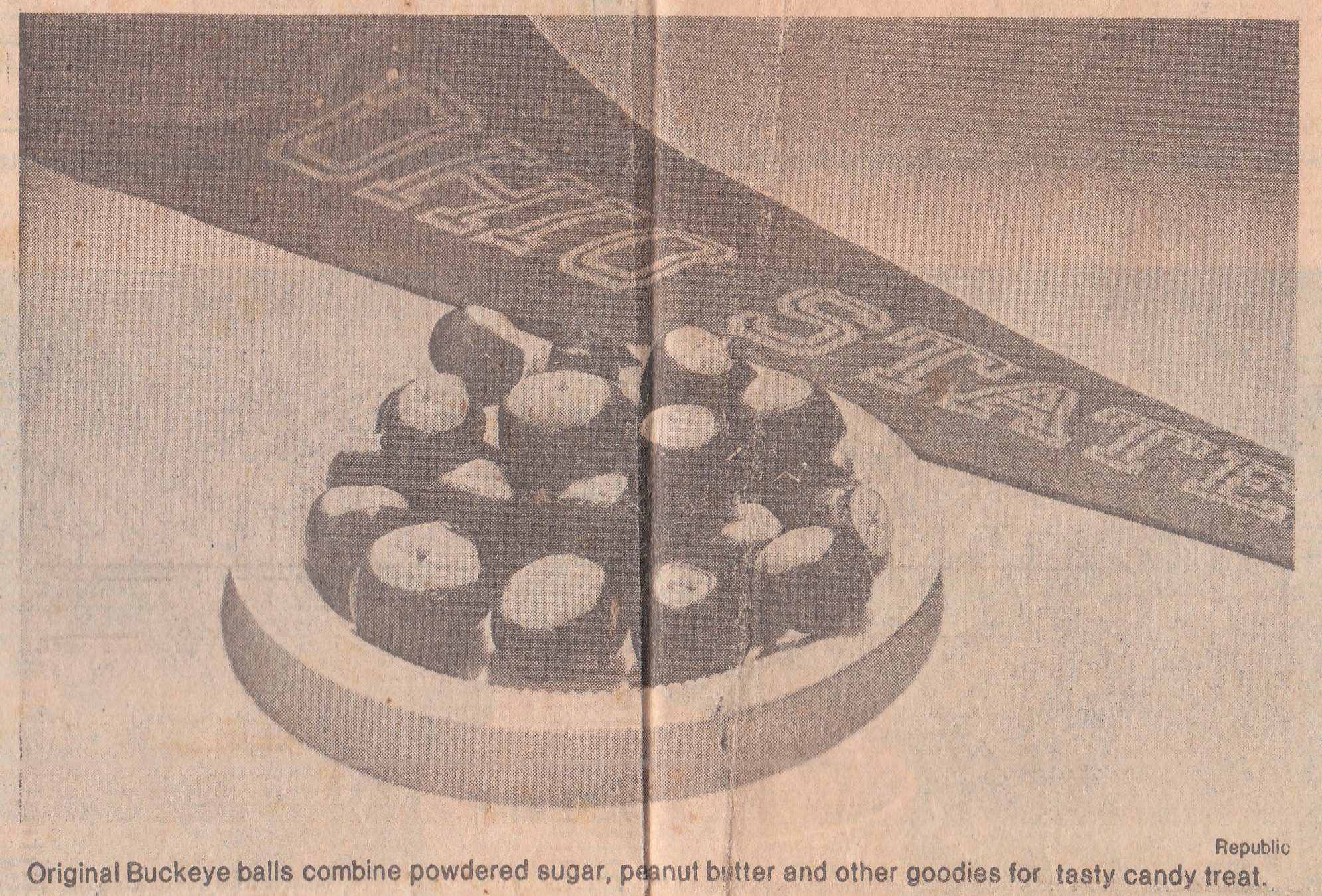
Photo from Dec. 28, 1983, Arizona Republic
Going through a huge box of my mother’s papers — personal, financial and some of her newspaper clips — I came across a column she wrote for the Arizona Republic in 1983 (under the byline Gail Tabor) claiming to be the person who first made a dessert that became popular among Ohio State fans, Buckeye Balls, which are peanut-butter balls dipped in chocolate with just a circle uncovered on the top so they look like buckeyes. A portion of the clipping was torn, and the whole was too long to fit on my flatbed scanner, so I’m typing in the text below. Note that if you try making them, the key in the recipe is “6 or more tablespoons peanut butter.” You start with six, then keep adding peanut butter to taste.

The story about where popular Buckeye balls started

By Gail Tabor

It is time, Ohio State fans, that you hear the truth about your favorite nibbling food, the Buckeye Ball. (A buckeye, for those who need explanation, looks somewhat like a bloated chestnut.)

Had it not been for me, you wouldn’t have the pleasure of gorging on those mouth-watering, chocolate-covered peanut-butter-flavored morsels.

As is so often the case concerning valuable and coveted items, the recipe was claimed by a conniving woman from Oklahoma. She fibbed and said it was hers, after promising me under oath that she would never let that recipe out of her hands.

Not only was she a dishonest purloiner, she instilled in me a deep distrust of everybody from Oklahoma, a fault that stays with me to this day.

It all began in 1964, when I married a rabid Ohio State fan whose idea of fun was sitting in the rain and snow watching football games. Oh, those memories: Finding the seat, wrapping sock-and-boot-clad feet and legs first in plastic, then in a layer of newspapers, and covering everything with a blanket. You didn’t dare move an inch the rest of the game for fear of disturbing the wrappings and letting in the cold air.

Christmas of that year, my mother brought us some candy. I begged her for the recipe, which she gladly shared. (Actually, you can say the whole thing started with her.)

When I was ready to start dipping the small balls of batter, I didn’t get the first one completely covered. I held it up on the toothpick and said to then-husband, “Hey, it looks like a buckeye.”

Thus it was christened. We gave batches away to friends, and they fell in love.

“How did you make them?” they would beg. But I was selfish and refused to part with the information. I wanted to be the only one in the world to have the secret of making candy-lovers happy.

In 1971, ex-husband graduated and we moved from Ohio. Before we left, the wife of a man who studied with my ex, and who was also graduating, pestered me unmercifully for the recipe.

“We’re returning to Oklahoma, and you will still be the only one over here who knows how to make them,” she said. “I promise I’ll never tell anyone else. Please, please, please,” she said, or words to that effect. All I know is, she pledged a solemn oath to keep her mouth shut. I relented.

Dates get fuzzy in retrospect, but it may have been 1973 when a visit was paid to Columbus during football season. Imagine my surprise when I picked up the local newspaper and saw an entire story on Buckeye balls. How in the world, I wondered, did somebody else figure them out?

“Well,” said a friend, “I didn’t want to tell you because I knew you would be furious. But (woman from Oklahoma) sent in the recipe to the Ohio State alumni magazine, under her name.”

Furious is an understatement. I felt deceived, betrayed, put-upon, hornswoggled and just plain enraged. I swore revenge.

That took a back seat. In the confusion during and following divorce and resettlement, the Buckeye ball donnybrook was forgotten until it came time to make them again. Every year, for 17 years, it has been a tradition in my house to make the delicacy on the day of the Ohio State-Michigan game. And every year my children, who have heard the story a million times, would help me make the balls and dip them in chocolate, saying all the while, “Mom, why in the world did you trust that woman?”

This year, I was in Columbus on assignment when the big day rolled around. While Ohio State and Michigan were slugging it out, I met a friend for lunch and moaned over another tradition going down the drain. This year, the making of Buckeye balls would be delayed a week.

“Gail,” my friend said, “this whole state has gone crazy over Buckeye balls. I think you ought to find some way to tell the real story about how they got started.”

So now you know. Today, and forevermore, as the scrumptious little bites disappear into eager mouths, bow to the West and give thanks to the woman in Phoenix (certainly not Oklahoma) who made such joy possible.

As one matures, one grows out of childish shortcomings like selfishness, so here is my original Buckeye ball recipe, for all the world to see. (But if you think I’m going to share my secret recipe for West Virginia Christmas pickles, you’re crazy.)

Buckeye Balls

4 pounds powdered sugar
1 pound butter
6 or more tablespoons peanut butter
2 teaspoons vanilla
12 ounces chocolate chips
1 block canning wax

Combine first four ingredients, adding a bit of milk if necessary. Rolls into small balls. Melt chocolate chips and canning wax in top of double boiler. Make sure chocolate and wax are mixed well so wax doesn’t rise to the top. With toothpick, dip the balls into the chocolate, but do not cover completely. Chill in refrigerator. After chocolate is hardened, store candy in plastic bags in freezer.

Read Full Post »
« Newer Posts