Ever see an iPad crease? Maybe it can happen, but I bet you can’t read it after that. But a newspaper crease, sometimes that’s the hand of God at work, perhaps a mischevous God testing to see if we’re paying attention, as when a crease merges an f and a t so that “shift” appears as sometime much more interesting. See more on the above from Charles Apple.
Archive for the ‘Print media’ Category
Another thing you’ll miss about newspapers
Posted in Print media, tagged news of the weird, page design on September 28, 2011| Leave a Comment »
How newspapers commemorate tragedy
Posted in Print media, tagged page design on September 12, 2011| Leave a Comment »
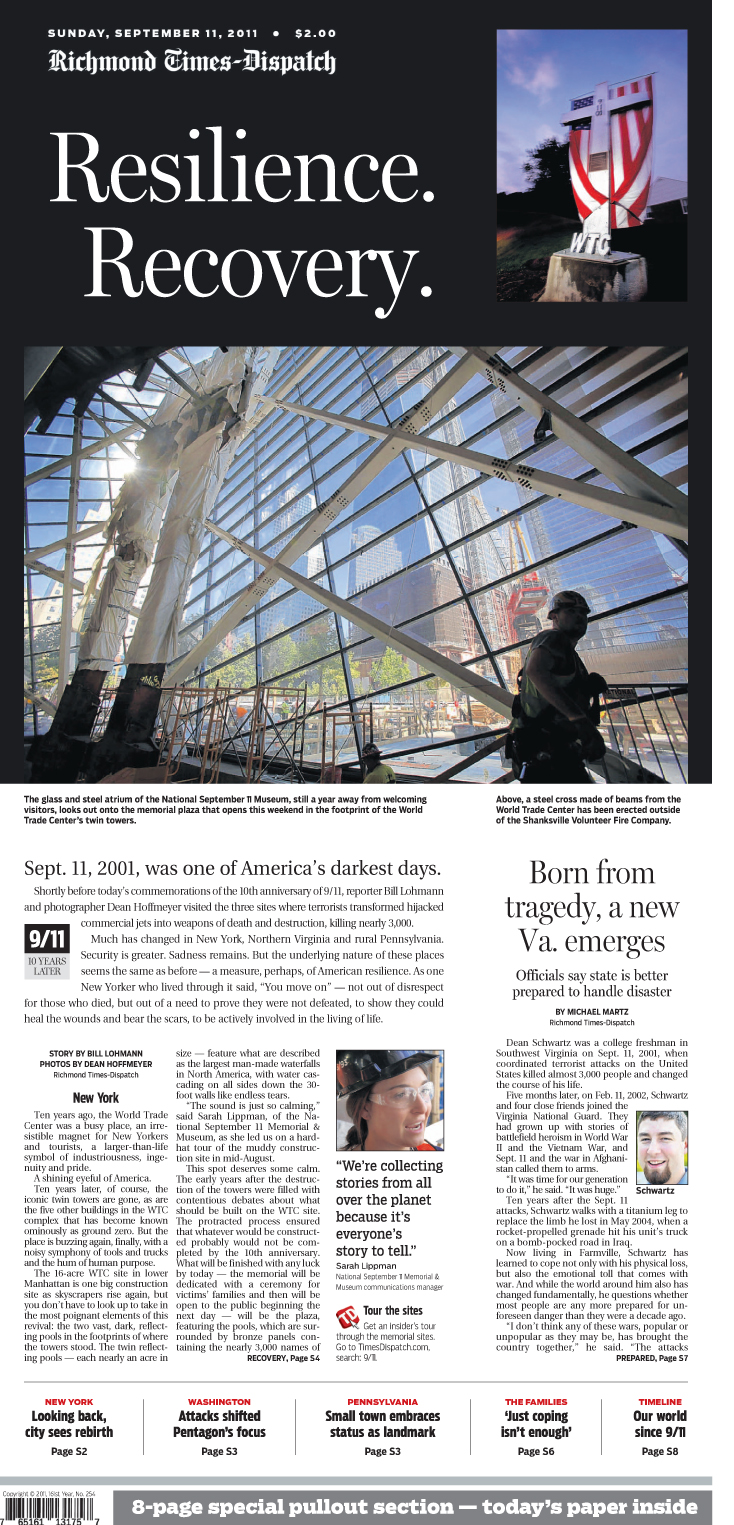
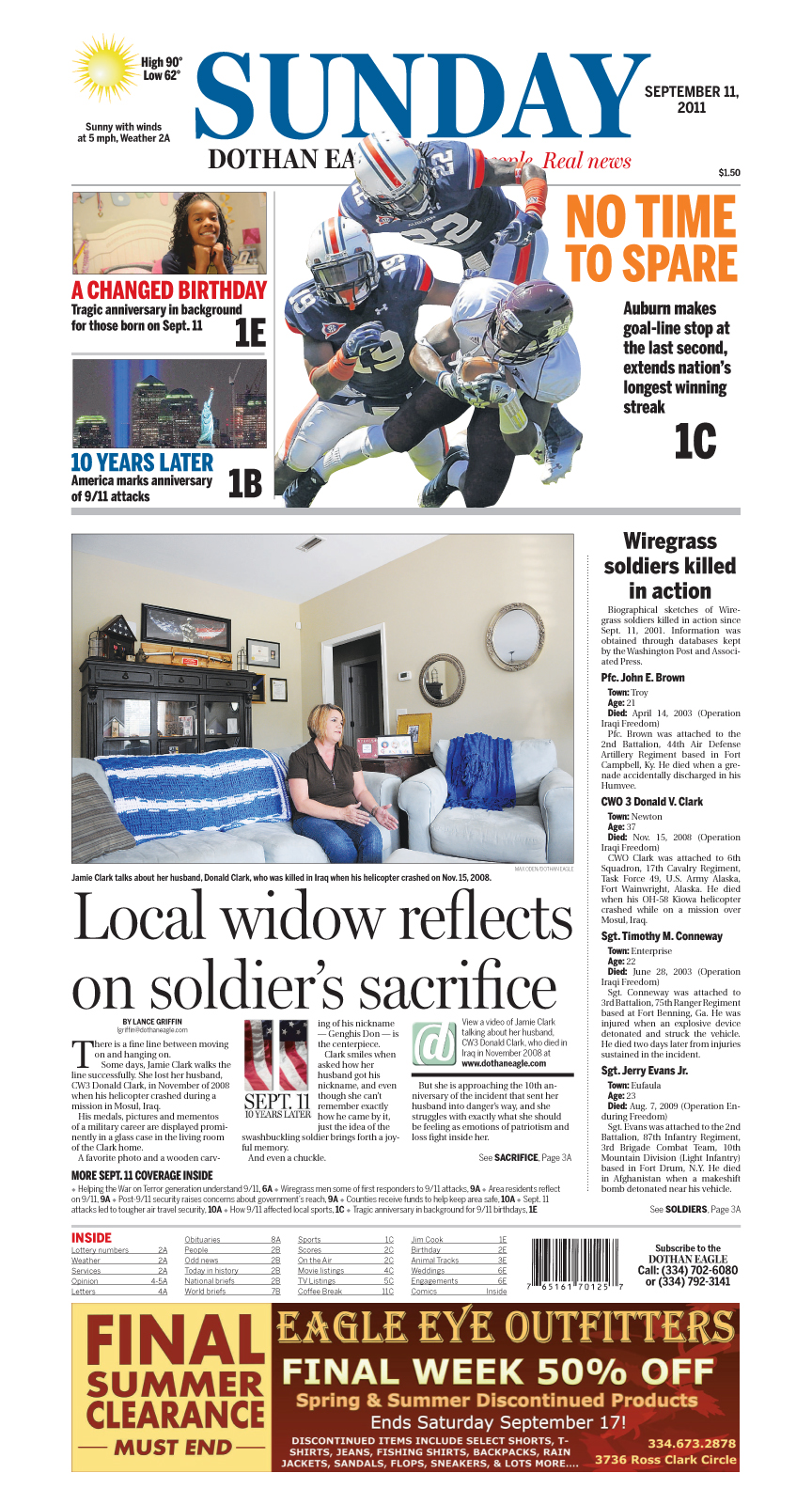
A friend and former colleague gets irritated by the way the media in general make big deals of round numbers — the 10th, the 100th, the 500th, the 1,000th whatever — and the 10th anniversary of 9/11 was no exception. He posted on Facebook, “Sept. 11: blow it out every year, or don’t blow it out at all.” I understand his point, but the media attach greater significance to big, round numbers because that’s human nature; if we didn’t do it, people would ask why because they themselves (with a few exceptions such as my friend) do it. So if you look over the Sept. 11 pages archived by the Newseum, for the most part you’ll see attempts to note the weight the date carried. Not all of them attempted to “blow it out,” but many did. At Poynter.org, Julie Moos highlights 25 front pages that she felt convey the power of deliberative design: “By using tower imagery, illustration, flags and iconic photos, they carry the power of the moment.” One that didn’t make Moos’ list but is extremely evocative is the Cleveland Plain Dealer, a very arty design of two arms either reaching into the air or grasping at it, with a person falling between them:

None of Media General’s pages from the day made the 25, but as you can see below there was quite a range — from pages that look almost like any other day to ones qualifying as keepsakes. What’s most striking may be that there are no two that look very much alike.




Earth-shaking news coverage
Posted in Broadcast media, Online media, Print media, Social media, tagged innovation, reporting, social on August 24, 2011| Leave a Comment »
Tuesday’s earthquake was a perfect “example of a breaking news story that called for audience engagement to be at the center of news reporting,” as Matt DeRienzo, a group editor of Journal Register Company’s publications in Connecticut, wrote in a blog post describing his company’s new-gathering efforts. I quote him mainly because the Journal Register currently is pointed to as a digital-first model, which a heavy emphasis on the Web and on social media, and yet as I read what DeRienzo describes I was struck by the parallels with what I knew had gone on at a number of the properties in my own Media General. JRC gets plenty of positive press, we don’t, so I’ll point out a few of the success stories.
In the most detailed story I have received so far, Ike Walker at WCMH in Columbus, Ohio, describes a big success using Twitter — and key to it is something mentioned a few months ago in a post by The Lost Remote:
“Within a minute of the quake hitting here our email inbox was filled with people asking what had happened. We tried to answer as many of them via email as possible but immediately switched our strategy to social media. Within a few minutes we had started the hashtag #columbusquake and were asking for people to share their stories and locations. The #columbusquake hashtag generated a large number of submissions and made it easier to track conversations in real-time with our users. Lesson learned: when you have a big event like this and you want to dominate the conversation at least on Twitter start a hashtag.”
Beyond Twitter, he has more often-repeated lessons — have staff dedicated to Web-first efforts, pay attention to what people in your audience are saying, and respond to them:
“As people continued to send us stories we used them on air and then created a Google map with pinpoints to map all of the stories showing how widespread the reports were. Because the reports were coming in so fast we had to dedicate a person to handling the map. I don’t know yet how many people clicked on the map however the story got almost 30k page views.
“The conversation continued on Facebook with our staff jumping in and engaging users.”
Kevin Justus at WSPA in Greenville/Spartanburg, S.C., says his station was soliciting information from the audience via social media 20 minutes before others in the market:
“Immediately after we felt the tremor we sent out a simple ‘Did anyone else feel that shaking?’ on Facebook and Twitter. Within 10 seconds we had more than 50 comments, so we knew it was an earthquake. We continued to cover the story on social media as the information came in. Our Facebook wall became a forum for our user’s experience with the earthquake.”
And cross-promote your online and social efforts, not only purely as promotion but also because during a news event such as this, phone lines and websites might be overwhelmed. Kari Pugh, the interim managing editor at the News & Messenger/insidenova.com in Prince William County, Va., just outside Washington, says she heard from readers that the phone and Internet were so overwhelmed in the region that the only news they were getting at times was from text relaying the updates to the insidenova.com Facebook page:
“We gained about 300 Facebook fans yesterday, and we were the only news source for people because Internet and cell and landline phone lines were clogged. They said they were able to get our FB updates via text. We posted continuous updates about damage, traffic, evacuations, aftershocks from the time it happened til about 1:30 a.m.”
(For a refresher on tips for “mastering live news,” have a look back a post on the subject at Steve Buttry’s blog.)
The future of news is (fill in the blank)
Posted in Broadcast media, Online media, Print media, tagged innovation on August 10, 2011| 1 Comment »
It’s funny what bubbles up at the same time in the industry. On Tuesday, Steve Buttry posted what he thinks the lessons are from the launch and failure of TBD.com, which a year ago many of us thought/hoped was a future model for the news business. Maybe it was, but the guy bankrolling it decided the gap from the present to the future was bigger than he was willing to try to jump all at once — which is one of Steve’s lessons, to start small or be patient.
You’ll find echoes of a number of Steve’s points in a feature posted today by the Business Insider, Media Mavens Weigh In: The Future of News Is …. The “mavens” are not equally insightful, as you’ll note off the bat when the first opinion comes from Glenn Beck — that’s not a political statement; his takeaway on the future of news is merely pedestrian and obvious, as are those of several others. But as a group, the visions of the future, from the least detailed to the most, line up in many ways with various things TBD was trying to do. That’s not to say TBD definitely had it right. It was too early to tell when the plug was pulled.
The experiments continue.
At a minimum, engagement means listening too
Posted in Online media, Print media, tagged engagement, innovation, social on July 11, 2011| Leave a Comment »

The Reynolds Journalism Institute has a good news/bad news report on engagement. The good news is that newspaper editors “overwhelmingly say they think audience engagement has become an important part of practicing journalism. The unsurprising part is “they’re often not sure what that means or how to go about it,” but the bad news is “Not even half of respondents said that they use social media to listen as well as share information, that they interact with readers in comments sections, or that they use their analytics reports to help make news decisions.” Not even half? I’m not saying you have to go diving into comments and mix it up, though constructive interaction is a good thing, but at a bare minimum you should be paying attention to the comments on the website and in social media, and the analytics reports are as much a tool as your circulation sales numbers are — you don’t do a story just because it will get big numbers, but the numbers inform your decision on story play and promotion.
Call it creative chaos in the news business
Posted in Online media, Print media, tagged curmudgeons, innovation on July 10, 2011| Leave a Comment »
Clay Shirky has produced another piece of what should be required reading for journalists, this time arguing the benefits of different news organizations trying many different things to either raise new revenue or reduce the cost of reporting. Much of the argument repeats the plain-English explanation of the economic underpinnings of the news industry and why those underpinnings no longer make the sense they did decades ago, but it bears repeating because of the many who still focus only on what the newsroom has lost and on so-called buzzwords that don’t fit traditional notions of journalism. Shirky rounds it up aptly:
“If we adopt the radical view that what seems to be happening is actually happening, then a crisis in reporting isn’t something that might take place in the future. A 30% reduction in newsroom staff, with more to come, means this is the crisis, right now. Any way of creating news that gets cost below income, however odd, is a good way, and any way that doesn’t, however hallowed, is bad.
“Having one kind of institution do most of the reporting for most communities in the US seemed like a great idea right up until it seemed like a single point of failure. As that failure spreads, the news ecosystem isn’t just getting more chaotic, we need it to be more chaotic, because we need multiple competing approaches. It isn’t newspapers we should be worrying about, but news, and there are many more ways of getting and reporting the news that we haven’t tried than that we have.”
7/11/2011 UPDATE: The Economist has an interesting series of stories on the evolution of the news industry. Particularly interesting is the installment Coming Full Circle, which argues that the Internet, “by undermining the mass media’s business models, that technology is in many ways returning the industry to the more vibrant, freewheeling and discursive ways of the pre-industrial era.”
A dirty mind will save you embarrassment
Posted in Online media, Print media, tagged news of the weird, page design on July 7, 2011| Leave a Comment »

You might giggle at the sight of a weather graphic that makes it look like the sun is horny, and you might be ashamed at having the mind of a 12-year-old boy on such matters. But if only someone at USA Today had that, the paper wouldn’t be enduring several days of ridicule. As design consultant Charles Apple notes, citing several other examples, you need a dirty mind to be an editor in this business. Actually, it will help you in any business that involves putting words and images out for anyone else to see.
That Media Guy
Categories
-
Join 1,213 other subscribers
-
Recent Posts
Archives
- September 2024
- April 2023
- December 2022
- June 2022
- February 2022
- December 2021
- October 2021
- September 2021
- August 2021
- May 2021
- February 2021
- December 2020
- August 2020
- June 2020
- May 2020
- April 2020
- January 2020
- November 2019
- October 2019
- September 2019
- July 2019
- June 2019
- April 2019
- March 2019
- February 2019
- January 2019
- December 2018
- September 2018
- August 2018
- July 2018
- March 2018
- February 2018
- January 2018
- December 2017
- November 2017
- October 2017
- September 2017
- July 2017
- June 2017
- May 2017
- April 2017
- March 2017
- February 2017
- January 2017
- October 2016
- September 2016
- August 2016
- July 2016
- June 2016
- May 2016
- April 2016
- March 2016
- February 2016
- January 2016
- December 2015
- October 2015
- September 2015
- July 2015
- June 2015
- March 2015
- February 2015
- January 2015
- December 2014
- November 2014
- October 2014
- September 2014
- August 2014
- July 2014
- June 2014
- May 2014
- April 2014
- March 2014
- January 2014
- December 2013
- November 2013
- October 2013
- September 2013
- August 2013
- July 2013
- June 2013
- May 2013
- April 2013
- March 2013
- February 2013
- January 2013
- December 2012
- November 2012
- October 2012
- September 2012
- August 2012
- July 2012
- June 2012
- May 2012
- April 2012
- March 2012
- February 2012
- January 2012
- December 2011
- November 2011
- October 2011
- September 2011
- August 2011
- July 2011
- June 2011
- May 2011
- advertising aggregation Andy Griffith arizona republic audience bad practices berkshire hathaway brand/reputation Buckeye Balls Citizen-Journal Clay Shirky clickbait crowdsourcing curation curmudgeons database David Brooks David Carr Democrat-Gazette Digital First Media disruption Earl Wilkinson engagement Facebook future Gail Tabor Google hyperlocal INMA innovation Inside Higher Ed Jay Rosen Jeff Bezos Jeffrey Bezos John Robinson legacy.com Lockbourne Air Force Base longform journalism management McClatchy media general miscellany mobile News & Observer news of the weird newsroom structure New York Times not work NPR obituaries Ohio State ONA opinion pages Orange County Register page design paywalls photography politics public records reporting search Seattle Times small-town journalism social SPJ Star-Tribune Steve Buttry Superman Tumblr twitter University of Virginia warren buffett Washington Post web metrics writing

 Newsroom With A View