Feeds:
Posts
Comments

Posts Tagged ‘engagement’

After my junior year of college, I had a summer internship at what was, unbeknownst to me at the time, one of the last PM daily papers in the United States, the Phoenix Gazette. The Gazette was down to about 1/10 of the circulation of its morning rival, The Arizona Republic – both were owned by the same company but maintained separate staff – but was hanging on. Given the trends underscored by the latest report from comScore, Digital Omnivores, we may be in a window where people one day will say they were at one of the last newspaper organizations NOT to have an online PM strategy.

For those of you too young to remember, a brief summary of the relevant history: A little more than a generation ago, more newspapers were sold in the afternoon than the morning, and many cities had both a morning-delivered paper and an afternoon-delivered paper, the latter of which originally was dominant. As lifestyles changed, the afternoon paper faded and the morning paper became dominant, and by the ‘80s few PM papers were left. Whatever news had happened in the wee hours overnight, people heard on the radio or TV in the morning, and whatever happened during the day, people heard on the radio on the drive home or on TV shortly after arriving home. In recent years (as many have observed) the Internet is accelerating the adaptation of news-consumption habits to peoples’ lifestyles and schedules – so much so, it seems, that there now is renewed and growing demand for a late update on the news, but later than the old PM paper and later than the evening TV news.

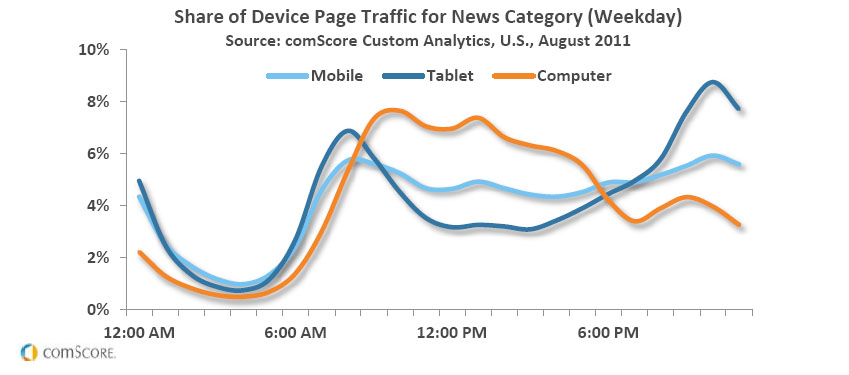
One of the highlighted elements of the comScore report is the rapid growth in mobile and especially tablet use. This is important because, as the chart shown above illustrates, when people use their computers to check online news, the pattern rises and falls according to the day’s work schedule – peaking in the mid- to late morning and declining late in the day. But mobile use hangs on later – especially tablets, which actually peak later in the night.

A danger of drawing too many conclusions about where the trend goes from here is that the current batch of tablet users are mostly young, male and affluent – not the typical computer user, let alone mobile user, let alone the average person. But they are typical of early adopters, and to that extent, you can look at their usage with an eye to what past early adoptive behaviors indicated was the shape of things to come.

For news producers, the news is hopeful:


News is relatively high on the list of what people do on mobile devices. True, it’s below e-mail … Facebook … games … Google and Yelp and other search … maps … . But still, it’s a solid third or more of the market.

Not only that, but it’s among the higher percentage of uses in a month, especially among tablet owners (and the report emphasizes the growth and potential of the tablet audience):

“Nearly 3 out of 5 tablet owners consume news on their tablets. 58 percent of tablet owners consumed world, national or local news on their devices, with 1 in 4 consuming this content on a near-daily basis on their tablets.”

(Note: Among tablet owners, “TV remained the most prominent source for news content, with 52 percent of respondents typically consuming news in this fashion. Computer use followed closely with 48 percent of tablet owners consuming news content via desktop or laptop computers, while 28 percent reported receiving their news from print publications. Mobile and tablet consumption of news were nearly equal in audience penetration, with 22 and 21 percent of respondents accessing news via their mobile or tablet devices.”)

And finally, a word of hope for the news organizations formally known as newspapers (yeah, I’m a few years ahead of myself, but that’s where we’re going): Newspapers, blogs and technology sites stand out as examples of categories in the U.S. exhibiting high relative mobile (phone and tablet) traffic.


“In August 2011, 7.7 percent of total traffic going to Newspaper sites came from mobile devices – 3.3-percentage points higher than the amount of mobile traffic going to the total Internet. As consumers continue to seek out breaking news and updated information on the go, it is likely that this share of traffic could grow further.”

In summary: It’s early, but this is another data point backing up indications that the trend is that at least a significant portion of the people using mobile devices (notably including the portion most likely to appeal to advertisers, or with the income to pay for access) have an appetite for news that extends late into the evening, and they go online to find it. When do you do your final online updates for the day?

Read Full Post »


This one feels a little different: the Wall Street Journal has launched a new Facebook app, but it keeps the user on Facebook the entire time while also delivering the Journal’s subscription-protected content (though sponsorships may allow that content to be delivered free within the app). That seems like a huge advance in the current, Facebook-dominated landscape.

But the bigger news, as Megan Garber reports at Niemen Journalism Lab, is the app advances the concept of personalized news, making “every user an editor” and “elevating the role of people as curators of content.” People already have been curating content — that’s the essence of sharing links — but this app seeks to make it a more seemless process, and the fewer clicks needed to do what the person wants to do online, the more pleasing the Web experience. It raises the question, will people be more willing to pay for the news if it’s this easy to interact with it?

9/26/11 UPDATE: The Washington Post also has an app to feed news directly to Facebook, but it’s even broader, including news from partners The Associated Press, Reuters, Mashable and SB Nation. At Poynter.org, Jeff Sonderman sounds a note of caution about such apps — asking, among other things, whether news organizations can trust Facebook as a partner — but I still think the movement of the audience in a fragmented, digital world makes it imperative to find ways to make it easy to stay in front of people’s eyes, and that means only having your own website and linking to it may not be quite enough. We’ll see if people adopt the apps.

Read Full Post »


The folks at insidenova.com, the website of the News & Messenger in Manassas and Prince William County, Va., stumbled into an excellent example of how to respond to what you see happening locally in social media. After severe flooding in the region last week, people found themselves without a clearinghouse for information and discussion — but they gravitated to the insidenova Facebook page and were filling it with just such information. So, seeing that, interim managing editor Kari Pugh created a flood information clearinghouse page on Facebook. In just a few hours it had garnered about 250 “likes,” and the community discussion on it was mostly self-sustaining. The community is doing the organizing and exchange of information, but the news organization has facilitated that and put itself at the hub of the conversation.

Read Full Post »


You could summarize the results of the new Nielsen Social Media Report as “all the trends you’ve heard about are still happening,” except there are a couple of details that seemed a little surprising. Topping the list: Internet users over the age of 55 are driving the growth of social networking through the mobile Internet. I did not know that and would not have guessed it. Less surprising is social media’s growing ubiquity: Social networks and blogs account for nearly a quarter of total time spent on the Internet, and nearly 4 in 5 active Internet users visit social networks and blogs.

I can’t tell how good or bad some numbers in the report are, such as that Americans spend 22.5 percent of their Internet time on social networks and blogs, and just 2.6 percent on current events & global news. As Steve Myers points out at Poynter.org, blogs could include news blogs, and portals post news stories. And he doesn’t point it out, but many news organizations now make social networks, especially Facebook — where Nielsen says Americans spend more time on than on any other U.S. website — a key part of their efforts to engage the audience, so people could be on social networks and still be on a news-related site.

Read Full Post »

A survey from Ad Age shows why news sites — or any content provider — need to be concerned about comments on the site and ways to engage the audience. In my own experience, people my age and older often seem baffled that anyone even bothers to comment on things they see on the Web, and that is reflected in the survey:

“Fully half of the 1,003 households that took part in our online survey said that adding more tools for engagement would have zero impact on the likelihood that they would visit a news site. Add in the 13% who said they would be less likely to visit and you get nearly two thirds of site visitors seemingly uninterested in having comments, photos and videos from their peers mixed in with the news content from the staff reporters and editors.”

But breaking down the numbers changes the picture substantially:

“Younger millennials (18- to 24-year-olds) are three times as likely as those 55 and older to say that engagement tools will make them more likely to visit a site.

“Almost 80% of the 55-plus crowd said they rarely or never comment on stories, compared to only 24% of the 18- to 24-year-olds and 27% of the 25- to 34-year-olds.”

As Matt Carmichael sums up in the Ad Age post, the younger generations “aren’t building the same news habits as previous generations who are keeping print afloat.” Online, where your organization’s future is, you have to pay attention to the habits those groups are developing.

Read Full Post »

Having said in the past that while I was not entirely comfortable with using “brand” as the modern term of discussion for a journalist’s reputation but accepted it as the term already in wide use, I find myself now saying I’m not ready to make a similar leap to describe the online interactions between journalists and their audience as “transactions,” as Lewis DVorkin does at Forbes. He explains:

“Now, journalism is not commerce and it’s not advertising. But the Web’s impact on the news media is not dissimilar. No longer is the journalist addressing the abstract notion of ‘the reader.’ On the Web, the author connects one at a time with individual readers, right down to the IP address. That means journalists now must engage, or ‘transact,’ accordingly.”

Although I can acknowledge it’s just a degree of a semantic difference, and we may both be looking for the same end result, “transaction” doesn’t feel quite human enough to me.

Read Full Post »

Among the phrases used in recent years in such efforts as the NewspaperNext report to try to get journalists to rethink the business in light of the changes in culture, work/leisure habits and technology was “jobs to be done,” as in ask yourself what is it that people really need help with in their daily life that news organizations are equipped to handle. One of the answers is providing them with something to talk about. Broadly speaking, that’s what good journalism does. In recent years, as social networking has taken off, it has become clear that conversation is one of the things people value most about the news. They share links constantly. An article by Megan Garber at the Nieman Journalism Lab site looks at whether this conversation — more specifically, the communities that can form around the conversation — is where news organizations should be looking for the future business model:

“News outlets are certainly getting into the community game — through social media, of course, but also through IRL events like the NYT’s TimesTalks, the Journal’s Weekend Conversations, the Texas Tribune Festival, the Register-Citizen’s newsroom cafe, and on and on — but often those happenings are presented as subsidiary products, as events that are separate from the news itself. They’re just another revenue stream — just another product sold, just another milkshake.

“But: What if they were more than that? What if news outlets were to consider themselves as doing a job rather than selling a product? And what would happen to organizations’ business models if we started to think of ‘the news,’ at its core, not as a product, but as an event?”

Read Full Post »

what not to do
Web designer Brad Colbow points out a number of common news site features that range from irritating to enraging, and he titled the post “This is why your newspaper is dying.” They might be why people get frustrated with news sites (not just newspaper-affiliated sites) online, but they have nothing to do with the economics driving newspapers to cut staff and features, which derives almost entirely from advertising declines. Still, he has valid points on the user-unfriendliness of the practices he highlighted, and if you are among the unfortunate, overworked few in a position to reduce them on your site, you should look into ways to do it. If you are in a position to drive changes needed to reduce the less serious but chronic ones (articles that have no links to source material or related sites, even if they are mentioned in the story, for instance, or graphics shoveled from print to online with no adaptation for the new medium), chances are there are people on your staff who already have suggestions.

Read Full Post »

listening
The Reynolds Journalism Institute has a good news/bad news report on engagement. The good news is that newspaper editors “overwhelmingly say they think audience engagement has become an important part of practicing journalism. The unsurprising part is “they’re often not sure what that means or how to go about it,” but the bad news is “Not even half of respondents said that they use social media to listen as well as share information, that they interact with readers in comments sections, or that they use their analytics reports to help make news decisions.” Not even half? I’m not saying you have to go diving into comments and mix it up, though constructive interaction is a good thing, but at a bare minimum you should be paying attention to the comments on the website and in social media, and the analytics reports are as much a tool as your circulation sales numbers are — you don’t do a story just because it will get big numbers, but the numbers inform your decision on story play and promotion.

Read Full Post »

As I noted a couple of weeks ago, I can sympathize with those who don’t like the use of “brand” in journalism conversations because it originated in marketing and advertising. The same applies to other words that have come into common use, such as engagement. But the world of journalism and all media has changed, so new words are needed. Got a better word to replace any of the ones you hate? Pitch it out there. Complaining about the existing word doesn’t help if you don’t have a better alternative. The buzzwords gained traction not because of an evil plot but because they are accurate, as Steve Buttry explains in greater detail than I could.

Read Full Post »

« Newer Posts - Older Posts »