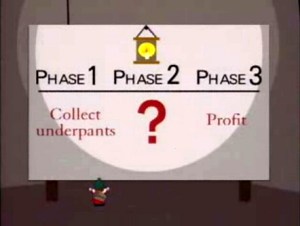
I had two thoughts as I read, belatedly, Megan Garber’s piece from last month for Nieman Journalism Lab about the new political team at Buzzfeed and how they approach reporting. First: Wow, that really sounds like exactly the right model for the online world. Second: How the hell are they going to make money from that? Which of course is the eternal Underpants Gnomes issue of online news.
But then it occurred to me that the Buzzfeed strategy may be a key part of how more traditional news organizations might survive into the digital future. More on that in a minute. First, what Buzzfeed is doing, from Garber’s article:
“The idea is to continue the type of work he’s been doing at Politico — reported blogging — and to combine that content with the social elements of Buzzfeed. So: Reporting, amplified. Reporting, viral-ized. … [The political team] will be starting from the premise … that people are now mostly (and increasingly) getting their news from social sources like Twitter, Facebook, and aggregators. Journalism is increasingly part of the social web.
“… And within the social space, Smith points out, one of the things people most like to share is news that is actually, you know, new. … [P]eople are increasingly aware of themselves not just as consumers of content, but as curators of it. They increasingly appreciate the role they play as, if not breakers of news, then disseminators of it.”
Buzzfeed’s aim is to “build the first true social news organization … the definitive social news organization.”
An early return, from Philip Bump at Mediaite, is positive – the headline is “What Buzzfeed’s New Politics Team Is Doing Right.”
It helps, of course, not to have to worry about doing all that while still producing a traditional news product such as a newspaper or TV show. But what if you started from the premise of reporters doing as Buzzfeed envisions? From there, part of the role of an editor could be pulling items out of the stream to cobble them into what is needed for the traditional product. Of necessity, that might well look very different than a traditional news story – but as I often argue and Bump’s piece at Mediaite points out, the traditional news story isn’t always needed:
“The long news story is an artificial construct, one largely predicated on filling a certain amount of printed space. Articles often don’t need to be 400-500 words with compelling intros and robust context – they certainly don’t always need to be.”
The result could be an organization with the nimbleness to operate in the online environment and build the kind of audience engagement that keeps people coming back, both to the short updates you get in social media and whatever more you produce on your main site, in the paper or on the air.
That’s where the Gnomes come in.
This morning I was reading Clay Shirky’s thoughts about the “leaky paywall” or threshold model for news sites, which lets visitors see a set number of free articles before requiring a payment for any subsequent articles. Shirky is among those who have long been skeptical that an absolute paywall – requiring a payment for any and all viewing of content – would work for news sites, but he clearly sees merit in setting a threshold. But his main purpose in the post is examining how the threshold model might end up reshaping the content of news sites. This stems from the fact that a small minority of the online users are paying the freight, so keeping that audience engaged is key:
“Threshold charges subject the logic of the print bundle — a bit of everything for everybody, slathered with ads — to two new questions: What do our most committed users want? And what will turn our most frequent readers into committed users? Here are some things that won’t: More ads. More gossip. More syndicated copy. … When a paper abandons the standard paywall strategy, it gives up on selling news as a simple transaction. Instead, it must also appeal to its readers’ non-financial and non-transactional motivations: loyalty, gratitude, dedication to the mission, a sense of identification with the paper, an urge to preserve it as an institution rather than a business.”
In other words, most people do not – and will never – pay for content, but some will pay for some specific content, and much more importantly that small number of people will pay to ensure that the general type of content you produce is around when they need it, because they enjoy it or they think it makes their world a better place, or they just can’t imagine their world without you around.
That last part, at least, is something that traditional journalists can identify with.
Read Full Post »


 Newsroom With A View