Feeds:
Posts
Comments

Posts Tagged ‘small-town journalism’

I spent most of the 12 years before coming to Lenoir trying to translate the national discussions about new media and news transformation for small newsrooms. Everyone talks in terms of big newsrooms and metro papers. But in terms of the national media scene, those are a minority of news organizations. The things that are of top importance in their newsrooms are luxurious daydreams for most newsrooms in the country.

In that sense, I was amply prepared for my current job. Yet I remain frustrated that smaller newsrooms, even those much larger than mine, seem to be less than an afterthought in journalism-discussion circles.

Take, as just one example, the Denver Post memo about the paper’s newsroom reorganization, much publicized and much discussed. “As part of the public meetings starting later in July, think about what The Post should cover, how should we be organized, what beats would you start and which would you eliminate,” it says.

It is the latest of many news conversations focused on rethinking what newspapers do cover versus what we should.

Good. I agree. Let’s rethink it.

I have four reporters in my newsroom, with these beats: sports (all), justice (cops and courts, countywide), city-county (Lenoir city government plus county government), and education plus the other five and a half (one is on the county line) small towns throughout the county.

I have no idea how I might reconstruct things to get better coverage. Literally everyone is a generalist. Half of all stories, at least, are what the city folk would call general assignment.

Do I stop having people cover the small towns in the county? That one reporter would like having Monday and Tuesday nights back, but the town leaders would view it as abandoning coverage, which would feed the negative narrative in the towns about our coverage. They are small towns. The average citizen in Charlotte may not give much weight to what his or her city council member thinks of the Observer’s coverage, but in Gamewell the elected officials are authorities, to many, and if they go around saying the newspaper doesn’t care, that carries significant weight.

Or maybe there should be no beats based on government structure at all. Except that my reporting staff is entirely under the age of 25 and from places other than here. Where would they begin? Beats, lets remember, are structure and help a new reporter figure out where to begin.

Or perhaps everyone would agree with me, that my newsroom is smaller than anyone would contemplate trying to reorganize beat structures.

Yes, well, move on, then, but it won’t mean I am less affected by the restructuring of media habits, advertising and news consumption patterns than you are.

The national discussion in journalism is divorced from the reality that the majority of papers face. Yet I know it is what the people on my staff will face if and when they decide to seek a job at a larger newsroom. And I know, from experience, that whatever larger newsrooms confront now will manifest themselves eventually in smaller newsrooms. Except it will be different, and no one will talk much about it then.
Read Full Post »

Smith fire
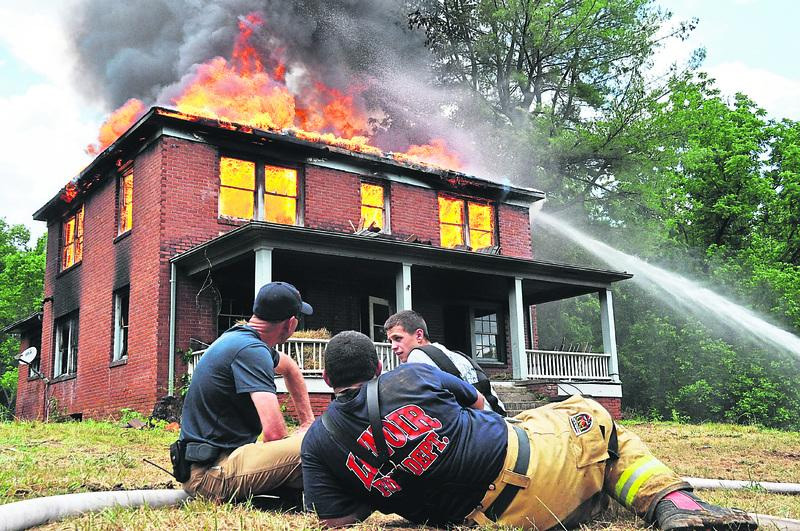
I didn’t stay to watch the old Smith family home at the corner of Abington Road and Harper Avenue burn all the way to the ground.

But it was long enough to be reminded that in fire, beauty and horror are siblings.

This is especially true when an old house like this one burns.

The house was a two-story, brick American Foursquare, an architectural style that was especially popular in the early 20th century. It was built in the 1930s. A firefighter on the scene said some of the interior walls and ceilings were beadboard.

I would imagine the interior woodwork remained a sight to behold right up to when the flames touched it, even if the view out the front door had changed significantly since the 1930s, where what must have once been a quiet, two-lane road now is a four-lane bypass.

As someone put it in an understated comment on a Facebook photo of the fire, the house looked like it had a lot of potential.

Unfortunately, the lot it sits on also has a lot of potential, but not for single-family uses such as that house.

The developers who bought it plan to begin work in July to build a three-story apartment complex intended for low-income adults over 55. The house’s footprint is where one end of the L-shaped building will be, said Roy Helm, president of Wesley Community Development, a Methodist-based company that is planning the apartments together with the Western North Carolina Housing Partnership.

The developers let firefighters use the house for training. Battalion Chief Ken Nelson of the Lenoir Fire Department said that nine teams of firefighters from Lenoir, Hudson and Gamewell each had at least two training sessions finding and fighting fires that were set inside the house.

A two-story house like this one is especially valuable for training, Nelson said, because fire behaves differently where there are stairs, which act like a chimney. Fire creates its own weather, and the structure of a house influences it. Firefighters need to be able to see how fire behaves in different kinds of structures.

By about noon, after setting and putting out 20 or more fires, the firefighters set the final one, then stepped back.

Eventually I had to step back too. I kept stepping back. Once the flames burned through the roof, the heat emanating into the front yard — even against the wind — felt uncomfortably hot. I wondered whether the lenses in my glasses would warp, even as I watched Chief Ken Briscoe, wearing glasses, stand his ground 20 feet closer than I was.

Many of the firefighters, standing in T-shirts, remained closer to the fire than I could bear. Perhaps that’s good training too. They get used to the heat.

One things I’m not sure I could get used to is the burning. That beautiful wood, those stately bricks, that old, crinkled glass. The things that would evoke memories and provoke stories from those who grew up here.

In a couple of months, even the ashes will be gone.

Read Full Post »

My heart ached as the sixth-graders walked one by one to the microphone at the J.E. Broyhill Civic Center, gave their first name and said what they want to be when they grow up.

Most appeared nervous. In some, that translated into a stiff gait, gaze locked forward. Some walked as if they were on a high wire, so conscious of the eyes on them that they perhaps feared tripping or stumbling. One skinny, gangly girl’s nerves made her long limbs jiggle as she walked, and she flashed a broad, self-conscious smile.

Some, like that girl, had begun the physical growth spurt that soon will make their parents feel suddenly much older. But most, even the taller ones, still had a child’s voice.

As each one, still brimming with a child’s energy but not yet a teenager’s bravado, spoke into the microphone, that child’s voice announcing a career ambition stabbed at the place in my heart where I keep sentimentality locked away.

“I want to be a technology designer,” a boy said, and the sweet earnestness bored into me.

These 41 children were this year’s recipients of Dream Awards from the Foundation of Caldwell Community College and Technical Institute. They were nominated by their teachers and guidance counselors because they show great potential to achieve these goals – or others that may replace them in the coming years.

“I want to be a paleontologist, vet or author,” a girl said, and the broad range of options she is considering swept me along like a river. She believes in these, I saw it in her eyes, she believes she can do it, and hearing that child’s voice speaking it, I wanted to pick her up and help her along.

These are all children who could become the first members of their families to attend college. Sixth-graders surely don’t realize what a barrier that is, but it is one, as adults come to understand. The understanding is part of what creates the ache when you look into a young face full of life and energy and dreams. An adult knows how many obstacles will come along.

A lack of money to pay tuition may be the least of the problems a child will confront before graduating high school, but unlike so many of those problems, it’s one that is easily addressed.

Not easily enough, of course. The 41 recipients of this year’s awards are not the only students who would be worthy of this attention. The money the foundation has raised goes only so far.

“I want to be a pediatrician,” a girl said, and I thought how many other girls might have said that but weren’t lucky enough to be chosen and brought to this room.

During their 25 years the Dream Awards have helped hundreds of students take a critical step closer to achieving their dreams.

It’s not enough. It’s not nearly enough.

Read Full Post »

The more things change, the more they stay the same.

That became evident to me recently as I examined, out of curiosity, some of the earliest news reports in the Caldwell County Public Library’s collection that you can find from the Lenoir, N.C., area, from the weekly Caldwell Messenger, which began publication in September 1875.

For instance, an item in the Dec. 2, 1875, edition reported on “a slight runaway” of a horse team on Main Street in downtown Lenoir:

“Cause – too many fire crackers in the rear. No damage. Moral – don’t leave your team standing without someone to look after the horses when the school boys have holiday. They will celebrate.”

We all can recall our father’s warning, if your father was like mine, about firecrackers in the rear, and while you won’t find any teams of horses downtown anymore, visit and you might find a fair share of horse’s rears, or you might at least run into me.

An item in the Nov. 18, 1875, edition commented, “It is well that our hog law has been repealed, or our town dogs would be immensely idle, nowadays. As it is, it keeps them pretty busy between meals playing with friend Johnson’s pigs on the public square.”

This was followed a week later by Mr. Johnson’s objection to that commentary:

“Friend Johnson says it isn’t his hogs that afford so much amusement for the town dogs. The hogs, he says, belong to various other parties, principal among whom are the Town Commissioners.”

I have not researched it, but the hog law must have been reinstated at some point, for hogs seldom are seen around the public square anymore. Perhaps Mr. Johnson shamed the commissioners into keeping their hogs penned and re-enacting the ban.

And then, as now, one of the chief functions of the local newspaper has been to shine a spotlight on local residents, particularly those who are active in civil affairs, such as this resident noted in the Nov. 25, 1875, edition:

“The most vigilant and persevering inhabitant of Lenoir is a certain cow we know of. She seems to regard herself as the miller of the town, from the way she takes toll of every wagon that is stopped on the square – or anywhere in smelling distance. She would have made a capital collector of tithes during the war. She has a determined energy unequaled by Grant himself.”

One thing that has changed is in the advertising. Newspapers have always been vehicles for local merchants to get their messages out to the public through advertisements, but many of the ones in those old papers would baffle young people now, selling such things as “tinware,” turbine water wheels and “dry goods.” (I have not yet seen an old ad for “wet goods,” but one presumes such things must have existed.)

But one that local pharmacist W.W. Gaither ran repeatedly in late 1875 and early 1876 is as relevant now as the day he penned it:

Drugs! Drugs!

I cannot afford to sell any more of them without pay. All who owe me are invited to settle without further notice. No more credit.

All kinds of country produce received.

Read Full Post »

Over a year ago I wrote that I soon would be posting about my experiences with a paywall. Sixteen months later, the paywall finally went up on the News-Topic’s site, so this is my first postcard.

This actually is the site’s second experience with a paywall. I was not here for the first, but I am told all hell broke loose from people angered that they could no longer get the site for free. There were about 200 paying subscribers (paid print circulation at the time was about 6,000) by the time the company switched website vendors in 2012 and the site became free again because the new vendor was not quite ready to handle a paywall. How unready it was apparently was a surprise.

Given that previous experience, folks were bracing for a similar round of trouble when the paywall went up again in mid-June, but there was barely a ripple of trouble, mostly questions from people wanting help registering online. We have eight or nine new online subscriptions so far. Our Web traffic has taken a slight dip, but nothing so far that looks significant, and it could be attributed to the slow news of the past few weeks, the pre- and post-July 4 summer holiday period. We’ll have to keep watching.

The talk this week focused on how to drive the traffic we have past the home page headlines so they have to pay. In other words, how much information beyond the headline goes on the home page. Whether the slow pace of new subscriptions is due to that is, to me, an open question, but what we put on the home page is a valid issue for us because our site’s analytics show that the home page remains the first stop for most of our users. It’s a local audience.

A proposal raised at another paper in the company is that there should be only headlines and photos because people see enough of the story on the home page and don’t dive in to read. That analysis may be correct, but the solution that was chosen seems wrong to me. First, it puts a heavy premium on good Web headlines, and newsrooms our size don’t have reliably good headline writers. Second, the behavior that practice seeks to stop is not limited to the website. At any newspaper rack, some people walk up, look in the window, read what they want and walk away. Worse, at a newspaper stack inside a convenience store, they pick up the paper, turn it over, read a lot more and then don’t buy it. There always will be window-shoppers who don’t become buyers.

No, the trick as always is figuring out how much information is needed to make a person want to read more. A headline alone — or headline and photo alone — usually won’t do it, especially with a feature. You need some text from the story. How much might vary, but it shouldn’t give away so much information that clicking on the link to read the whole story will leave the person feeling that he/she wasted time because all the really important information was on the home page.

This is not a question unique to the Web. The same basic issues apply to writing teasers on A1 for stories appearing inside the paper. That’s all you’re doing on a website homepage if your goal is to drive readers past that page. Entice the reader with factual information, but leave questions hanging. Don’t overpromise or mislead. This is a writing skill. Use your writer’s instincts.

Read Full Post »

For the past four years, I have wondered why there has been no equivalent of Craigslist for obituaries. The question was sparked by a post by Steve Buttry in 2010, but it wasn’t until my mother’s death in May 2012 that I learned myself how truly awful – and expensive – the newspaper-based obituary system is. Submitting obituaries is, in many cases, cumbersome and emotionally taxing, exactly the opposite of what people who are placing obituaries need, and the cost of a single obituary in larger newspapers is equivalent to what I spend on my credit card in an entire month.

The difficulty and cost of placing obituaries is pretty much equivalent of some of the reasons people migrated away from newspaper classified ads years ago to free or cheap online listings (and why journalists themselves shifted their own job ads from the expensive Editor & Publisher, which used to be the go-to place to look for a job, to the relatively cheap journalismjobs.com).

Why, I have wondered, had that not happened with obituaries?

Part of it, I am sure, is that having a print obituary still has some emotional value to people. They can hold it, put it in a scrap book, frame it. It’s a tangible link to someone who is no longer there.

Perhaps a bigger part is that people grew up with newspapers being considered the place to announce births, engagements, marriages and deaths. There are people in the city where I live now who have told me that if it weren’t for their desire to see who died, they wouldn’t buy the paper anymore, and I doubt that I am the only editor who has been told such a thing.

Despite all that, I wondered why there was not a cheap online alternative to obituaries.

And then last week, the people behind The Memorial Post sent me a link to a video explaining their cheap online alternative to obituaries. The site itself is not actually functional yet (it has only the video and a field to sign up for email updates), so I can’t say whether it’s as easy as the video makes it appear, but the video paints a picture of a potential Craigslist for obituaries – a site that could siphon away yet another revenue category from newspapers.

An online-only obituary site might not appeal to traditional print readers, but it may seem perfectly reasonable to those raised on the Internet.

My newspaper is in a mostly rural, conservative, very traditional area, yet our website’s metrics tell me that the people coming to our site online may be part of the audience that would be willing to go to an online-only obituary alternative.

More than 60 percent of our online readers are under 35, according to Google Analytics, and only 11 percent are 55 or older.

Our online obituaries have more pageviews than any other page but the homepage, accounting for nearly 15 percent of overall pageviews – and our obits are not fancy, consisting only of the text of each obit, no photos.

In other words, for someone who gets information primarily online, our obits are not a satisfying reader experience.

We are a small publication, so our charge for obituaries is not much more than The Memorial Post’s, but if the Post’s online reader experience lives up to what its video promotes, it is the kind of thing that has serious potential going forward, as fewer of the people placing obituaries will have ever had the newspaper habit.

UPDATE: Via Twitter, ‏@TheMemorialPost says, “We are on schedule for mid-August and the U/X will be unparalleled”

Read Full Post »

Sturgill87
We were both 22.

As a young reporter covering courts in Caldwell County in 1987, I noticed what a high percentage of people facing charges were roughly my age. Sometimes what landed them in trouble was a situation similar to one I had been in, but a different choice here or a different starting point there made all the difference in the outcome.

There was not a lot about Sammy William Sturgill or his background that felt familiar to me, but we were both 22 – he was born in October 1965, I was born a couple months earlier. We were both slim. He appeared to be in better shape. He looked like a nice enough guy, and from the thumbs-up he flashed at the News-Topic’s photographer while being led out of the courtroom during his murder trial, he sure seemed to have a sense of humor.

Sturgill testified in his own defense in that November 1987 trial, a not at all common thing for murder suspects to do. I recall that he was calm and seemed relaxed as he described the events of Feb. 3, 1987, that ended with Walter Blevins, 68, bleeding and unconscious, suffering from many injuries but dying of a blow to the side of the head.

Both of them, Sturgill said, were drunk; Sturgill described himself as having a chronic drinking problem. But in Sturgill’s telling, Blevins was the aggressor, angry that Sturgill had sold him for $6 a whiskey bottle half full not of whiskey but a mix of whiskey and soda, and Sturgill, drunkenly defiant, refused to give the money back. Blevins pulled a pocket knife. Sturgill, stumbling back into the woods, saw a discarded wine bottle, picked it up and smashed Blevins in the side of the head, causing Blevins to drop the knife, which Sturgill said he picked up and used to stab Blevins.

The story sounded reasonable to me.

But Sturgill’s version didn’t account for the extent of Blevins’ injuries, which included a number of fractured ribs, the prosecutor pointed out. Nor did it explain how fibers from the Blevins’ wool cap became stuck to the toe of one of Sturgill’s boots. The prosecutor’s contention was that the fatal blow to the head came not from a wine bottle swung in self-defense but from a kick to the head while Blevins already lay bloody and broken on the ground.

I had largely forgotten that trial until a couple of weeks ago when I was searching through microfilm at the Caldwell County Public Library, trying to find a particular story I wrote around that time and came upon that front-page photo of Sturgill giving the thumbs-up, with perhaps a wry smile under his moustache and a light in his eyes, on the day that he testified.

Sturgill14Last week, after Sturgill himself died after being stabbed in another confrontation with an older man, I kept thinking about that photo — the distance from that courthouse scene to a recent county jail mug shot of Sturgill, and the distance from my seat in that courtroom to my office now.

Sturgill’s family describes a man who, when sober, was kind and generous, who planted flowers and vegetables at the Gateway Nursing Center on Harper Avenue. When he was younger, “he was a good kid,” his older sister told the News-Topic on Wednesday.

It all awakens in me that feeling I had at my first full-time job, sitting in court, watching young men my age stand not more than 10 yards from me and face judgment. Where do things begin going wrong? Where did things pass that point that ultimately one person would sit on one side of that courtroom, able to walk out the building’s front door, and another person would sit on the other, being led out the back in handcuffs?

Read Full Post »

The goat must be fed
In the 16 months since I came to the News-Topic, I have had the basic idea rumbling around my head for a post on the disconnect I see between posts about digital storytelling tools and the reality of small-town journalism, which accounts for the great majority of news organizations in the U.S. But I never had the time to pull my thoughts together.

Now the Duke Reporters Lab has helped do a lot of the heavy lifting for me with a study showing that there is a “significant gap between the industry’s digital haves and have-nots – particularly between big national organizations, which have been most willing to try data reporting and digital tools, and smaller local ones, which haven’t.”

I object to the word “willing” in that sentence. It may be the case in many places that there is active resistance to using data and digital tools, but I have not seen that at many of the small newsrooms I visited in my previous job or in this one. The spirit is willing at places like this, but the flesh is exhausted.

The study finds newsroom leaders citing “budget, time and people as their biggest constraints” but “also revealed deeper issues – part infrastructure, part culture. This includes a lack of technical understanding and ability and an unwillingness to break reporting habits that could create time and space to experiment.”

In the case of my organization – print circulation approximately 5,000-6,000 – I can tell you the issue is approximately 95 percent one of time and people. My news staff, including me, totals six people, one of them dedicated full-time to local sports. There is no clerk to compile our extensive events listings or obituaries. I am expected to have an all-local front page in the print product, and I have my own set of standards for what I will accept out front (and while the bar is lower than it might be at a major metro, it largely is set higher than “incremental” news). Three of my four writers have less than two years’ experience. And no matter whether I find some events very newsworthy, there are longstanding community expectations for coverage of certain things, and skipping them carries stiff costs in community relations. With all of that, I find that getting my minimum number of local stories worthy of A1 takes about all the staff time that can be managed.

I can recognize that digital storytelling is worthy in its own right, not just “bells and whistles,” and still say there is precious little room here for “difficult trade-offs” in coverage.

That’s the 95 percent obstacle. The 5 percent is primarily infrastructure and, to at least some extent, technical understanding. Simply put, our CMS seems terrible – it’s locked down, limited, balky and not at all user-friendly. But it’s possible we are wrong, since no one here has ever been able to get formal training for it. Whatever we know how to do is based on our knowledge of other CMSes each of us has used (I at other companies, and my staff at their school papers) or the bare-bones “this is how you post a story” knowledge that the existing reporting staff provided me when I arrived here.

This is not to say we don’t talk about the website, our online audience or how to engage readers online. We are active in social media, almost everyone on the staff has shot and posted video, and we have interactions with readers online. We do more online now than this newsroom ever has. We WANT to keep doing more, and I WILL keep looking for ways to do it.

But as the Duke report says: The goat must be fed. Everything else has to come later.

Read Full Post »

“The paper is mainly full of bad news.”

A reader, or maybe by now it’s more accurate to call her a former reader, included that in a letter this week. News, as defined by what most news organizations write about, was at the very bottom of the list of things she wants in a newspaper. (“Ziggy” was at the top.)

It’s a complaint that editors have heard at times literally for decades. It’s not true, though. Just looking through the past week’s front pages of my paper (which is published Sunday, Tuesday, Wednesday, Thursday and Friday):

Last Sunday had a story about a young boy who appears to be recovering from a near-fatal blood infection.

Tuesday had a story alerting readers of the coming Red Dress Dance to benefit the Wig Bank, one of the community’s many great charities.

Wednesday had a feature about John Hawkins, who plans to step down as director of the Caldwell Heritage Museum at the end of the year.

Thursday had a picture of children playing in the snow, and a promotional teaser about a feature on the sports page on the county’s high school runner of the year.

Friday had a feature about a man who puts together giant jigsaw puzzles.

We try as much as we can to present a mix, reflecting to some extent the variety of daily life in this community.

I don’t think it’s a majority view, but there definitely is a certain segment of the population who would rather the paper be filled only with positive news.

But that would not seem to be what most people want. Go to any newspaper in the country and ask to see the best-selling and worst-selling papers of the past year, and check the website metrics, and you’ll be able to tell. I have a list of ours, and the worst-selling papers almost all were dominated by feel-good stories: the first day of school, the fiddler’s convention, a feature on a man living atop a mountain who has a lot of weather-watching instruments, a feature on a retiree, a festival preview, a positive business news story – on and on.

The top-selling papers by far, and the top website headlines, have been anything involving a killing or anything involving the bankruptcy of Furniture Brands International, one of the largest local employers.

You might argue that the high interest in bad news indicates that people like prurient news, kind of the print version of reality TV, but that’s not how I see it at all.

One thing that makes bad news inherently more attractive as reading material is that it’s more dramatic, which makes it more interesting.

And sometimes there certainly is a “there but for the grace of God go I” element at play. Stories of lives upended grab people and engage their emotions. Often, people call the News-Topic wanting to offer help to people whose tragedies have been told in the paper.

But mostly, I think people are looking for things to talk about. When they get together with friends or coworkers, someone is going to say, “Hey, did you hear about,” and launch into the most interesting thing that person has heard or read recently, and there is always a lot more to talk about when something bad happens than when something good happens.

“Did you hear? All of the planes coming to Charlotte yesterday landed safely.”

By definition, news is something unusual or unexpected. You expect your house not to burn down. You expect to arrive safely at your destination. You expect not to lose your job because the company is going out of business. You expect all these things because that’s what almost always happens, and it’s unusual when it doesn’t.

That’s why if any newspaper, TV station or website focused on local news ever makes a lot of money reporting nothing but good news it will be one of the biggest news stories of the year.

Read Full Post »

The past year has been a whirlwind.

I’m three weeks away from the anniversary of my arrival in Lenoir. By Jan. 21 I will have been working here four months longer than I did when this place gave me my first reporting job in 1987-88.

The change in my working life from 2012 to 2013 is reflected in part by what you don’t see. Before, I blogged an average of several times a week about news issues, new media and social media. In large part, that reflected my job at Media General – part of my role to was to track trends on things like that and point our newsrooms to what other news organizations were doing.

During 2013, WordPress tells me, my posting dropped to an average of two or three times a month.

Mostly that’s the result of the time-consuming role of running a small, resource-starved newsroom. At a place this small, the editor is not just the editor; he (or she) is also a reporter, tech support, obit clerk, calendar editor, photo editor, editorial page editor and sometimes handyman. If you want your reporters to be reporters, you have little choice but to sweep up those other roles.

Among my frustrations from my job hunt was that editors and publishers often seemed to think my time in the corporate news division of Media General actually was a detour out of news, that the 11-plus years there could only have dulled my instincts for supervising reporters or my willingness to pull long hours. My publisher here would say otherwise.

But one thing I can credit to my time in Media General is learning, by observing nearly two dozen newsrooms, from weeklies up to metro dailies, that when the resources are cut, you have to let something go. I had seen many examples of editors trying to keep doing the same with less. As busy as I am, I could be busier if I weren’t willing to embrace what’s “good enough” and move on to the next battle.

Which brings me to another change in my blog posts. In general, my posts now most often address what confronts me as the editor of a small-town newspaper, or they are personal observances. I haven’t taken time to rethink the “About” portion of the blog, so I blog less.

My main challenge during 2013 was setting expectations for the staff: The main point isn’t to fulfill a byline count but to make sure what you do is interesting to the reader. That has meant shooting down stories that the paper might have done before and sending others back for more work. It has meant learning to use social media to draw attention to stories since fewer people subscribe. We’ve begun getting a little video in as extras, but the emphasis has stayed on the writing.

The staff is smaller than it was in mid-2012, but this paper is better written now, I think it’s more interesting, and the number of local news items in print is about the same.

I could be wrong about our performance. We didn’t do well in the state press awards, and home subscriptions continue their years-long slide (though the most common reason given for canceling is free news online). But single-copy sales are stronger.

My biggest frustrations are things that are out of my control: the budget, and the ability of a paper this size, in this kind of market, to appeal to young talent.

In those, I am sure, I have plenty of company.

Read Full Post »

« Newer Posts - Older Posts »