Feeds:
Posts
Comments

Posts Tagged ‘innovation’

image from everythingpr
Couldn’t have said it better myself — a portion of what Liz Heron, social media editor for the New York Times, told Poynter’s Steve Myers about whether reporters should use Twitter to break news before it appears on the Times’ own website:

“Encouraging individual journalists to use social media for reporting is a key part of our journalistic strategy and an important part of our future success as a news organization. … If our staff uses social media well, it only serves to enhance our journalism as a whole.”

The question to my mind is what constitutes using social media well, and I would say it’s making your newsroom known as the go-to place for news that’s relevant to your community (whether that community is oriented to a place or a topic) and helping drive traffic to where your full stories appear, whether that’s in print, online or on the air. Certainly breaking news via Twitter can build the reputation of delivering news fast; whether it also drives traffic depends on how you follow up after those initial tweets — send a link, refer to details that will appear in the paper or on the air.

Having said that, know what your boss wants and expects. I don’t sign your paycheck.

Read Full Post »


Initially, the Nieman Journalism Lab’s look at how several highly touted innovation projects from 2006 fared, as part of the Newspaper Next project (more on that can be found here, but it’s a 2008 post), depressed me a little bit. As the Nieman post notes, of the seven projects, only three saw the light of day (including one by MG’s own Richmond Times-Dispatch — conducting market research to find out what local businesses wanted) and all three were not really started as a result of Newspaper Next. Others either never launched or petered out — a common factor seems to be aiming higher than your resources allow you to get. Also, some of the people involved at the outset moved on, so it wouldn’t be surprising if whatever urgency an innovation project had moved on with them.

So I was stewing a bit in mild despair about the industry’s ability to change. After all, these seven projects got national attention; these organizations raised their hands and volunteered to climb that stage, so you might have expected a serious push to have been made on all seven. The best that came out of any of them was an internal change in thinking and culture. That’s no small accomplishment for a newspaper company, but it’s pretty far short of what anyone hoped for five years ago.

But after thinking about it a while, I had to change my mind. Looking at my computer screen, with the TweetDeck symbol in the status bar and the word “Facebook” on one of the browser tabs, reminded me of a few of the changes that have crept through newsrooms since 2006. What the still-growing acceptance of Facebook and Twitter in newsrooms have in common with the Newspaper Next projects is an internal change in thinking and culture. Like experiments a few newsrooms have tried in opening their daily news budgeting process to varying degrees of public scrutiny (most recently rolled out in several Journal Register newsrooms), the idea of using social media to open the news process to public view initially strikes news people like it probably would strike a sausage maker if you suggested setting up webcams so people could watch the hog in live video all the way from the farm to the deli counter. A few years ago, it was not a popular concept at all. In some quarters, it remains highly unpopular.

But things changed. Those weren’t the only changes. Video, mobile, chat, website analytics – you could make a list of things that in many newsrooms now are part of the daily flow of conversation and (we hope) planning. The sum total of change from 2001 to 2011 in newsrooms is significant, but most of the individual changes were small and somewhat unheralded.

So I end up in a better place psychologically on this Friday afternoon than I had been a couple of hours ago. Incremental, internal change, as the Nieman Lab post notes, may be harder to notice and measure at the time. From Nieman’s interview with Tom Silvestri, publisher of the Times-Dispatch: “What happens is there’s no parade or Outlook invitation,” he said. “You don’t even get a cake with candles. But something happens.”

Read Full Post »

After my junior year of college, I had a summer internship at what was, unbeknownst to me at the time, one of the last PM daily papers in the United States, the Phoenix Gazette. The Gazette was down to about 1/10 of the circulation of its morning rival, The Arizona Republic – both were owned by the same company but maintained separate staff – but was hanging on. Given the trends underscored by the latest report from comScore, Digital Omnivores, we may be in a window where people one day will say they were at one of the last newspaper organizations NOT to have an online PM strategy.

For those of you too young to remember, a brief summary of the relevant history: A little more than a generation ago, more newspapers were sold in the afternoon than the morning, and many cities had both a morning-delivered paper and an afternoon-delivered paper, the latter of which originally was dominant. As lifestyles changed, the afternoon paper faded and the morning paper became dominant, and by the ‘80s few PM papers were left. Whatever news had happened in the wee hours overnight, people heard on the radio or TV in the morning, and whatever happened during the day, people heard on the radio on the drive home or on TV shortly after arriving home. In recent years (as many have observed) the Internet is accelerating the adaptation of news-consumption habits to peoples’ lifestyles and schedules – so much so, it seems, that there now is renewed and growing demand for a late update on the news, but later than the old PM paper and later than the evening TV news.

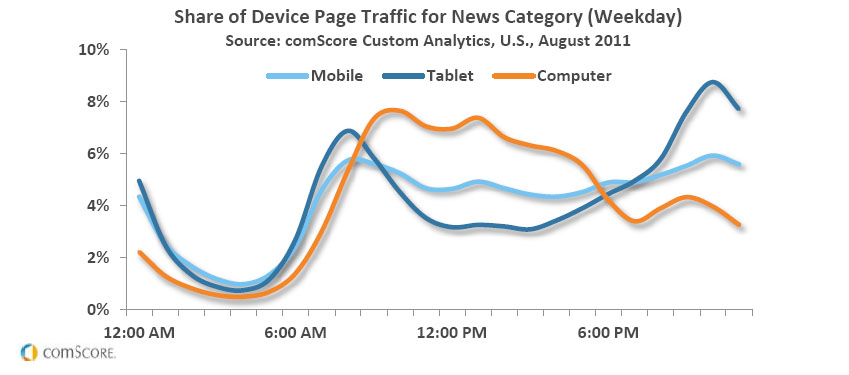
One of the highlighted elements of the comScore report is the rapid growth in mobile and especially tablet use. This is important because, as the chart shown above illustrates, when people use their computers to check online news, the pattern rises and falls according to the day’s work schedule – peaking in the mid- to late morning and declining late in the day. But mobile use hangs on later – especially tablets, which actually peak later in the night.

A danger of drawing too many conclusions about where the trend goes from here is that the current batch of tablet users are mostly young, male and affluent – not the typical computer user, let alone mobile user, let alone the average person. But they are typical of early adopters, and to that extent, you can look at their usage with an eye to what past early adoptive behaviors indicated was the shape of things to come.

For news producers, the news is hopeful:


News is relatively high on the list of what people do on mobile devices. True, it’s below e-mail … Facebook … games … Google and Yelp and other search … maps … . But still, it’s a solid third or more of the market.

Not only that, but it’s among the higher percentage of uses in a month, especially among tablet owners (and the report emphasizes the growth and potential of the tablet audience):

“Nearly 3 out of 5 tablet owners consume news on their tablets. 58 percent of tablet owners consumed world, national or local news on their devices, with 1 in 4 consuming this content on a near-daily basis on their tablets.”

(Note: Among tablet owners, “TV remained the most prominent source for news content, with 52 percent of respondents typically consuming news in this fashion. Computer use followed closely with 48 percent of tablet owners consuming news content via desktop or laptop computers, while 28 percent reported receiving their news from print publications. Mobile and tablet consumption of news were nearly equal in audience penetration, with 22 and 21 percent of respondents accessing news via their mobile or tablet devices.”)

And finally, a word of hope for the news organizations formally known as newspapers (yeah, I’m a few years ahead of myself, but that’s where we’re going): Newspapers, blogs and technology sites stand out as examples of categories in the U.S. exhibiting high relative mobile (phone and tablet) traffic.
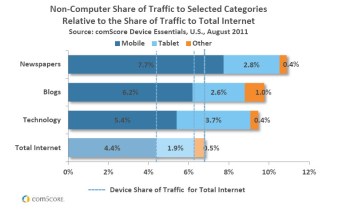

“In August 2011, 7.7 percent of total traffic going to Newspaper sites came from mobile devices – 3.3-percentage points higher than the amount of mobile traffic going to the total Internet. As consumers continue to seek out breaking news and updated information on the go, it is likely that this share of traffic could grow further.”

In summary: It’s early, but this is another data point backing up indications that the trend is that at least a significant portion of the people using mobile devices (notably including the portion most likely to appeal to advertisers, or with the income to pay for access) have an appetite for news that extends late into the evening, and they go online to find it. When do you do your final online updates for the day?

Read Full Post »

The Storm Collection from Storm Collection on Vimeo.

The above is a video telling, from the perspective of future historians, the evolution from pre-history to the early 21st century, not more than a few years from now, of how people receive their news. The co-creators, Matt Thompson and Robin Sloan, previously made a video that gained wide circulation, Epic 2014, which depicts from a future historian’s perspective the events that led to all news media except the New York Times being consumed in an all-everything incarnation of Google, but even the Times was driven by it to remove itself from the Web. (That’s an oversimplification; watch the video.) Where “Epic” dealt with the evolution of the production of news, the new one, “The Storm Collection,” focuses on the consumer.

I don’t know whether it’s a measure of how coccooned in my daily work I am lately that it took a week for me to come across this new one or it’s just that the above video doesn’t strike as many people as striking as close to the bone as “Epic 2014,” but I suspect it’s the latter. “Storm” is not as slick and seems rather slow-moving and padded, not so much of a story, as though they had an end point — the ultimate news-consumption device, depicted in the video as a pair of glasses by Apple with displays embedded in the lenses — and tried to find a way to build to it — which is essentially what they wind up saying in a Society of News Design presentation was the case. (In the video of their presentation, the “Storm” video starts 5:30 in, and the actual 19-minute presentation/discussion starts about 14:40 in.)

However, what’s really interesting is not the “Storm” video but how they explain in the SND presentation what they are thinking. It really IS hard to think how to make a video depicting it. They describe technology enabling a proliferation of small opportunities for people to seek out and receive information – instead of the 30 minutes with the morning paper or the 30 minutes with the evening news on TV, it’s many smaller bits throughout the day, and the challenge for people who produce the news is find ways to make their presentation compelling. One comparison they make is to NPR’s so-called “driveway moments,” when people hear a story on the radio as they drive, reach their destination but remain in the car to finish hearing it. “These moments are emerging all around us,” with advancing technology creating ever more seamless points of entry into people’s attention.

I’m not sure I like their depictions of some possible future technologies – one of the least intrusive, but still creepy: an electronic frame you have on your desk displaying a picture of your sweetheart along with a display of that person’s most recent status update. But I know I’m not that future news consumer. I’ll be the dinosaur who’s clinging to a tablet and reading at a table in the coffee shop instead of getting all my news through my glasses while riding in my self-driving car.

Read Full Post »


This one feels a little different: the Wall Street Journal has launched a new Facebook app, but it keeps the user on Facebook the entire time while also delivering the Journal’s subscription-protected content (though sponsorships may allow that content to be delivered free within the app). That seems like a huge advance in the current, Facebook-dominated landscape.

But the bigger news, as Megan Garber reports at Niemen Journalism Lab, is the app advances the concept of personalized news, making “every user an editor” and “elevating the role of people as curators of content.” People already have been curating content — that’s the essence of sharing links — but this app seeks to make it a more seemless process, and the fewer clicks needed to do what the person wants to do online, the more pleasing the Web experience. It raises the question, will people be more willing to pay for the news if it’s this easy to interact with it?

9/26/11 UPDATE: The Washington Post also has an app to feed news directly to Facebook, but it’s even broader, including news from partners The Associated Press, Reuters, Mashable and SB Nation. At Poynter.org, Jeff Sonderman sounds a note of caution about such apps — asking, among other things, whether news organizations can trust Facebook as a partner — but I still think the movement of the audience in a fragmented, digital world makes it imperative to find ways to make it easy to stay in front of people’s eyes, and that means only having your own website and linking to it may not be quite enough. We’ll see if people adopt the apps.

Read Full Post »

Virginia Tech seismograph, WSLS
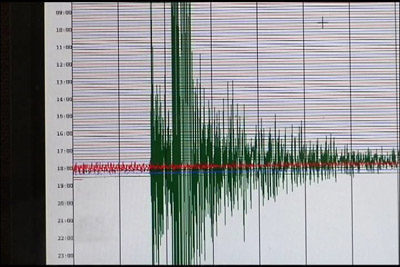
Tuesday’s earthquake was a perfect “example of a breaking news story that called for audience engagement to be at the center of news reporting,” as Matt DeRienzo, a group editor of Journal Register Company’s publications in Connecticut, wrote in a blog post describing his company’s new-gathering efforts. I quote him mainly because the Journal Register currently is pointed to as a digital-first model, which a heavy emphasis on the Web and on social media, and yet as I read what DeRienzo describes I was struck by the parallels with what I knew had gone on at a number of the properties in my own Media General. JRC gets plenty of positive press, we don’t, so I’ll point out a few of the success stories.

In the most detailed story I have received so far, Ike Walker at WCMH in Columbus, Ohio, describes a big success using Twitter — and key to it is something mentioned a few months ago in a post by The Lost Remote:

“Within a minute of the quake hitting here our email inbox was filled with people asking what had happened. We tried to answer as many of them via email as possible but immediately switched our strategy to social media. Within a few minutes we had started the hashtag #columbusquake and were asking for people to share their stories and locations. The #columbusquake hashtag generated a large number of submissions and made it easier to track conversations in real-time with our users. Lesson learned: when you have a big event like this and you want to dominate the conversation at least on Twitter start a hashtag.”

Beyond Twitter, he has more often-repeated lessons — have staff dedicated to Web-first efforts, pay attention to what people in your audience are saying, and respond to them:

“As people continued to send us stories we used them on air and then created a Google map with pinpoints to map all of the stories showing how widespread the reports were. Because the reports were coming in so fast we had to dedicate a person to handling the map. I don’t know yet how many people clicked on the map however the story got almost 30k page views.

“The conversation continued on Facebook with our staff jumping in and engaging users.”

Kevin Justus at WSPA in Greenville/Spartanburg, S.C., says his station was soliciting information from the audience via social media 20 minutes before others in the market:

“Immediately after we felt the tremor we sent out a simple ‘Did anyone else feel that shaking?’ on Facebook and Twitter. Within 10 seconds we had more than 50 comments, so we knew it was an earthquake. We continued to cover the story on social media as the information came in. Our Facebook wall became a forum for our user’s experience with the earthquake.”

And cross-promote your online and social efforts, not only purely as promotion but also because during a news event such as this, phone lines and websites might be overwhelmed. Kari Pugh, the interim managing editor at the News & Messenger/insidenova.com in Prince William County, Va., just outside Washington, says she heard from readers that the phone and Internet were so overwhelmed in the region that the only news they were getting at times was from text relaying the updates to the insidenova.com Facebook page:

“We gained about 300 Facebook fans yesterday, and we were the only news source for people because Internet and cell and landline phone lines were clogged. They said they were able to get our FB updates via text. We posted continuous updates about damage, traffic, evacuations, aftershocks from the time it happened til about 1:30 a.m.”

(For a refresher on tips for “mastering live news,” have a look back a post on the subject at Steve Buttry’s blog.)

Read Full Post »

New York Times logo
Felix Salmon makes the case for the New York Times’ version of a paywall, which in the Times’ case is a “leaky” wall, not hard to avoid and, as Salmon points out, not even trying to block a great deal of traffic. The argument is that letting access remain fairly easy encourages frequent visitors, and then the paywall reminds them of how they can pay for this thing they like so much. Though to me that sounds like putting up a sign on an open park saying it costs $5 to enter the park, then hiring a bum to carry a jar around and poke people while asking if they’ve paid yet. If the argument carries water, why not have no paywall but have a prominent button on every page where people can choose to pay as much as they like? If they WANT to pay to support the Times because they love it so much, that should work, shouldn’t it? Have Sally Struthers record a video intro. “Just $5 a day can feed an investigative reporter who otherwise would sit home in his underwear and blog. He’s waiting.”

Not that I’m against the idea that people should pay for news. I’m just on the fence myself on the topic of paywalls. I can see merit to the argument that paywalls inevitably will turn news sites into niche products targeting a wealthier demographic rather than general-interest sites benefitting the public at-large without regard to payment. However, that’s kind of what newspapers have become anyway, while television (free news) has become the main place most people get their news. There are varying approaches to paywalls. As I said a couple days ago, the experiments continue.

8/16/2011 UPDATE: At Poynter.org, Jeff Sonderman makes an excellent point about “leaky” paywalls — that essentially is the same pay model as is used for the print edition. More:

“The Newspaper Association of America has long claimed there are 2.3 readers for every print edition circulated — which means more people were picking up a loose paper at their kitchen table, coffee shop or subway station than were buying one. And when someone drops a quarter into a newspaper box on the street, you could get away with taking an extra copy (or all of them).

“So, if it’s always been possible on any given day to pick up the local paper somewhere for free, why did people ever pay? Not because they had to, but because it was easier to get it placed on their doorstep every morning (convenience), because they felt if they were going to read it every day they ought to pay (duty), or because they wanted to support the institution and people that produced it (appreciation).

“Those are the same three reasons someone might subscribe to the The New York Times’ digital content.”

Read Full Post »

It’s funny what bubbles up at the same time in the industry. On Tuesday, Steve Buttry posted what he thinks the lessons are from the launch and failure of TBD.com, which a year ago many of us thought/hoped was a future model for the news business. Maybe it was, but the guy bankrolling it decided the gap from the present to the future was bigger than he was willing to try to jump all at once — which is one of Steve’s lessons, to start small or be patient.

You’ll find echoes of a number of Steve’s points in a feature posted today by the Business Insider, Media Mavens Weigh In: The Future of News Is …. The “mavens” are not equally insightful, as you’ll note off the bat when the first opinion comes from Glenn Beck — that’s not a political statement; his takeaway on the future of news is merely pedestrian and obvious, as are those of several others. But as a group, the visions of the future, from the least detailed to the most, line up in many ways with various things TBD was trying to do. That’s not to say TBD definitely had it right. It was too early to tell when the plug was pulled.

The experiments continue.

Read Full Post »

Among the phrases used in recent years in such efforts as the NewspaperNext report to try to get journalists to rethink the business in light of the changes in culture, work/leisure habits and technology was “jobs to be done,” as in ask yourself what is it that people really need help with in their daily life that news organizations are equipped to handle. One of the answers is providing them with something to talk about. Broadly speaking, that’s what good journalism does. In recent years, as social networking has taken off, it has become clear that conversation is one of the things people value most about the news. They share links constantly. An article by Megan Garber at the Nieman Journalism Lab site looks at whether this conversation — more specifically, the communities that can form around the conversation — is where news organizations should be looking for the future business model:

“News outlets are certainly getting into the community game — through social media, of course, but also through IRL events like the NYT’s TimesTalks, the Journal’s Weekend Conversations, the Texas Tribune Festival, the Register-Citizen’s newsroom cafe, and on and on — but often those happenings are presented as subsidiary products, as events that are separate from the news itself. They’re just another revenue stream — just another product sold, just another milkshake.

“But: What if they were more than that? What if news outlets were to consider themselves as doing a job rather than selling a product? And what would happen to organizations’ business models if we started to think of ‘the news,’ at its core, not as a product, but as an event?”

Read Full Post »

what not to do
Web designer Brad Colbow points out a number of common news site features that range from irritating to enraging, and he titled the post “This is why your newspaper is dying.” They might be why people get frustrated with news sites (not just newspaper-affiliated sites) online, but they have nothing to do with the economics driving newspapers to cut staff and features, which derives almost entirely from advertising declines. Still, he has valid points on the user-unfriendliness of the practices he highlighted, and if you are among the unfortunate, overworked few in a position to reduce them on your site, you should look into ways to do it. If you are in a position to drive changes needed to reduce the less serious but chronic ones (articles that have no links to source material or related sites, even if they are mentioned in the story, for instance, or graphics shoveled from print to online with no adaptation for the new medium), chances are there are people on your staff who already have suggestions.

Read Full Post »

« Newer Posts - Older Posts »